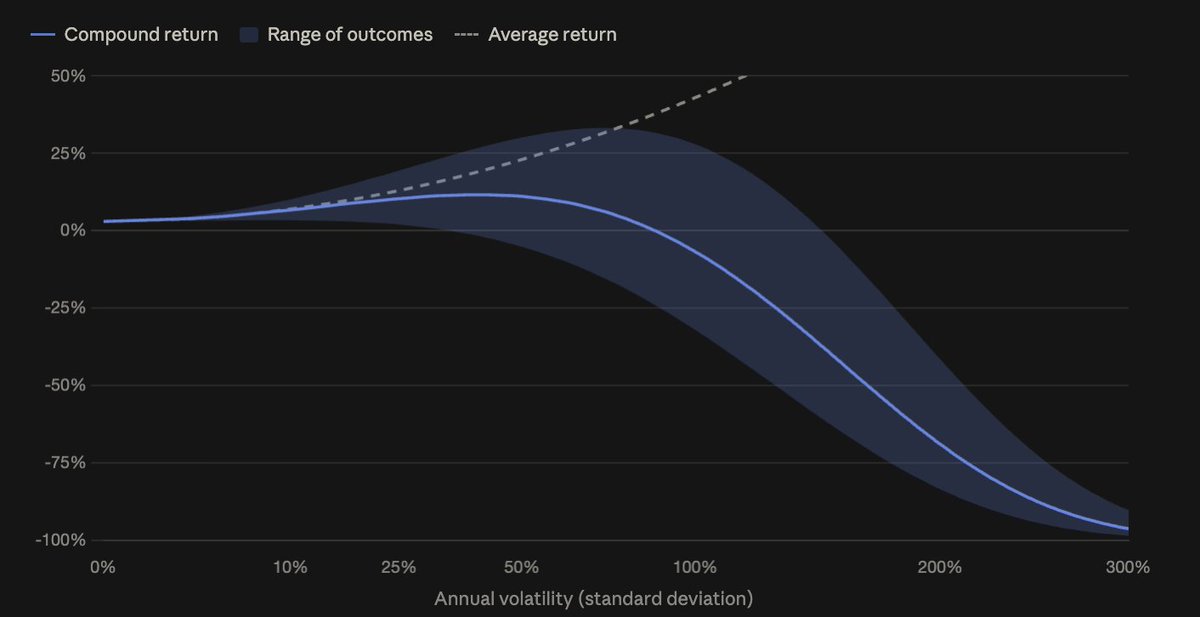
Great post, thanks for sharing! Do you actually agree with "the more risk you take, the higher your expected reward"? I think it holds for the average outcome, but not for the outcome you should actually expect to get.
Compound return is roughly the average return minus half the variance. At 10% volatility that drag is 0.5% a year. At 20% it's 2%. At 40% it's 8%. So as you add risk, the range of outcomes keeps getting wider, but the compound return rises more slowly, flattens, and eventually falls. (Probably related to why high-volatility stocks haven't historically out-earned low-volatility ones.)
At the extreme you get Powerball. The average outcome is something like -50%, but the outcome you will actually experience is -100%.
So I think the relationship looks like the attached. Is that how you see it? You are better at this aspect than I am.
For anyone who missed the first thread, the nickel and quarter story: Try this story on a retiree… Imagine all your money stacked on the table in front of you. I will place two coins on the table, a nickel and a quarter. You have to choose to pick up one of them to flip. If you choose the nickel and it lands on heads you will be up 5%, but you will be down 5% if it lands on tails. If you choose the quarter, you will be up 25% if it lands on heads, but down 25% if it lands on tails. With all of your money on the line, which coin will you pick up? Almost all retirees who have enough money choose the nickel! They care more about risk! So that’s what I focus on. It resonates. Further, while returns are totally out of my control, risk is at least somewhat in my control. It is a deliverable. https://t.co/DeoLmbAs5k
6/ A 65-year-old divorcee with $5M outside her home was seriously afraid of ending up a bag lady. Afraid to spend. A few years of conversations and visual evidence later, she feels safe and spends appropriately (including the Porsche she always wanted). Referrals followed.
9/ Your mileage will vary. But none of this took a big team or a marketing budget. Risk first, real advice, repeatable value. Referrals do the marketing when clients have a story worth telling. If I can do it, so can you. Thanks @MichaelKitces for spreading the first one. #Advicers. And yes, I know Michael keeps telling the world to do more marketing!
5/ She called in distress, about to lose the house and the $20K. I reminded her the line was already there. We closed on time. Referrals followed. (It's still a loan. Interest, collateral calls, and a market drop can make it a bad idea. The point is flexibility.)
1/ I'm a bad marketer who could never raise money. I run $200M as a solo RIA about a decade in. A few years ago I posted a version of this at $100M. Here's what got me to $200M.🧵 #Advicers
4/ I set up securities-backed lines of credit for clients before they need them. Liquidity. One client had hers unused for years. She found the perfect house, put down a $20K non-refundable deposit, and days before closing her mortgage fell through.
3/ The first $100M came from a story (nickel vs. quarter), a process, and some press. Getting to $200M came from something more boring: being the advisor who actually gives advice. Four examples.
2/ Quick backstory: stock picker at Bear Stearns (RIP), then a solo RIA that only charged if I beat the S&P 500. Performance fine, marketing terrible. So I stopped picking stocks and started managing risk. Retirees care more about not going back to work than about extra return.
I spent the summer tearing my model portfolio down to the studs and rebuilding it. Every parameter now carries one label, one source, and one condition under which we would revise it. Nothing is inherited, nothing is unexplained. Here's what changed (and what didn't). The organizing idea: risk is chosen, return is the output, withdrawal is derived. Volatility is forecastable; returns aren't. So we hold fixed the thing we can actually estimate and let return be the unknown.Our bar for any asset in the portfolio: it must behave differently when it matters, for structural reasons, and still clear a correlation-adjusted return hurdle. Different payoff shapes, not just different tickers. The surprising result: in several places, the new formal process landed close to where years of hand-built judgment already were. The rebuild wasn't about getting different answers everywhere. It was about knowing exactly why each answer is what it is. The full letter walks through the whole thing: what changed, what deliberately did not, and the reasoning behind each call. Link below.