10 OPEN-SOURCE GITHUB REPOS THAT CAN SAVE STARTUP FOUNDERS DOZENS OF HOURS AND THOUSANDS OF DOLLARS:
gstack — https://t.co/JEplyCPUlz
Last 30 Days — https://t.co/bN6QnNuDtq
Marketing Skills — https://t.co/RJjJv5fBfQ
Novu — https://t.co/fd6ql1Dzev
Papermark — https://t.co/uw0Fxj1Co7
OpenReplay — https://t.co/YOxzbi9rJY
shadcn/ui — https://t.co/LQJEYwRz7F
Cap — https://t.co/UWDWWXcT6I
Dify — https://t.co/Fbh1WqZDwH
Devopness — https://t.co/lmtxJIvCdD
@steipete Hey! I’ve been experimenting with this approach to harness engineering:
https://t.co/PYI8sq8OnI
I’d love to hear your thoughts. Do you use anything similar, or how is your own harness set up? Especially interested in how you manage memory, context retention.. .
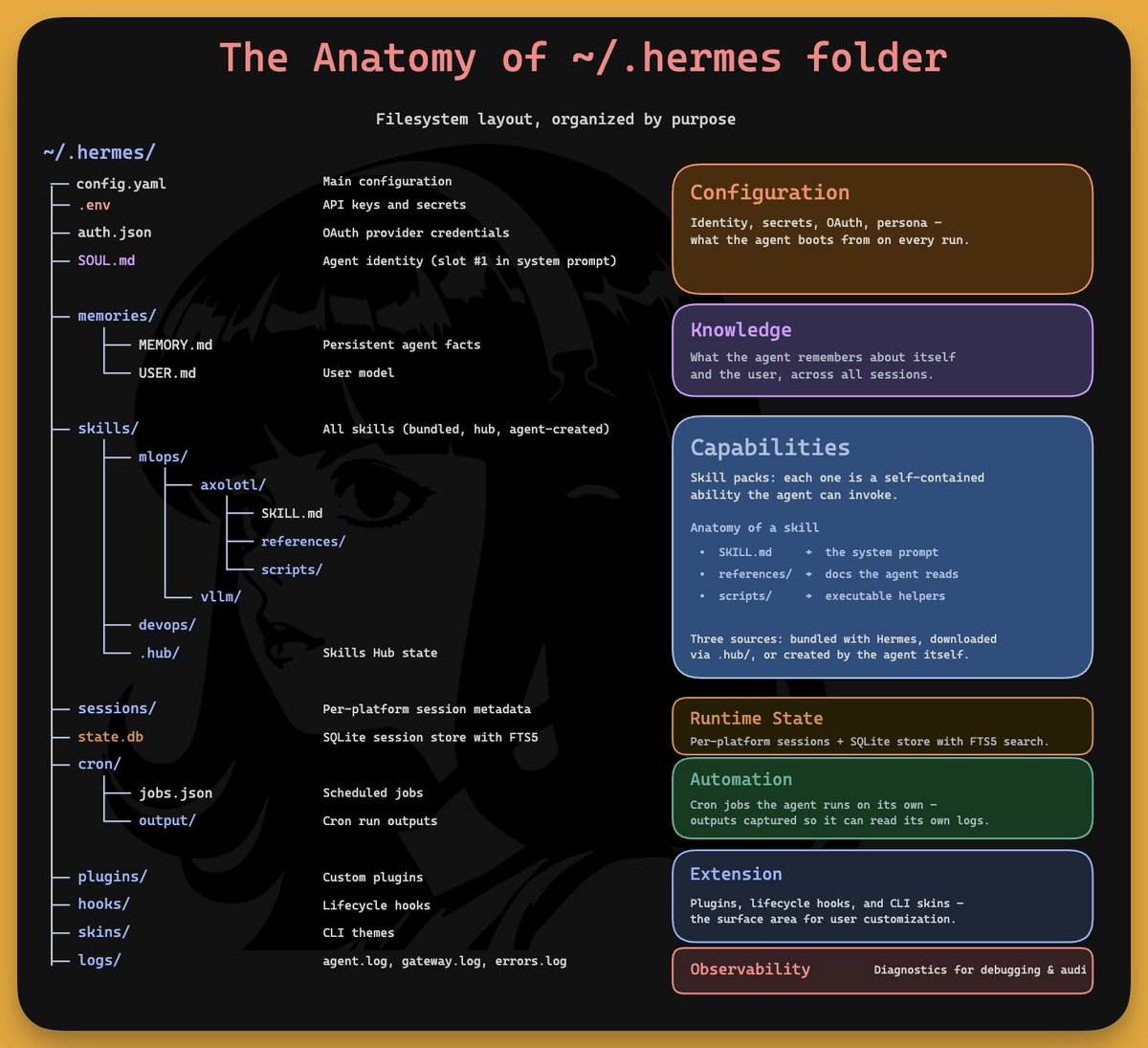
the anatomy of ~/.hermes folder.
one folder controls everything your hermes agent knows, remembers, and can do. understanding its layout is the difference between treating hermes as a black box and actually customizing it.
here's what lives inside and why each piece matters.
𝗰𝗼𝗻𝗳𝗶𝗴𝘂𝗿𝗮𝘁𝗶𝗼𝗻
𝗰𝗼𝗻𝗳𝗶𝗴.𝘆𝗮𝗺𝗹 is the source of truth for everything non-secret: model choice, terminal backend, tool enablement, MCP servers. 𝗲𝗻𝘃 holds your API keys and bot tokens. 𝗮𝘂𝘁𝗵.𝗷𝘀𝗼𝗻 stores OAuth credentials.
then there's 𝗦𝗢𝗨𝗟.𝗺𝗱. it occupies slot #1 in the system prompt, before anything else loads. it defines who the agent is: personality, tone, communication style, hard limits. everything the agent writes, creates, and remembers passes through this identity layer.
𝗸𝗻𝗼𝘄𝗹𝗲𝗱𝗴𝗲
𝗺𝗲𝗺𝗼𝗿𝗶𝗲𝘀/ contains two tiny files. 𝗠𝗘𝗠𝗢𝗥𝗬.𝗺𝗱 (2,200 chars) holds project conventions, tool quirks, lessons learned. 𝗨𝗦𝗘𝗥.𝗺𝗱 (1,375 chars) holds your profile.
both get injected into the system prompt as frozen snapshots at session start. when they fill up, the agent consolidates: merges entries, drops redundancy, keeps only what's dense and useful.
𝗰𝗮𝗽𝗮𝗯𝗶𝗹𝗶𝘁𝗶𝗲𝘀
𝘀𝗸𝗶𝗹𝗹𝘀/ is where the learning loop lives. each skill is a self-contained ability: a 𝗦𝗞𝗜𝗟𝗟.𝗺𝗱 (the procedure), a 𝗿𝗲𝗳𝗲𝗿𝗲𝗻𝗰𝗲𝘀/ folder (docs the agent reads), and 𝘀𝗰𝗿𝗶𝗽𝘁𝘀/ (executable helpers).
skills come from three sources: bundled with hermes, downloaded from the hub via 𝗵𝘂𝗯/, or created by the agent itself during your sessions. hermes ships with 687 skills across 18 categories, and you can add any GitHub repo as a custom tap.
𝗿𝘂𝗻𝘁𝗶𝗺𝗲 𝘀𝘁𝗮𝘁𝗲
𝘀𝗲𝘀𝘀𝗶𝗼𝗻𝘀/ stores per-platform session metadata. 𝘀𝘁𝗮𝘁𝗲.𝗱𝗯 is the SQLite database with FTS5 indexing that backs tier 2 memory. this is what makes "what did we discuss three weeks ago?" actually work across CLI and messaging.
𝗮𝘂𝘁𝗼𝗺𝗮𝘁𝗶𝗼𝗻
𝗰𝗿𝗼𝗻/ holds scheduled jobs in 𝗷𝗼𝗯𝘀.𝗷𝘀𝗼𝗻 and their outputs in 𝗼𝘂𝘁𝗽𝘂𝘁/. the gateway daemon ticks every 60 seconds and runs due jobs in isolated sessions. you describe schedules in plain English, hermes converts them.
𝗲𝘅𝘁𝗲𝗻𝘀𝗶𝗼𝗻 + 𝗼𝗯𝘀𝗲𝗿𝘃𝗮𝗯𝗶𝗹𝗶𝘁𝘆
𝗽𝗹𝘂𝗴𝗶𝗻𝘀/, 𝗵𝗼𝗼𝗸𝘀/, and 𝘀𝗸𝗶𝗻𝘀/ are the surface area for user customization. 𝗹𝗼𝗴𝘀/ gives you 𝗮𝗴𝗲𝗻𝘁.𝗹𝗼𝗴, 𝗴𝗮𝘁𝗲𝘄𝗮𝘆.𝗹𝗼𝗴, and 𝗲𝗿𝗿𝗼𝗿𝘀.𝗹𝗼𝗴 for debugging.
you won't manually edit most of these files. but knowing this layout means you understand exactly where identity, memory, skills, automation, and state live, and how they connect.
i wrote a full deep dive covering hermes agent's architecture, memory system, self-evolving skills, GEPA optimization, and setting up multiple specialized agents.
The article is quoted below.
My Hermes Agent’s personality is better than most people I know in real life.
Here’s how I made the coolest agent on the block with one single markdown file. 👇
This works really well btw, at the end of your query ask your LLM to "structure your response as HTML", then view the generated file in your browser. I've also had some success asking the LLM to present its output as slideshows, etc.
More generally, imo audio is the human-preferred input to AIs but vision (images/animations/video) is the preferred output from them. Around a ~third of our brains are a massively parallel processor dedicated to vision, it is the 10-lane superhighway of information into brain. As AI improves, I think we'll see a progression that takes advantage:
1) raw text (hard/effortful to read)
2) markdown (bold, italic, headings, tables, a bit easier on the eyes) <-- current default
3) HTML (still procedural with underlying code, but a lot more flexibility on the graphics, layout, even interactivity) <-- early but forming new good default
...4,5,6,...
n) interactive neural videos/simulations
Imo the extrapolation (though the technology doesn't exist just yet) ends in some kind of interactive videos generated directly by a diffusion neural net. Many open questions as to how exact/procedural "Software 1.0" artifacts (e.g. interactive simulations) may be woven together with neural artifacts (diffusion grids), but generally something in the direction of the recently viral https://t.co/z21CP5iQfu
There are also improvements necessary and pending at the input. Audio nor text nor video alone are not enough, e.g. I feel a need to point/gesture to things on the screen, similar to all the things you would do with a person physically next to you and your computer screen.
TLDR The input/output mind meld between humans and AIs is ongoing and there is a lot of work to do and significant progress to be made, way before jumping all the way into neuralink-esque BCIs and all that. For what's worth exploring at the current stage, hot tip try ask for HTML.
Codex /goal With Hermes Agent is life-changing.
I updated my Hermes agent skill to give Codex a goal on the fly using Telegram and track each one of those codex goals in a Kanban board.
It has been really insane to see and track Codex execute goals in the wild.
Peekaboo 3.0 is live. Biggest release since 2.0.
⚡ Action-first macOS computer use
👁️ Unified screenshot + UI detection
🧩 Cleaner JSON across CLI + MCP
🛠️ Better snapshots
I started this last year, but the models just weren’t good enough. Now they are. https://t.co/0wvhR0NWOj
@karpathy@karpathy Strongly agree. I ended up building my own process around the same principle: persistent project memory, resumable protocols, and task artifacts that survive agent sessions. That workflow helped me ship dozens of projects already. https://t.co/PYI8sq8OnI
Wow, this tweet went very viral!
I wanted share a possibly slightly improved version of the tweet in an "idea file". The idea of the idea file is that in this era of LLM agents, there is less of a point/need of sharing the specific code/app, you just share the idea, then the other person's agent customizes & builds it for your specific needs.
So here's the idea in a gist format: https://t.co/NlAfEJjtJV
You can give this to your agent and it can build you your own LLM wiki and guide you on how to use it etc. It's intentionally kept a little bit abstract/vague because there are so many directions to take this in. And ofc, people can adjust the idea or contribute their own in the Discussion which is cool.
I made a Claude Code skill that turns any arxiv paper into working code.
Every line traces back to the paper section it came from & any implementation detail the paper skips will be flagged, and not assumed.
open sourcing it -
https://t.co/sSio4JfpIo