@AmandaMurdie@raulpacheco I am so sorry for your loss Amanda .. Raul was everything I aspire to be.. so kind and generous with his time and knowledge. His legacy will live on through the thousands his academic practice blogs have helped.
Imagine a world in which not only you but everyone you knew was so deeply embedded in the reality of the natural world that miracles like the below were almost quotidian.
Where a fact like "while processing an animal for food you may occasionally discover its body spontaneously produced a single precious gemstone that you will be the first and probably only human to ever see or comprehend" is at least as widely known, understood, and respected as something like "while looking up at the sky you may sometimes see a shooting star ..."
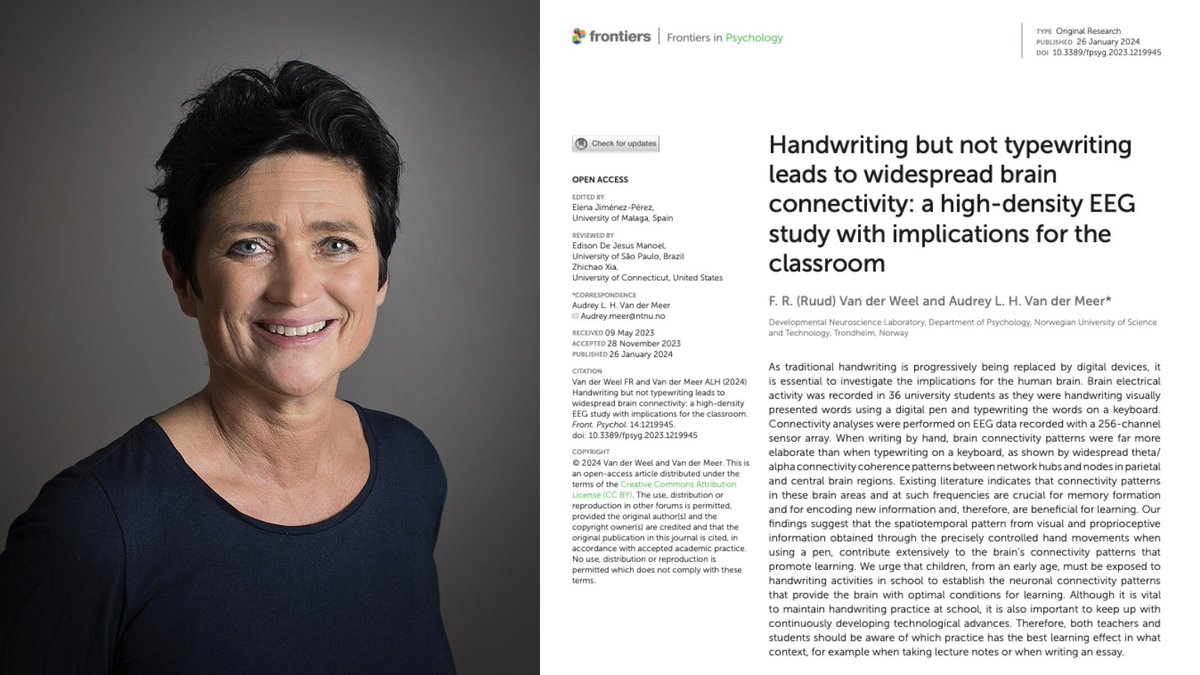
A Norwegian neuroscientist spent 20 years proving that the act of writing by hand changes the human brain in ways typing physically cannot, and almost nobody outside her field has read the paper.
Her name is Audrey van der Meer.
She runs a brain research lab in Trondheim, and the paper that closed the argument was published in 2024 in a journal called Frontiers in Psychology. The finding is brutal enough that it should have changed every classroom on Earth.
The experiment was simple. She recruited 36 university students and put each one in a cap with 256 sensors pressed against their scalp to record brain activity. Words flashed on a screen one at a time.
Sometimes the students wrote the word by hand on a touchscreen using a digital pen, and sometimes they typed the same word on a keyboard. Every neural response was recorded for the full five seconds the word stayed on screen.
Then her team looked at the part of the data most researchers had ignored for years, which is how different parts of the brain were communicating with each other during the task.
When the students wrote by hand, the brain lit up everywhere at once.
The regions responsible for memory, sensory integration, and the encoding of new information were all firing together in a coordinated pattern that spread across the entire cortex. The whole network was awake and connected.
When the same students typed the same word, that pattern collapsed almost completely.
Most of the brain went quiet, and the connections between regions that had been alive seconds earlier were nowhere to be found on the EEG.
Same word, same brain, same person, and two completely different neurological events.
The reason turned out to be something nobody had really paid attention to before her work. Writing by hand is not one motion but a sequence of thousands of tiny micro-movements coordinated with your eyes in real time, where each letter is a different shape that requires the brain to solve a slightly different spatial problem.
Your fingers, wrist, vision, and the parts of your brain that track position in space are all working together to produce one letter, then the next, then the next.
Typing throws all of that away. Every key on a keyboard requires the exact same finger motion regardless of which letter you are pressing, which means the brain has almost nothing to integrate and almost no problem to solve.
Van der Meer said it plainly in her interviews.
Pressing the same key with the same finger over and over does not stimulate the brain in any meaningful way, and she pointed out something that should scare every parent who handed their kid an iPad.
Children who learn to read and write on tablets often cannot tell letters like b and d apart, because they have never physically felt with their bodies what it takes to actually produce those letters on a page.
A decade before her, two researchers at Princeton ran the same fight using a completely different method and ended up at the same answer. Pam Mueller and Daniel Oppenheimer tested 327 students across three experiments, where half took notes on laptops with the internet disabled and half took notes by hand, before testing everyone on what they actually understood from the lectures they had watched.
The handwriting group won by a wide margin on every question that required real understanding rather than surface recall.
The reason was hiding in the transcripts of what the two groups had actually written down.
The laptop students typed almost word for word, capturing more total content but processing almost none of it as they went, while the handwriting students physically could not write fast enough to transcribe a lecture in real time, which forced them to listen carefully, decide what actually mattered, and put it in their own words on the page.
That single act of choosing what to keep was the learning itself, and the keyboard had quietly skipped the choosing and skipped the learning along with it.
Two studies. Two countries. Same answer.
Handwriting makes the brain work. Typing lets it coast.
Every note you have ever typed instead of written went into your brain through a thinner pipe. Every meeting, every book highlight, every idea you captured on your phone instead of on paper was processed at half depth.
You did not forget those things because your memory is bad. You forgot them because typing never woke the part of the brain that would have made them stick.
The fix is the thing your grandmother already knew.
Pick up a pen. Write the thing down. The slower road is the faster one.
A 17-year-old in Iowa boiled beets in her chemistry class and turned them into stitches that change color when your wound gets infected. Her name is Dasia Taylor. It started as a science fair project.
She wanted a low-tech version of the "smart stitches" Tufts researchers built in 2016. Those used thread wired up with sensors and a tiny chip that pinged your phone if something went wrong. Cool, but useless without a phone or a hospital that can afford it.
Her version doesn't need any of that. Healthy skin is slightly acidic, like lemon juice but much milder. When bacteria grow in a wound, the chemistry flips and turns more like soap or baking soda.
Beet juice has a quirk. The same red pigment that stains your fingers when you cook it shifts color based on what it touches. Bright red on healthy skin. Dark purple on infected skin. The switch lines up with infection almost exactly.
She tested ten threads before finding a cotton-polyester blend that soaked up the dye and changed color within five minutes. That was the prototype.
Around 1 in 40 American surgeries end in an infection at the cut, costing hospitals more than $3 billion a year. In poorer countries the rate is closer to 1 in 9. In parts of Africa it's 1 in 6. In some Ethiopian hospitals, up to a quarter of surgery patients leave with an infection.
The whole game is catching it early. Spot it in time and antibiotics handle it. Miss the window and the patient is back on the operating table.
Dasia filed a patent in 2021 and started a medical device company called VariegateHealth in 2022. The stitches haven't been tested on real patients yet. New medical device patents can take a decade. She's also looking into a side benefit: the beet pigment kills bugs like E. coli and Klebsiella in lab tests.
Smart stitches need a phone to read them. Hers just need eyes.
The strongest El Niño in 150 years?
That’s not hype, it’s the actual median forecast right now for the developing event later this year.
It could rival — or even surpass — the legendary 1877 El Niño, the strongest on record, which was linked to widespread drought, monsoon failure, and global food crises in parts of Asia, Africa, and South America.
But what does that mean today?
It means a tremendous amount of excess ocean heat being released into the atmosphere - energy that can rearrange weather patterns around the world.
That typically leads to:
🌧️ Increased flood risk in some regions
🔥 More intense/ prolonged heatwaves, drought and fires
🌪️ A shift in severe storm tracks
🌀 And often a suppressed Atlantic hurricane season, but boosted in the East Pacific.
Since it’s so huge, when the Pacific talks, the atmosphere listens!
But this isn’t 1877… forecasting, infrastructure, and global awareness are far better today. We’ll be better prepared.
Now transparency on the science: the 1877 3-month Nino 3.4 ocean temp anomaly maxed out at +2.7°C. The latest median forecast for all ensembles in late 2026 is +2.75°C in the Nino 3.4 region. So, it may be stronger. Here’s the caveat: that region is now approx .75 - 1°C warmer than it was in 1855, so some of the heat building up there is on top of a baseline which is already warmer today. So in absolutes… this will probably rival 1877, but relatively speaking due to global warming, the event will likely fall short and thus its global impacts may not rise to that level. That’s why we now have the RONI (index) which accounts for our new warmed World. (Pictured here is the October NMME with a region of +3-4°C over the East Tropical Pacific)
Will certainly be interesting to watch from a scientific perspective.
A Persian scholar finished a single math book in 9th century Baghdad that quietly became the foundation for every line of code running on Earth today.
I started reading about him at midnight and could not believe how many things in my daily life trace back to one man.
His name was Muhammad ibn Musa al-Khwarizmi. The book is called The Compendious Book on Calculation by Completion and Balancing.
Every time you say the word algebra, you are saying his book title. Every time someone says the word algorithm, they are saying his name. Both English words come from him. Both are Latin transliterations of Arabic and of his own identity. The man did not just contribute to mathematics. He named it.
Here is the part almost nobody tells you.
Al-Khwarizmi was born around 780 CE in Khwarazm, in what is now Uzbekistan. He moved to Baghdad and worked at a research institution called the House of Wisdom, which during the Islamic Golden Age was the single most important center of learning on the planet. The caliph al-Mamun hired the best mathematicians, astronomers, and philosophers from across three continents and put them in one building with one job. Translate, study, and produce new knowledge.
Al-Khwarizmi finished his book on algebra around 820 CE. The Arabic title contained the word al-jabr, which referred to one of the two operations he used to solve equations. When the book was translated into Latin in the 12th century, the Latin world did not have a word for what he had built. So they kept his Arabic word. Al-jabr became algebra. The discipline was named after a single Arabic word in the title of a single book by a single man.
The deeper insight is what he actually changed about how humans think.
Before al-Khwarizmi, mathematical problems were solved geometrically. You drew shapes. You measured them. You compared areas. The Greeks had built an entire mathematical tradition on visual proofs and physical constructions. It was beautiful and limited. You could not solve a problem you could not draw.
Al-Khwarizmi did something nobody had done before him at this scale. He said you could solve any problem using abstract symbols and rules. You did not need a shape. You needed a procedure. You moved terms across the equation. You cancelled like terms on both sides. You isolated the unknown. He invented the idea that mathematics is a manipulation of symbols according to rules, not a study of physical figures.
That single shift made everything that came afterward possible. Calculus. Differential equations. Linear algebra. Quantum mechanics. None of it works if math is locked inside geometry. He pulled it out.
The second thing he did is the one that changed how the world counted forever. He took the Hindu numeral system from Indian mathematics, refined it, and wrote a book introducing it to the Arab world. That system included the concept of zero as a placeholder, and a positional notation where the value of a digit depends on its location. Roman numerals could not do complex calculation. Hindu-Arabic numerals could.
When his book on numerals was translated into Latin as Algoritmi de numero Indorum, the word Algoritmi was just the Latin spelling of his own name. Europeans started calling the new method "doing algorism," then "running an algorithm." The word for the most important concept in computer science is literally his name in Latin.
The third thing he did is the part that should haunt anyone who works in tech.
His method of solving problems was systematic. Step one, do this. Step two, check that. Step three, if condition A, then do X, otherwise do Y. He wrote down procedures that could be followed by anyone, anywhere, who knew how to read. The procedure did not depend on intuition or genius. It worked because the steps worked.
That is exactly what an algorithm is. A finite, deterministic procedure for solving a problem. He did not just give us the word. He gave us the entire concept of programming a thousand years before there was anything to program.
When Alan Turing built the first abstract model of computation in 1936, when John von Neumann designed the first stored-program computer in 1945, when every engineer at Google, OpenAI, Anthropic, and DeepMind writes code in 2026, they are working in a paradigm that started with one man in Baghdad twelve centuries ago.
The strangest part is what happens when you walk into any tech office in San Francisco or Bangalore or Lahore today. Engineers say the words algebra and algorithm hundreds of times a day. They do not know whose name they are saying. Almost nobody can spell al-Khwarizmi correctly on the first try.
His original Arabic manuscript is preserved at Oxford. His book on Hindu numerals survives only in Latin translation. The Latin version was the textbook that taught medieval Europe how to count.
The man who built the foundation of the AI revolution did not live to see a calculator. He died around 850 CE, a thousand years before the first electric current was sent through a wire. The civilization he built mathematics for collapsed. The library he wrote in burned. His own grave is unmarked.
But every algorithm running on every machine on Earth right now still answers to his name.
A parasite that has been eating people for 3,500 years is about to be wiped off the planet. It infected 3.5 million people in 1986. Last year, it infected 10. And I have not seen it make a single front page.
It is called Guinea worm. You drink contaminated water from a pond in a poor village. A year later, a worm up to three feet long starts coming out of your leg through a burning blister. There is no pill that stops it and no surgery that works. You wrap the worm around a stick and pull it out slowly, over days or weeks, inch by inch. If you rush, the worm breaks inside you and causes a fresh infection.
Guinea worm is ancient. Preserved worms have been pulled out of Egyptian mummies from around 1000 BCE. The Ebers Papyrus, an Egyptian medical scroll from 1550 BCE, describes pulling the worm out with a stick. For three and a half thousand years, that was the best humans could do.
Then in 1986, public health workers decided to kill the parasite off. They had no vaccine and no drug. What they had was cheap cloth water filters and a small army of volunteers willing to walk from village to village for decades.
The plan was simple. Give everyone who drinks from a pond a cloth filter to strain out the tiny water fleas that spread the parasite. Then send volunteers walking house to house, year after year, teaching people how to use the filters and keeping anyone with an emerging worm out of the water.
It worked. From 3.5 million cases a year to 10. Four were in Chad, four in Ethiopia, two in South Sudan. The other four countries where the worm used to be common, Angola, Cameroon, the Central African Republic, and Mali, had zero human cases for the second year in a row. The World Health Organization has already certified 200 countries as Guinea worm free. Six are left.
The last hurdle is dogs. Cameroon had 445 infected animals last year and Chad had 147, so a lot of the remaining work is on animals, not humans. Strays get leashed, and crews treat ponds to kill any remaining worms. The campaign keeps watching until the number hits zero.
When Guinea worm hits zero, it becomes the second human disease ever erased from the planet. The first was smallpox. It will also be the first parasite humans have ever wiped out, and the first disease ever ended without a single dose of medicine. Volunteers walked village to village with cloth filters for 40 years. Now a plague from the age of the pharaohs is about to be gone.
We joined hands with @historybyhuz and Arsalan to present to you our favourite work yet: a map of Pakistani folklore🗺️✨
Here's to two years of recording, collecting, translating, and illustrating folk narratives from cultures which dot the banks of the Indus✨
@cryptomemeduck @TrungTPhan Euan was making stop motion videos for school presentations as a 7 year old (when I first met him). ..Like really really good videos ..couldn't believe a 7year old could be that talented- he's incredibly hard working. You don't get to be this level of good without working hard.
The argument that Afghan refugees are a burden on the economy is ridiculous. Burden on the economy are the elites who receive $17.4 billion in annual subsidies, not refugees doing the hardest jobs. Out state is unable to challenge mafias but is using Afghans as a distraction.
In the world's largest vacuum chamber, a bowling ball and feathers are used for a real-life demonstration of a concept Galileo first proposed over 400 years ago.
Art Nouveau was a nature-inspired, decorative movement which flourished between 1890 and 1910 across Europe and the Americas.
A thread of its most beautiful examples 🧵
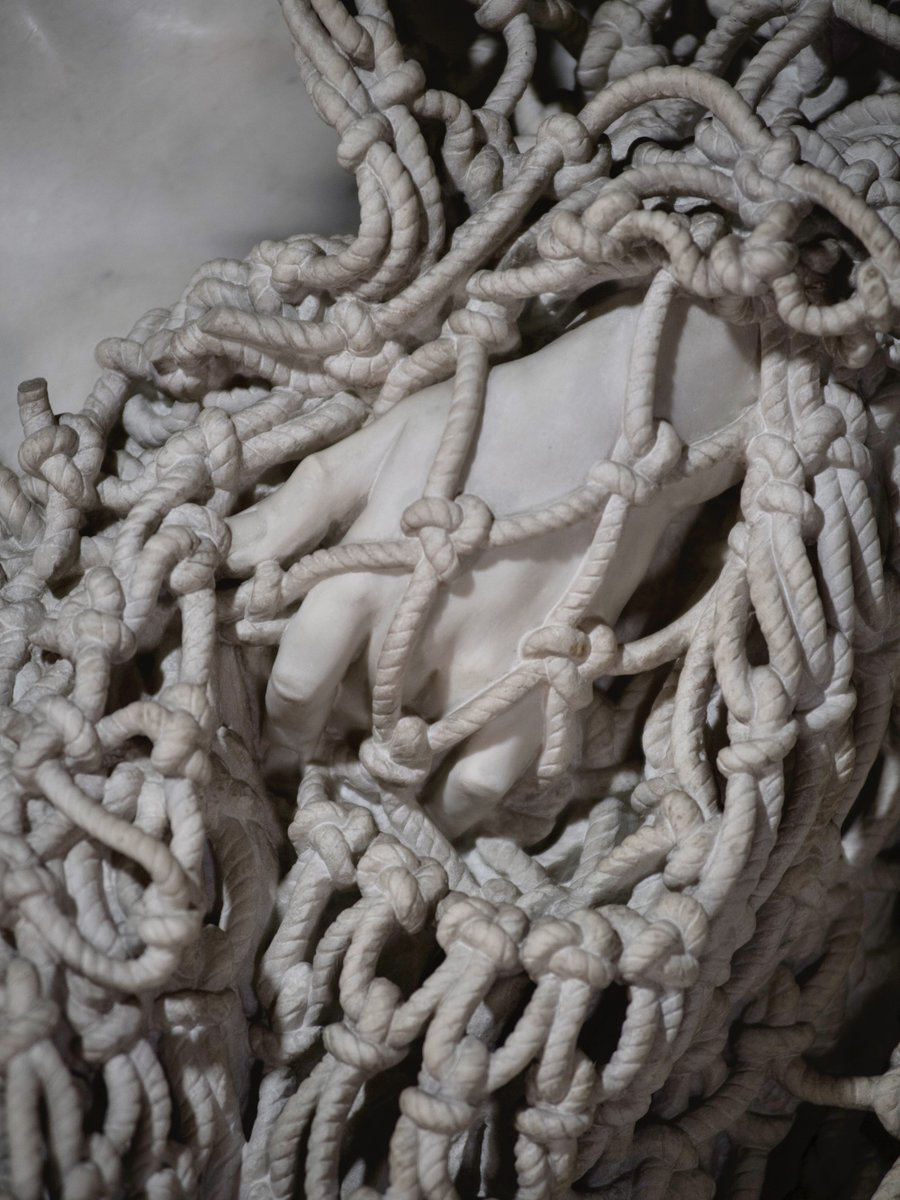
Some things shouldn't be possible to carve from stone, but the master sculptors managed it anyway.
A thread of impossible details of marble sculptures 🧵