@Yusro_web3 ... following:
- benefits will be cut (estimated 22% cut from current)
- SS tax rate will go up
- SS income threshold subject to tax goes up
- Congress votes to deficit spend for SS like everything else
- eligibility age for SS goes up
- means testing
- some other tax
- etc.
2/2
@Yusro_web3 The money you put in has been spent. Your payout will depend on collecting from current workers or deficit spending which is currently not allowed for SS.
So, when SS runs short in 2032, actually the exhaustion of the mythical SS Trust Fund, some combination of the ...
1/2
@jimgeraghty ...
likely goes way down if government takes over.
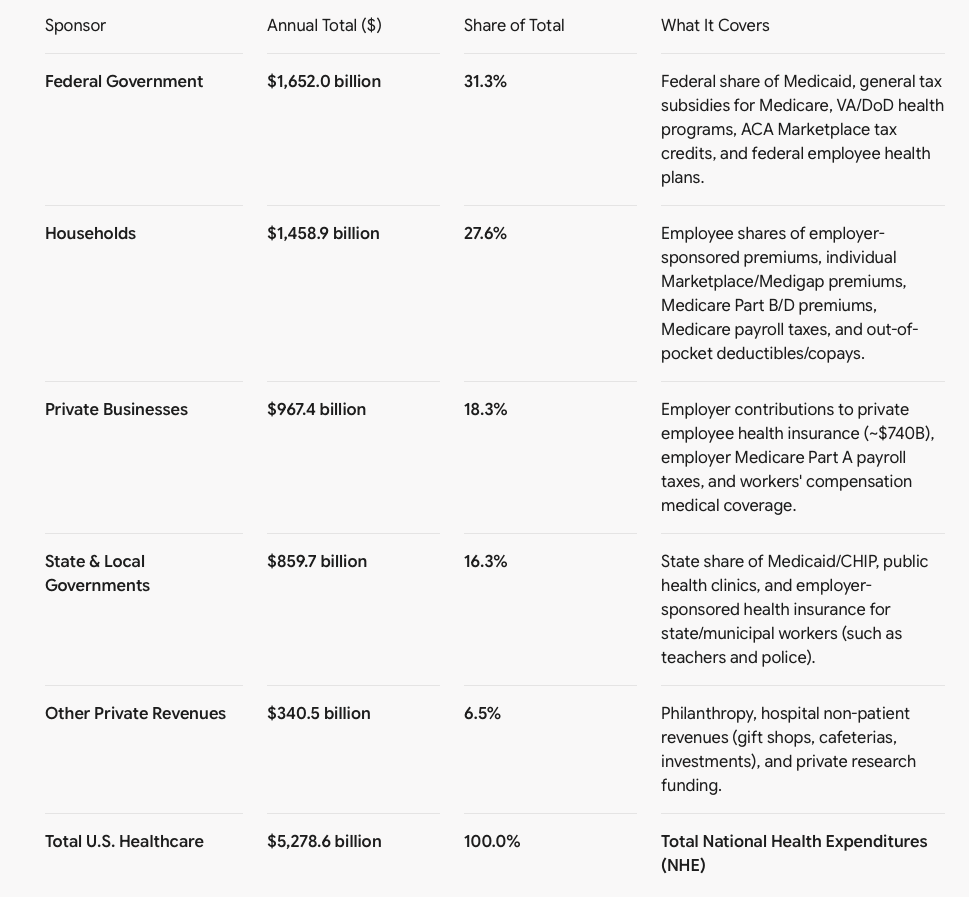
Therefore there is almost $3B which will undoubtedly be more than $3B if government takes over, that needs to be paid through new taxes or somme way.
Take a look at the following chart of who pays what.
From Gemini:
2/2
@jimgeraghty ⏫ This!
Can MFA be accomplished? Of course.
Have other wealthy countries done it? Certainly.
Taxing billionaires alone will not do it. Money needs to move around.
Money paid into healthcare:
$1.5B individuals
$1.0B employers
$.3B other (mostly philanthropy) which ...
1/2
@LarryLewisSays@newbish@BluVirginiaMAGA Larry, my point was that costs may not go up in total, but they do move around. So how does this shift from employers, employees, and individuals transition to new taxes? I do not think it's as easy as saying corps. pay $1T now so just send that to the government, right?
@newbish@LarryLewisSays@BluVirginiaMAGA ...
Etc.
Many think MFA works just like Medicare for seniors. To your point there has to be new money to make it work. Employers pay $1T of healthcare in US. Who pays that under MFA?
Employees/individuals pay $.75T in premiums and $.6T out of pocket.
It's a tough transition.
2/2
@newbish@LarryLewisSays@BluVirginiaMAGA Keith, thanks, very respectful response.
Yes, I think the argument is that our entire healthcare spending might not go up, it just moves around.
Right now, there are multiple streams of input costs:
Employer premiums
Employee premiums
Individual premiums
Out of pocket ...
1/2
@m_dyline As a product of the 70s, I can say there are a lot:
Wine: Boone's Farm, MD 20/20, Blue Nun, Mateus
Beer: Schlitz, Malt Liquor
Drinks: Harvey Wallbanger, Tequila Sunrise, Sloe Gin Fizz, Singapore Sling
I am sure there are a lot more.
@NeckJoan@BluVirginiaMAGA I don't leave them out at all, rather that someone has to pay in the end. Undoubtedly in a Medicare for all world that is government with a whole lot of new taxes.
@RandomGuyDog@BluVirginiaMAGA I think there are a lot of people that do not agree with the better.
Regardless, the main point is correct. It is unrealistic to think that total healthcare spending goes down, and there are no new taxes.
@malbecpoodle@BluVirginiaMAGA ... the author himself called unrealistic. He later said people were misquoting him. It’s mostly a massive cost shift from employers/premiums to taxpayers. It's not free money or savings.
2/2
@malbecpoodle@BluVirginiaMAGA Thanks, I haven't researched the article in detail, however, I know this is incomplete.
The Mercatus study’s main finding was a $32+ trillion (10-year) jump in federal spending. The $2T “savings” was a best-case national total that assumed huge provider rate cuts ...
1/2
@LarryLewisSays@BluVirginiaMAGA Larry, that is a different argument than what this thread is talking about.
I am not saying we shouldn't provide some form of universal healthcare.
I am saying MFA doesn't magically cut our costs in half, and it will of course require significant new taxes.
See the difference?
@LarryLewisSays@BluVirginiaMAGA ... utilization are very different.
Any realistic Medicare for all plan requires new taxes because government would be takin on trillions in spending currently paid by employers, premiums, and out of pocket costs.
A move to Medicare for all is quite a transition.
2/2
@LarryLewisSays@BluVirginiaMAGA Larry, that is not basic accounting.
Just because someone pays less than you for anything (say housing) doesn't mean you will.
Lower spending in NL or Australia does not magically transfer those costs to U.S. Our prices, provider pay, drug costs, admin complexity and ...
1/2
@UziCryptoo SNAP is supplemental, not a full food budget.
Most recipients get other help (SSI/SSDI, TANF, housing subsidies, Medicaid, wages, family support, food banks, etc.). Program assumes you put ~30% of your own net income toward food. That’s why avg benefit is only ~$190–210/person.