The Strat Stats
There's so much to consider for this that, frankly, 988463628 images was not something I was willing (or able) to entertain
So I asked Claude for an interactive HTML app...then remembered X doesn't like that
So Claude made a page:
https://t.co/GqJbqMrJ7p
If you want the app in your browser, go to Share --> export --> HTML. Drag the download to Chrome and hit enter
All the stats are there along with the method used and what's covered etc
@kieran__duff enjoy watching this one! maybe i'll watch others ones if i have enough time.
your system looks good and efficient...you are on another level man.
how do you handle mt5 compilation?? is claude does all the process by itself.
Seeing 7,000+ traders learning TheStrat for free is so humbling.
I spent 100+ hours putting this together and I am constantly updating it.
It's 100% free, as the truth was designed to be.
https://t.co/ns8myIjjFy
not sure how many of you guys use “The Strat” by Rob Smith, but here you go:
https://t.co/LaPMbjgVGu
I just released a fully customisable indicator for finding Strat patterns, with alerts as well.
So you want to build a strategy, but are not sure where to source inspiration or ideas from? Here are some top sources I have found overtime. Many of these will provide full strategy parameters, some will spark ideas, some will simply teach you things you didn't know.
SSRN (https://t.co/pkUCNBglGm)
A main home for academic finance papers, free to read. Search specific keywords for things of interest.
arXiv (https://t.co/BoQd4Jb2Nr)
A main home for academic finance papers, free to read. Search specific keywords for things of interest.
Concretum Group (https://t.co/rnoiuw8pqR)
The authors have published several intraday papers on various things including opening range breakout and intraday momentum.
Ernie Chan's blog (https://t.co/nvf7AOUZFX)
Free posts on mean reversion and momentum from a well known quant.
Quantocracy (https://t.co/5GY7DzWTjN)
A daily aggregator of quant blog posts. Good way to discover new authors.
QuantConnect (https://t.co/iOQOVTlyvf)
Research articles written by various traders sharing ideas, strategies, and concepts.
Unger Academy (https://t.co/HAdRfHD3FQ)
Free articles from a well known futures systematic traders covering strategy breakdowns and concepts.
Robot Wealth (https://t.co/GyMqUdcQpD)
Free practical, code driven articles.
Alvarez Quant Trading (https://t.co/grinXHvhbV)
Free blog with tested equity and futures ideas.
Explain to me the difference between buying and selling a few years later…..vs…..buying and selling a few minutes later?
Why is one gambling and one investing? The definition of investing is buying an asset with the expectation it will appreciate in value overtime. “Overtime” doesnt mean years, it means overtime….could be 5 years, could be 5 minutes.
People are quick to call day trading “gambling” because it removes the accountability from their failure of not being able to follow a process and control their emotions.
Nothing will change for your trading because you think I’m not talking to you right now.
You think your experience means you don’t need to learn it.
But that makes it EVEN MORE important.
Don't want to click on my free site? That’s fine. Here’s the entire thing ⬇️
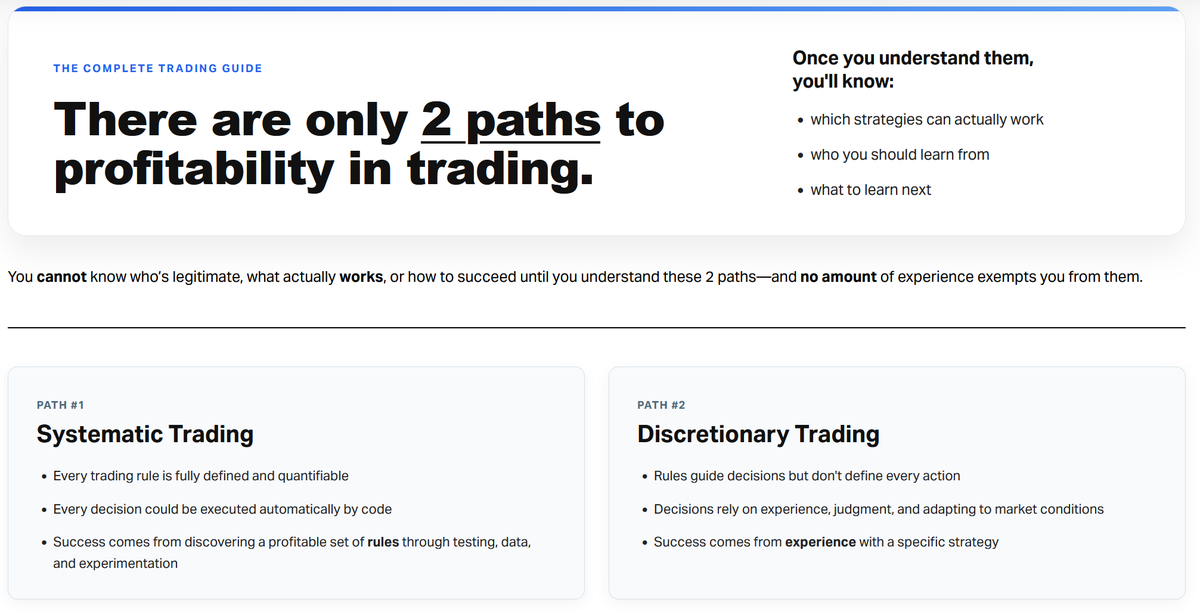
First, view the picture and get an overview of the 2 paths. It's very simple and quick to learn. If you'd like more clarity on the differences and what they mean for trading, then start here:
🚨Systematic:
A 100% quantified and fully-automated system/algorithm that could FULLY run itself if you coded it (or you can just manually execute it).
It is rules based without any freedom on decisions, which means when your criteria for entering a trade is hit, you enter it, and you never do anything that isn't in your pre-written instructions.
A genuine systematic edge is something you have an incentive to keep private. If a strategy reliably produces excess returns, publicly revealing the exact rules allows other traders to copy it, compete for the same opportunities, and potentially reduce or eliminate the edge.
This is what essentially every publicly shared “strategy” claims to be doing. Whether it is a set of indicators, a price-action setup, a specific entry model, or a complicated algorithm, the pitch is ultimately the same: follow these rules consistently and the strategy will produce profitable results over time. But, as you saw in the previous section, they don’t work. Trading influencers just continuously spread them in order to convert more beginners into buying courses and mentorships. But, if the strategy being sold/taught actually worked when automated, then they would keep it to themselves.
🚨Discretionary
You have a trading system, but you give yourself the freedom to make different decisions on a trade-by-trade basis. Some part of the process isn't 100% rules based.
No matter how quantified and clear your strategy is, including your rules about trade management, you are a discretionary trader if you retain the ability to override those rules in the moment. This includes deciding whether to take a trade that meets your criteria, changing your stop loss or profit target, moving or adjusting a position, or exiting for a reason that isn't already defined by your strategy.
The degree of freedom you give yourself to manage trades and enter or exit positions varies by person, but, ideally, you want everything to be quantified as much as possible. Remove ambiguity and unnecessary choice wherever you can, because every undefined decision creates another opportunity for human error.
⬇️⬇️⬇️⬇️⬇️⬇️⬇️⬇️⬇️⬇️⬇️⬇️
🚨How does this expose the ENTIRE industry and ALL fake gurus?
Simple. It proves every paid course is a scam. If a strategy can be automated (path #1), nobody who actually has an edge would sell it to you. They would lose money by giving it away. And, if it requires discretion (path #2), then no amount of money can buy you the experience required to make it work. Imagine thinking you could become the next Tiger Woods by reading books and watching YouTube videos about golf.
Regardless of which path you take, no amount of money can substitute the work and experience required to succeed. Nobody shares strategies that work on their own. Nobody can sell you experience. So, what are you actually paying for in a course or mentorship? This is why you’ve never learned these concepts before. How many public trading figures would be left if paid courses, mentorships, indicators, trade alerts, trading bots, and everything else disappeared? That’s why the truth about how to succeed at trading will never be widely shared. It exposes the entire industry.
🚨Who should you learn from or follow? What should you read/watch for learning? How do you actually learn how to trade?
Wondering who to follow is a legitimate question every beginner has. However, the 2 paths to profitability actually make the question irrelevant. You should both follow everybody and follow nobody. Nobody is handing out or selling strategies that actually work on their own when automated (path #1), and even the greatest discretionary trader of all time can't give you the experience that makes them successful (path #2).
This means that all books, videos, and people are simply sources of ideas. Ultimately, you are the only one who can make trading work. Either you discover a profitable set of rules that can be automated, or you spend enough time with a strategy to develop the experience required to make it work. YouTube, TikTok, X, Instagram, and everything else are simply places to find ideas. If you follow people instead of ideas, you’ve lost.
Even if the trading influencer you’re wondering about is profitable, they still have nothing worth buying. Go ahead and follow them. Watch what they do and test what they’re saying. But, buy nothing. A terrible trader can give good advice, and an excellent trader can give bad advice. All you can do is test the ideas you find.
🚨Does ______ trading strategy actually work? Learn how to answer that question for ANY strategy in 5 seconds:
When it comes to online trading strategies to learn, just think about path #1. Every publicly shared strategy on social media can be or already has been automated. For the ones that have specific enough entry and exit criteria for trades, they’ve already been automated. You can even find algorithms and indicators for free on sites like TradingView that perfectly plot these strategies on the charts. They’re given away for free or sold for $10 because they don’t actually work. That’s why the question of what to learn reverts back to the first section above this. If you found a profitable set of rules, then you would keep them to yourself. If you shared them, others could copy the strategy until the edge would be wiped out.
The instructions on how to take the information you find and then begin building your own strategy are below. That is how you actually apply the lessons you’ve learned based on the 2 paths to profitability. You don’t need another strategy video. You need to learn how to test ideas and start developing your approach.
Now that you understand the 2 paths, you can properly start learning how to trade. I have a FREE video on the FREE site that helps you learn how to test ideas, experiment with trades, and other important stuff. It doesn't teach 1 strategy. It teaches you the foundation of learning ANY trading strategy. https://t.co/zuhe58AW9a - there is no course to buy, I don't know how to say that any other way. It also contains a collection of videos that will help you develop your strategy. For example, are you thinking about the distribution of typical price action conditions in relation to the expected win rate of your system? Are you aware of how often per year there are days that allow your system to work? All kinds of stuff.