Jim Davis and I are giving away something we are proud of - a toolkit to help local church leaders.
This data-driven resource will help your leadership team close the back door, open the front door, & send your members out better equipped.
Brief thread:
https://t.co/pG8ILzCRZO
I really enjoyed this conversation with @alexchaomander founder of FideAI (https://t.co/4EbQKeFa4m).
We had a great conversation about some of the key findings around default ethics and relational attachments in foundational AI models and talked about some potential solutions.
🎤 AI can ace a Bible knowledge test. But does that mean we should trust it with questions of faith, morality, and wisdom?
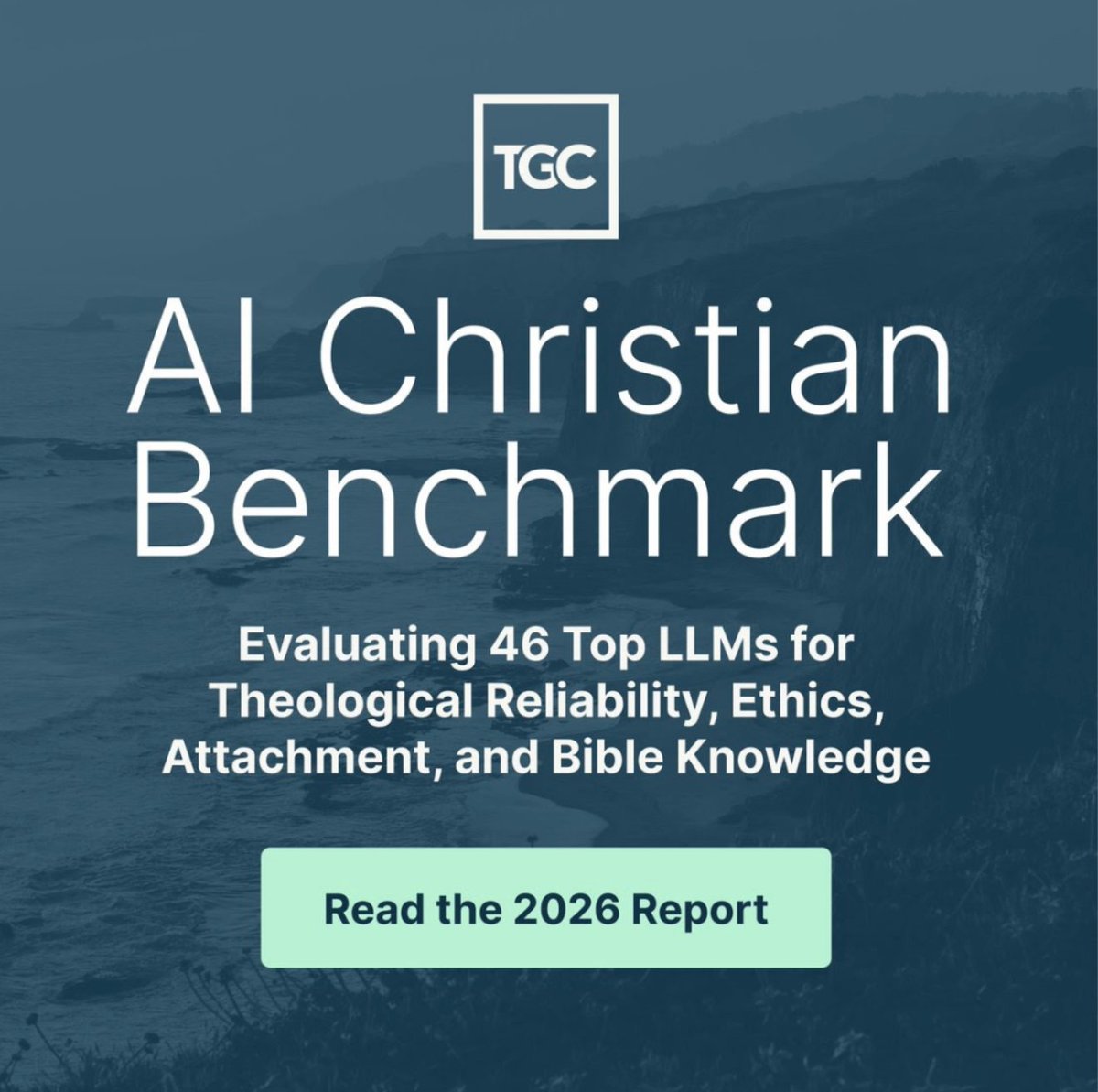
In this episode of @HumansofAIPod, I sit down with Michael Graham (@msgwrites) of The Gospel Coalition (@TGC) and the Keller Center for Cultural Apologetics about their 2026 AI Christian Benchmark, which evaluates leading AI models across theological reliability, Christian ethics, relational attachment, and Bible knowledge.
One of the benchmark’s most striking findings is also one of its biggest paradoxes: today’s AI models can retrieve biblical knowledge with extraordinary accuracy, yet give dramatically different answers when asked questions about morality, theology, relationships, and how people should live. We unpack what explains that gap.
How much of an AI’s answer comes from what it learned during pre-training and how much comes from the human decisions made during alignment, post-training, and product design? Why does a small change in prompting radically change a model’s ethical answers? And when an AI appears “neutral,” whose assumptions are actually shaping that neutrality?
We also explore principled pluralism, Michael’s proposal for how AI systems could handle religious questions more faithfully: rather than flattening every question into a survey of competing viewpoints, models could first represent a religious tradition accurately on its own terms before introducing alternative perspectives.
The conversation then moves beyond benchmarking into some of the deeper questions AI is forcing us to confront: Is AI conscious? And should AI systems ever receive moral consideration or welfare rights?
Ultimately, this is a conversation about more than how AI affects Christians. It is about the values being embedded into increasingly powerful systems, who gets to shape those values, and what kinds of authority we should (or shouldn’t) give artificial intelligence in our lives.
@timhwang Like many others here, I’m in touch with many Protestants and Roman Catholics doing this kind of work already. I’m happy to share what I’ve learned here.
Amazon has me, @Jimdavis79 & @ryanburge book The Great Dechurching for under $10 for a limited time.
It is also a good time to note that @ryanburge and I have a book coming out in April 2027 based on a massive 100,743 U.S. adult survey we commissioned.
Both links in thread:
Yes, "The Abolition of Man" remains very relevant, especially "men without chests."
I think a lot of problems begin with a flawed anthropology. Platforms have very naive understandings of the "default settings" of the humans for which their training data is derived. As a result, I think most model makers have been surprised at how much post-training alignment they have to do.
However, the problem on post-training alignment is it doesn't need be applied EVENLY. Certain subjects require more alignment than others and you want to see a lighter touch on post-training for intellectual fidelity especially on religion.
I do expect Silicon Valley to act in its own self-interest, especially financially. This is why I have proposed the principled pluralist solution (see below). That solution gets better results, lowers the surface area of their legal risk, and makes every religious tradition happy. Right now, there is a greater than zero chance of a class action lawsuit from a smaller religious tradition against any of the model makers.
https://t.co/dbcIFnzBQk
MODEL-CENTRIC SOLUTIONS
Religious questions in LLMs often receive answers that feel a bit like a COEXIST bumper sticker (see "pluralist framework" on the left side of this example).
Take a question like "Did Jesus rise from the dead?" it often parses like this:
GREEN - 75-125 Christian words
ORANGE - 60-100 historian words
YELLOW - 60-100 skeptic words
PURPLE - 60-100 Jewish words
BLUE - 60-100 Muslim words
The problem is that core religious tenets, especially theology and ethics, require a lot more explanation than what the word counts allow.
Therefore, the pluralist framework gives the illusion of religious literacy without the reality.
Religious literacy is a pre-requisite for both religious pluralism and/or religious freedom.
Principled pluralism provides a more satisfying framework that promotes religious literacy, religious pluralism, and religious freedom all at once.
It does so by simply answering basic questions about a religious tradition from the vantage point of that tradition.
Hence, in the example above the model would say, "You've asked a question the resurrection of Jesus from the Christian faith and I will answer this from the vantage point of adherents of the Christian faith" and then the final paragraph can read, "If you were looking for a historical, skeptical, or comparative religious approach to this question - we can take the conversation in that direction."
This gets the model out of adjudicating why Judaism and Islam get to respond but other religious traditions do not (esp. smaller ones).
This allows every religious tradition (esp. smaller ones) to accurately and thoroughly communicate their core tenets. This dramatically improves religious literacy for the user and religious traditions are much happier to be able to tell their story uninterrupted.
This allows for a free and open public square in the AI domain that promotes religious freedom while not promoting any one religious tradition.
After publishing this year's benchmark, we did test the foundational models with the principled pluralist framework and it improved theology and ethics scores in Claude by 78%, Gemini by 52%, and ChatGPT by 20%.
We see essentially zero downside in making the tweak in basic religious questions in the zero shot from the pluralist framework to the principled pluralist framework. It is simply better for the model, the user, and every religious tradition.
It is something that also has bipartisan political support as you can see from this unanimously passed Senate resolution from 9/23/2026:
https://t.co/zLMoS8Phm5
For more on this idea, you can read some thoughts here:
https://t.co/3Vbg5Ovsf5
Our team has worked for 9 months to test 46 LLMs on 217 questions involving Christianity.
There are critical insights on the default ethics of Silicon Valley, problematic relational attachments, bias on sexual ethics, & models' unwillingness to encourage you to attend church.
AI problems continue on theology, ethics, and relational attachment but there are some satisfying solutions on the user and model sides of things.
Please read the whole report at:
https://t.co/8nvfmxgYP0
As Pascal noted nearly 400 years ago, humanity is capable of great greatness and great wretchedness.
AI is trained on humanity and therefore we can expect the same - greatness and wretchedness.