agentic engineer in 2026.
Andrew Ng, the godfather of AI, gave the complete playbook to become one from scratch.
1 hour course. Free:
• 00:00 - AI agent basics
• 12:12 - AI Agentic workflows & design patterns
• 53:27 - Practical tips for building AI agents
• 1:20:30 - self-improving AI agent loops
• 1:30:19 - multi-agent AI systems
I watched it last night.
Halfway through, I realized I could get into Anthropic in weeks, not years.
Bookmark now. Watch it. Then build your own AI agent
A San Francisco startup says it just turned mercury into real gold, and their own math says gold is one of the cheapest things their machine can make. Aim it at a different metal and it makes a cancer drug ingredient worth tens of billions of dollars a gram.
Here's how it works. When you fuse two kinds of hydrogen, deuterium and tritium, every single reaction kicks out a neutron moving at 14.1 MeV, which is absurdly fast. Fire one into mercury-198 and it knocks another neutron loose on the way through, so two come out and you're left with mercury-197. Give that a few days and it decays into gold-197, the only stable kind of gold there is. The whole trick needs neutrons above about 6 MeV, and regular nuclear reactors barely make those, while fusion makes one every time it fires.
Now swap the mercury for radium-226. Same reaction, one neutron in and two out, and you end up with radium-225, which decays into actinium-225. Novartis is building its next prostate cancer drug around actinium-225, and it's so scarce it sells by the millicurie, roughly $1,200 to $2,500 apiece. Price it by the gram and you're into the tens of billions of dollars, for a material so radioactive nobody could safely hold a gram of it anyway.
Marathon's team actually put a dollar value on a single fusion neutron in a paper this year. Use it to make electricity and it's worth about $3 × 10⁻²⁰. Gold comes in at $2.6 × 10⁻²⁰, basically a wash. Molybdenum-99, which goes into about 80% of nuclear medicine scans, is worth $2.6 × 10⁻¹⁷ a neutron. Actinium-225 is worth about $10⁻¹⁰, around 3 billion times what the electricity's worth.
That's why fusion people should care. Every fusion company you've heard of is chasing electricity, and selling electricity only pays once the plasma puts out something like 10 to 22 times the energy you pump in to heat it. The best result so far, at JET in England, was about a third. Add gold on the side and Marathon's math says you break even around 3x. For molybdenum-99, the number is 0.001x.
So a machine that gives back one-thousandth of the energy you feed it can still make money, as long as the neutrons hit the right metal.
By their numbers, a 3 megawatt machine running way below breakeven could cover the whole world's supply of molybdenum-99, which today comes from splitting uranium in a handful of research reactors. Today's experimental fusion machines already beat the gain that job needs.
Their second post basically says this out loud. Marathon now describes itself as an isotope company for radiopharma. Their chart shows roughly 390 targeted radiotherapy trials. Pluvicto, the prostate cancer drug Novartis launched at $42,500 a dose, did $1.9 billion in sales last year.
Gold still matters to them, just later. It's about a $700 billion a year market, and Marathon's paper figures it could soak up around 2 terawatts of fusion capacity, which is roughly the scale where fusion actually moves the grid. So the plan is to sell cancer isotopes out of small machines now and use gold to pay for the giant ones, years before electricity can pay for itself.
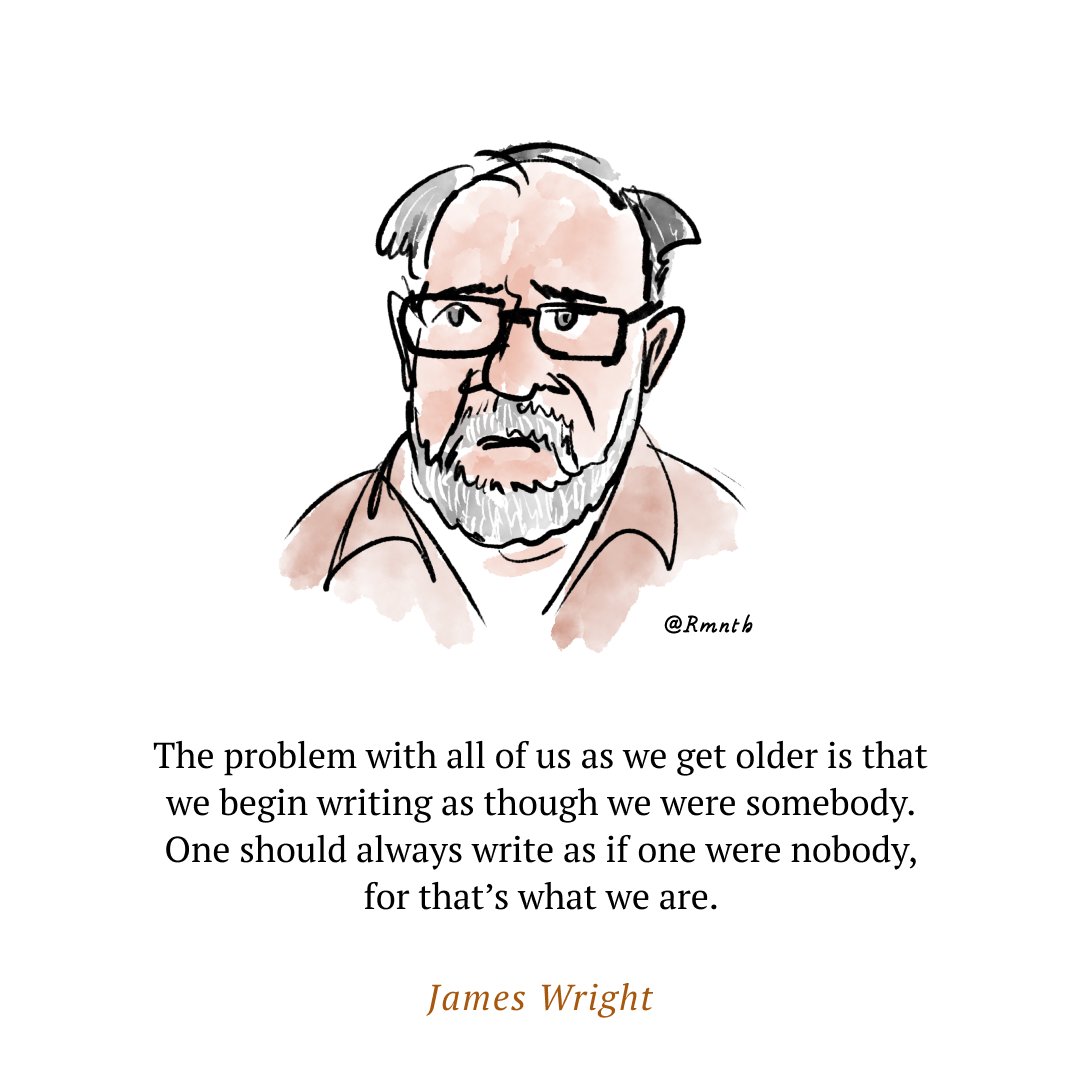
In the giant shadow of Dante’s wing, for instance, we are nobody and should never forget it. So we should always write out of our ignorance and desire and ambition, never out of some sense of false wellbeing, some tinge of success.
~ James Wright
Jensen closed his GTC Berlin 2026 keynote with this Hermes Agent demo as the finale.
He introduced it by saying the way to build an agent is to ask an agent to build it for you, so he installed and set up a customized Hermes in one prompt.
Then he used Hermes, running on @nvidia RTX Spark, to create a simulated training environment for the @huggingface Microduck. Hermes planned an obstacle course with Nemotron and had GPT-6 Astra build it using FreeCAD, Omniverse libraries, Blender, Newton, and Isaac Lab. Hermes trained thousands of simulated ducks on that course until the validated policy was ready to run on the real robot in the physical world.
At Nous, we believe open source is a practical tool as much as a philosophical ideal. It gives users the ability to build powerful, complex workflows chaining numerous local+cloud models, devices, and tools themselves instead of waiting for a company to enable them.
Airbnb engineers are building with AI agents in ways most developers are still trying to figure out....👀
Two Senior Staff Engineers walk through how they actually use agents in production
15 minutes that might completely change how you approach coding with AI🔥
Software's moats are falling one by one, and most founders haven't noticed.
Satya Nadella explained where it's going:
"The notion that business applications exist, that's probably where they will all collapse, right? In the agent era. Because if you think about it, they are essentially CRUD databases with a bunch of business logic. The business logic is all going to these agents."
"And once the AI tier becomes the place where all the logic is, then people will start replacing the back ends."
It's already happening. Some customers now build their own version of the tools they pay for.
Vick runs customer success at HeyReach. One customer left to rebuild it with AI, then came back 4 months later and said:
"We spent more in 4 months trying to build it than we paid you in 2 years."
What he couldn't rebuild in HeyReach:
- unlimited LinkedIn sender accounts for one flat fee
- sending that auto-rotates across every account
- one inbox for every LinkedIn reply, with warm leads tagged automatically
- leads pulled in from Sales Navigator and Clay, synced back to HubSpot
That's the moat now, and you have to earn it every month. Worth reading in full:
This is f*king insane. SpaceXAI engineer Lauren Tan:
"250 applications over two years. Not one offer
Then he showed up running 20 agents and got a $500K offer"
In this 1-hour workshop, Lauren shows how to build a Grok Bot team that delegates work and verifies the results
Grok Bot → Chief of Staff → Managers → Workers
A chat window gives you one bot. An agent team gives you a system
This free workshop is worth more than most $800 agent engineering courses
Bookmark and watch it today
Then read Harness Engineering article below ↓
Google has released a free 1-hour course on AI engineering, covering everything from building your first AI agent to creating fully autonomous systems.
7:02 — Build your first AI agent
13:34 — Explore what AI agents can do
23:08 — Learn context engineering
32:56 — Understand graph engineering
54:11 — Create a fully autonomous system
One agent can save hours of work. Multiple agents can completely change how a team operates.
Prompts → Agents → Loops → Graphs
Most people focus on prompts, but the real power comes from building AI systems that can think, act, and improve through structured workflows.
Same models. Same tokens. Better systems. Better results.
Watch the full course and save it for later.
The complete guide to loops and graphs is below. 👇
Madhu Guru (@realmadhuguru) led product for Gemini.
He thinks fewer than 75 PMs are qualified to do the work.
That's a pretty wild stat. Madhu is now a senior director of AI at Meta, and he identified 5 skills that every PM working on things like Gemini needs to be able to do:
1) Vision and opinionated UX design
2) Model intuition to extract max value
3) Going from pixels to evals to hill climbing
4) Agentic flows: tools, context and safety guardrails
5) Deep user understanding
He says it's scar tissue from hiring, so I'm inclined to believe him. He means AI-native PMs, but I really think it's fewer than 75 for model PMs.
I found 46 open model PM roles, oddly close to 75. I read all the postings, and they ask for similar things. Here's what they look for, by percentage of postings:
1) Vision and opinionated UX design: 61%
2) Model intuition to extract max value: 61%
3) Going from pixels to evals to hill climbing: 76%
4) Agentic flows: tools, context, safety guardrails: 59%
5) Deep user understanding: 50%
Now the last line of his tweet:
"It is a rare, but learnable skillset. Only way is to build, build, build."
I think that's the most important point, and the postings agree with him. Only 7 of the 46 require production experience. What they're really looking for is that you are building, and you can go build these things on the side.
What I recommend: pick a task your favorite model struggles with. Write down the failure modes. That's the start of your eval set, and that's the product you should build, something that solves them. Start with a behavior spec for it: "the model should..." Those lines become additional evals. Then ask Claude Code to build a product that passes those evals, and iterate. You'll learn how to build on top of models.
Model PMs are paid extremely well. The median posted base is $345K, and the range runs from $144.6K to $490K.
As he said, it's learnable. Because there's so little supply, why don't you become one? Why don't you get that pay bump? I think you can, and I'm here to help. Let me know any challenges you face in the comments.
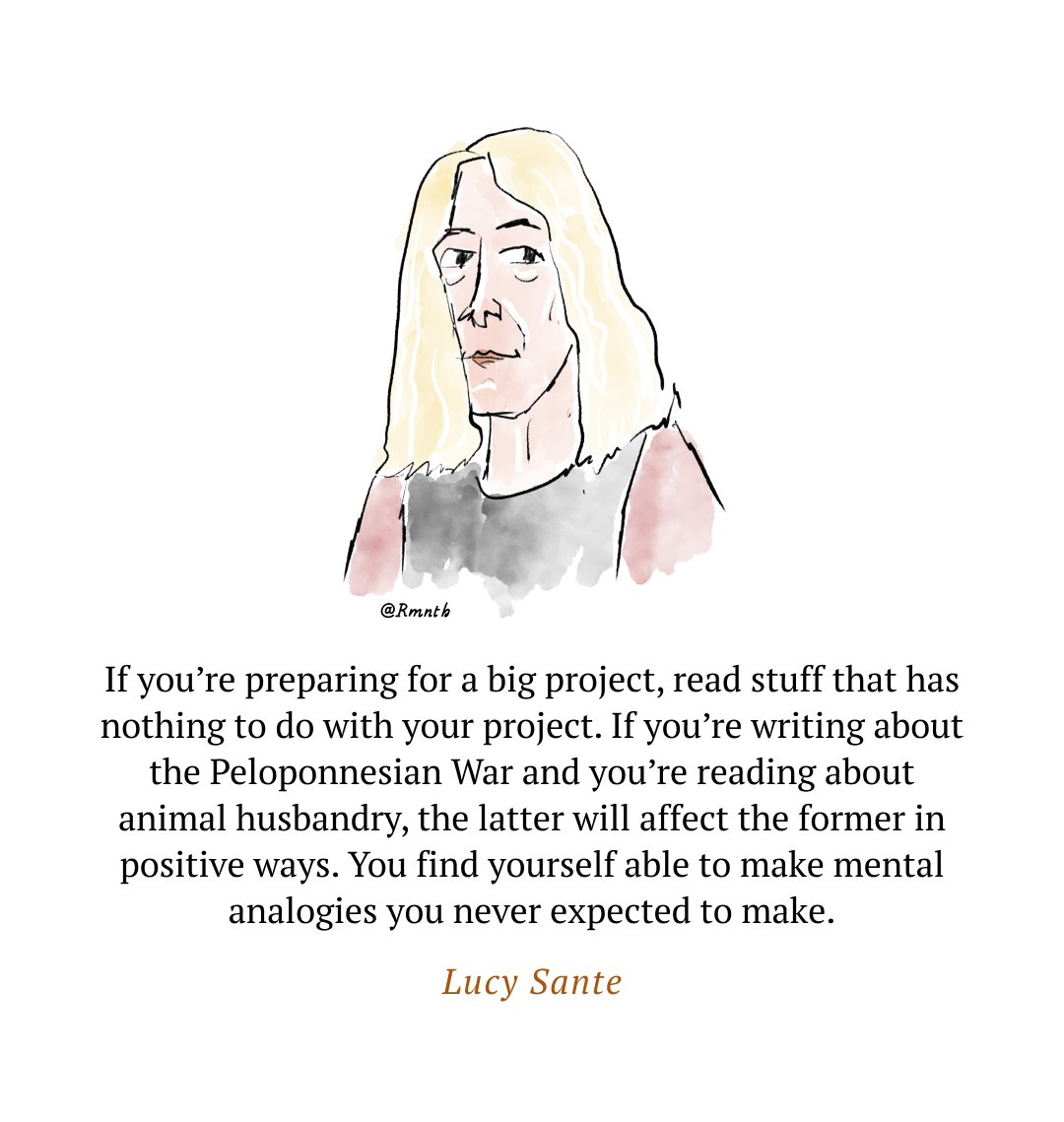
Read stuff that has nothing to do with your project.. you find yourself able to make mental analogies you never expected to make.
~ Lucy Sante
#writingtips
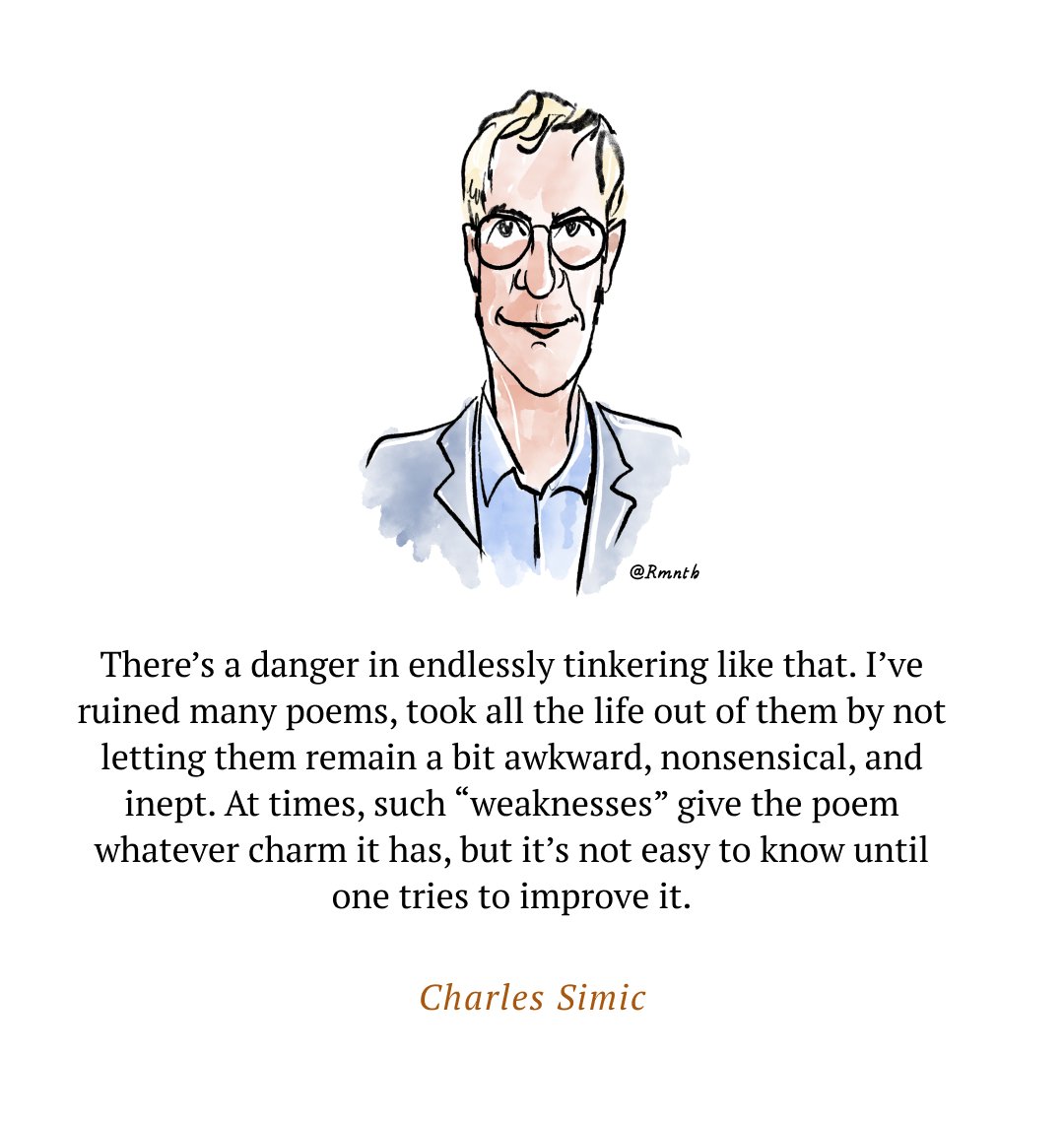
At times, such “weaknesses” give the poem whatever charm it has, but it’s not easy to know until one tries to improve it.
~ Charles Simic
Plans are worthless, but planning is everything.
~ Dwight D. Eisenhower
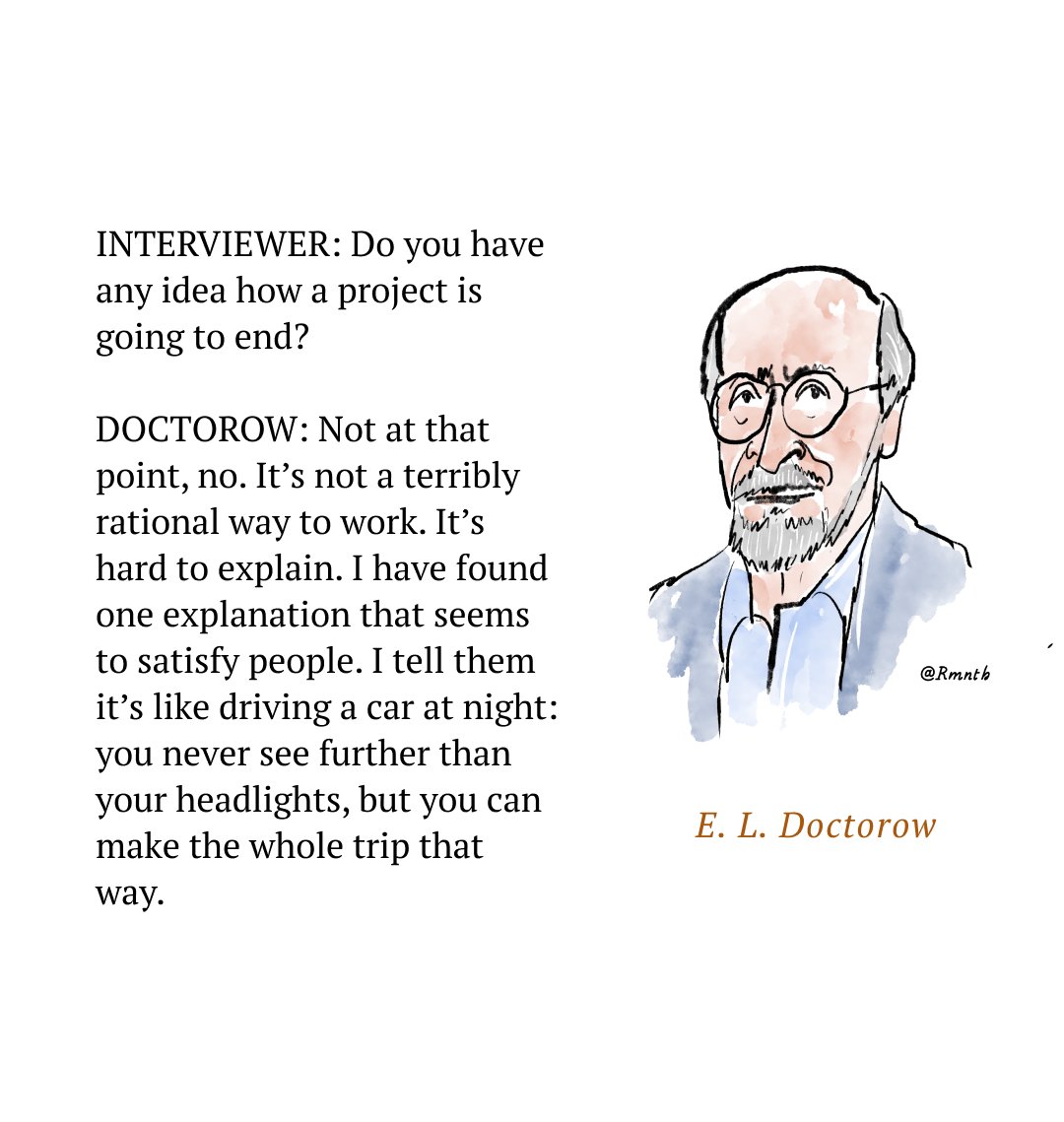
It’s like driving a car at night: you never see further than your headlights, but you can make the whole trip that way.
~ E. L. Doctorow
#Frozen2:
"I won't look too far ahead
It's too much for me to take
But break it down to this next breath
This next step
This next choice is one that I can make"
#writing #life #complexity
I recently wrote about why we need to treat models as insider risks, with security controls sitting outside the model itself.
Today, we're putting that principle into practice by expanding Project Perception with new capabilities to help continuously assess agent risk, adapt permissions, and contain threats.
https://t.co/ec3Z2B260G
You can’t write for other people. You can’t write for the left or the right, this religion or that religion, or this belief or that belief. You have to write the way you see things.
~ Ray Bradbury
Intellectual integrity is the ability to see the world as it is, not as you want it to be.
~ Peter Drucker
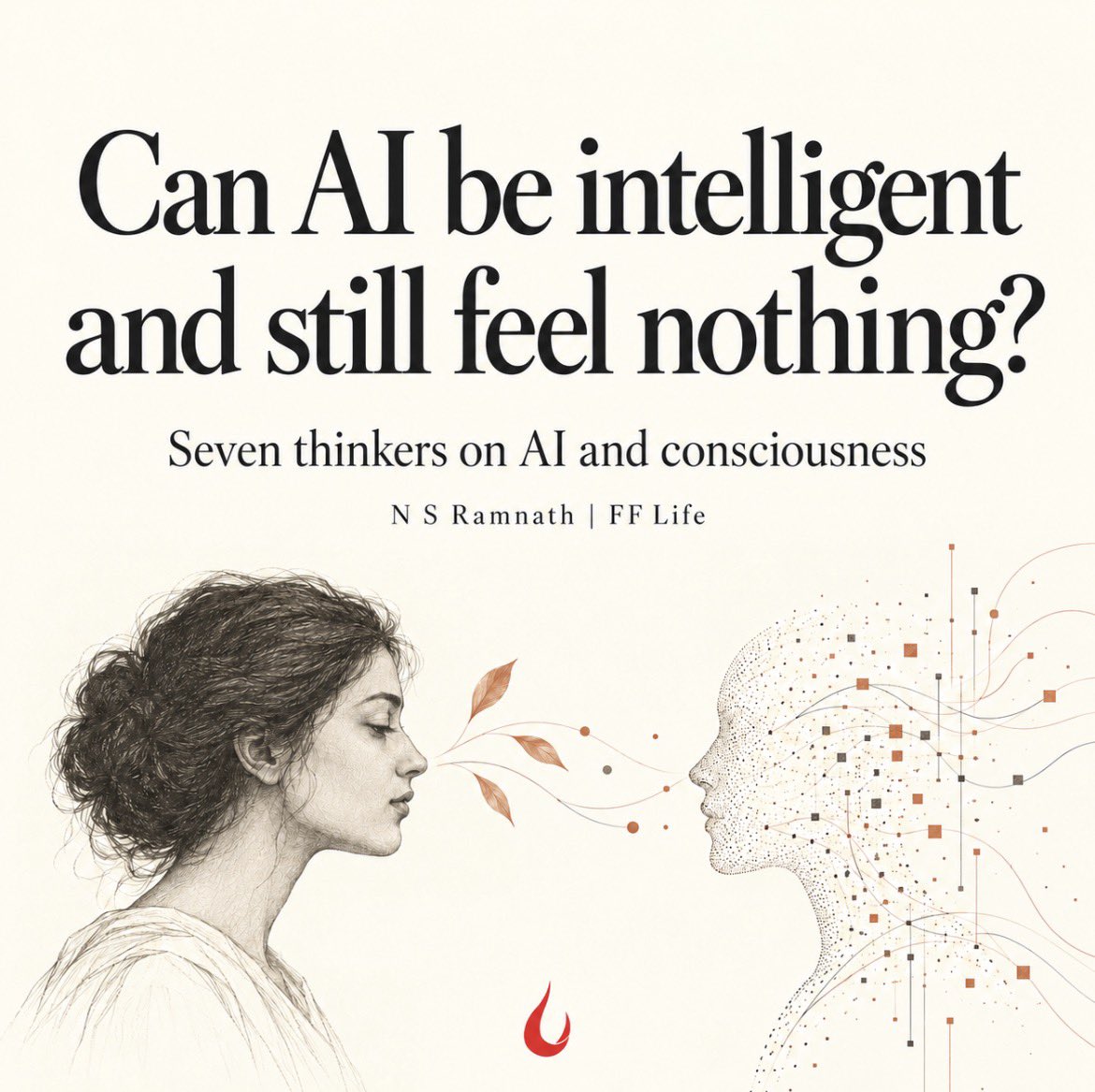
Can AI be intelligent and still feel nothing?
My colleague @rmnth’s weekend special for @FoundingF provides a useful way into this question: seven thinkers who disagree about what consciousness is—and what it would take for a machine to have it.
A short thread 🧵