Every single thing you want in life is on the other side of something that sucks. That suck might be 100 workouts, 100 bland meals, 100 hours of work, or 100 hard conversations. Embrace it as the cost of entry. The answers you seek are found in the actions you avoid.
Psychological distancing is the greatest life hack.
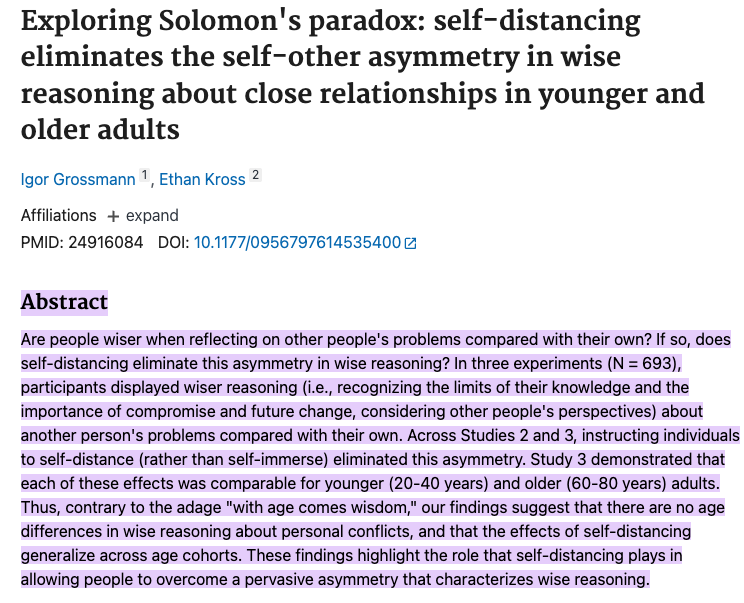
When psychologist Igor Grossmann presented people with relationship dilemmas, participants gave remarkably wise advice about other people's situations. They considered multiple perspectives, acknowledged uncertainty, recognized that circumstances change over time, and suggested nuanced solutions that balanced competing interests.
Then he gave the same people identical dilemmas about their own relationships.
Their wisdom vanished.
Suddenly, the same individuals who had been thoughtful and measured became reactive and absolute in their thinking. They ignored contradictory evidence, assumed their perspective was complete, and made black-and-white judgments they would have criticized if someone else had suggested them.
Grossmann called this "Solomon's Paradox" after the biblical king renowned for his wisdom in judging others while making catastrophically poor decisions about his own life.
The takeaway is we are literally less intelligent about our own problems than identical problems happening to other people.
The mechanism explains why your friends can see obvious solutions to situations that feel impossibly complex to you, and why you can instantly diagnose what someone else should do while remaining completely stuck in your own circumstances.
When you think about someone else's problem, your brain automatically engages what psychologists call "psychological distance." The situation feels separate from your identity, so your analytical capabilities remain online. You can weigh pros and cons, consider long-term consequences, and imagine multiple scenarios without emotional interference.
When you think about your own problem, psychological distance collapses to zero. The situation becomes fused with your sense of self. Your ego gets involved, your emotions spike, and the prefrontal cortex that generates wise decisions goes offline. You're no longer thinking about the problem; you're drowning in it.
Mental distancing artificially recreates the psychological distance that naturally exists when you consider other people's situations. The technique tricks your brain into treating your own problem as if it belonged to someone else, which reactivates the same wise decision-making capabilities you use when advising friends.
This connects to why journaling works, why talking to therapists helps, and why ancient wisdom traditions emphasize witness consciousness. All of these practices create psychological distance between the self and experience.
The observer self and the experiencing self are different neurological systems with different capabilities.
Your experiencing self is designed for immediate survival and emotional processing. It's reactive, personal, and immersive. Your observer self is designed for learning, planning, and complex decision-making. It's reflective, impersonal, and spacious.
Most of us spend their entire lives identified exclusively with the experiencing self. We never discover that stepping into the observer self is possible, let alone that it dramatically improves judgment and emotional regulation.
But mental distancing is not some kind of forced positive thinking or emotional suppression. It's activating a higher-order cognitive capacity that evolution gave you but culture never taught you to use.
When you can observe your thoughts and emotions from the outside instead of being consumed by them from the inside, you recover access to the same wisdom you naturally apply to everyone else's problems.
The paradox is that gaining distance from yourself actually makes you more effective at managing your life.
You become your own best advisor.
Cognitive reframing explained. Shifting your mindset to view situations from a different, more positive or productive perspective, thereby reducing stress, anxiety, and improving emotional regulation.
There’s a Japanese saying:
“If you feel like you’re losing everything, remember, trees lose their leaves every year, yet they still stand tall and wait for better days to come.”
“Practice any art… no matter how well or badly, not to get money and fame, but to experience becoming, to find out what's inside you, to make your soul grow.”
- McKellen reciting Vonnegut
You can read all the books. Watch all the documentaries. Listen to all the stories. But nothing, and I mean nothing, will prepare you for certain moments in life until you're standing in them yourself. Marriage. Divorce. Childbirth. Losing someone you love. Parenting. They all look so different when it's your heart on the line. Your choices. Your pain. Your mess. Your miracle.
It's easy to sit on the outside with theories, opinions, and assumptions. It's easy to think you'd handle it better. Until life turns to you and says, "Your turn." And suddenly, you understand. You understand the tears. The silence. The fight to keep going. The strength it takes to show up when everything feels heavy. The courage it takes to start over.
Life has a way of humbling us all. So be slow to judge, quick to offer grace, and always remember, what you don't understand today, you just might face tomorrow. We're all just figuring it out as we go. And that's more than okay.
A mentor once told me this: Life will test you with the same challenge until you learn the lesson. The same fight in every relationship. The same burnout in every job. The same regret in every missed chance. Until you do the inner work, the outer world won’t change.
Stop hiding your authentic self. You have great taste. You have unique interests. You have a gift that can change people's lives. But you keep it hidden. The pain you feel is the pain of hiding your true potential. Express it. It will end your pain. Do it. The time is now. NOW.
@RufasKe@Bookten8 Avoid gluten, lactose, seed oils and added sugar in the diet. Eat more vegetables than fruits and start adding fermented foods to the diet.