It is hard to communicate how much programming has changed due to AI in the last 2 months: not gradually and over time in the "progress as usual" way, but specifically this last December. There are a number of asterisks but imo coding agents basically didn’t work before December and basically work since - the models have significantly higher quality, long-term coherence and tenacity and they can power through large and long tasks, well past enough that it is extremely disruptive to the default programming workflow.
Just to give an example, over the weekend I was building a local video analysis dashboard for the cameras of my home so I wrote: “Here is the local IP and username/password of my DGX Spark. Log in, set up ssh keys, set up vLLM, download and bench Qwen3-VL, set up a server endpoint to inference videos, a basic web ui dashboard, test everything, set it up with systemd, record memory notes for yourself and write up a markdown report for me”. The agent went off for ~30 minutes, ran into multiple issues, researched solutions online, resolved them one by one, wrote the code, tested it, debugged it, set up the services, and came back with the report and it was just done. I didn’t touch anything. All of this could easily have been a weekend project just 3 months ago but today it’s something you kick off and forget about for 30 minutes.
As a result, programming is becoming unrecognizable. You’re not typing computer code into an editor like the way things were since computers were invented, that era is over. You're spinning up AI agents, giving them tasks *in English* and managing and reviewing their work in parallel. The biggest prize is in figuring out how you can keep ascending the layers of abstraction to set up long-running orchestrator Claws with all of the right tools, memory and instructions that productively manage multiple parallel Code instances for you. The leverage achievable via top tier "agentic engineering" feels very high right now.
It’s not perfect, it needs high-level direction, judgement, taste, oversight, iteration and hints and ideas. It works a lot better in some scenarios than others (e.g. especially for tasks that are well-specified and where you can verify/test functionality). The key is to build intuition to decompose the task just right to hand off the parts that work and help out around the edges. But imo, this is nowhere near "business as usual" time in software.
we're making @blocks smaller today. here's my note to the company.
####
today we're making one of the hardest decisions in the history of our company: we're reducing our organization by nearly half, from over 10,000 people to just under 6,000. that means over 4,000 of you are being asked to leave or entering into consultation. i'll be straight about what's happening, why, and what it means for everyone.
first off, if you're one of the people affected, you'll receive your salary for 20 weeks + 1 week per year of tenure, equity vested through the end of may, 6 months of health care, your corporate devices, and $5,000 to put toward whatever you need to help you in this transition (if you’re outside the U.S. you’ll receive similar support but exact details are going to vary based on local requirements). i want you to know that before anything else. everyone will be notified today, whether you're being asked to leave, entering consultation, or asked to stay.
we're not making this decision because we're in trouble. our business is strong. gross profit continues to grow, we continue to serve more and more customers, and profitability is improving. but something has changed. we're already seeing that the intelligence tools we’re creating and using, paired with smaller and flatter teams, are enabling a new way of working which fundamentally changes what it means to build and run a company. and that's accelerating rapidly.
i had two options: cut gradually over months or years as this shift plays out, or be honest about where we are and act on it now. i chose the latter. repeated rounds of cuts are destructive to morale, to focus, and to the trust that customers and shareholders place in our ability to lead. i'd rather take a hard, clear action now and build from a position we believe in than manage a slow reduction of people toward the same outcome. a smaller company also gives us the space to grow our business the right way, on our own terms, instead of constantly reacting to market pressures.
a decision at this scale carries risk. but so does standing still. we've done a full review to determine the roles and people we require to reliably grow the business from here, and we've pressure-tested those decisions from multiple angles. i accept that we may have gotten some of them wrong, and we've built in flexibility to account for that, and do the right thing for our customers.
we're not going to just disappear people from slack and email and pretend they were never here. communication channels will stay open through thursday evening (pacific) so everyone can say goodbye properly, and share whatever you wish. i'll also be hosting a live video session to thank everyone at 3:35pm pacific. i know doing it this way might feel awkward. i'd rather it feel awkward and human than efficient and cold.
to those of you leaving…i’m grateful for you, and i’m sorry to put you through this. you built what this company is today. that's a fact that i'll honor forever. this decision is not a reflection of what you contributed. you will be a great contributor to any organization going forward.
to those staying…i made this decision, and i'll own it. what i'm asking of you is to build with me. we're going to build this company with intelligence at the core of everything we do. how we work, how we create, how we serve our customers. our customers will feel this shift too, and we're going to help them navigate it: towards a future where they can build their own features directly, composed of our capabilities and served through our interfaces. that's what i'm focused on now. expect a note from me tomorrow.
jack
The new best models changed in a week.
planning - o3
code - Sonnet 4
live/real-time - Grok
workhorse - GPT 4.1
at scale - Gemini Flash 2.5
visuals - GPT image-gen (but Imagen 4 is very good)
video - Veo-3
open-source - Qwen-235b
music - lyria
We see a lot more Google in the list now!
At #GoogleIO, we shared how decades of AI research have now become reality.
From a total reimagining of Search to Agent Mode, Veo 3 and more, Gemini season will be the most exciting era of AI yet.
Some highlights 🧵
Say goodbye to the silent era of video generation: Introducing Veo 3 — with native audio generation. 🗣️
Quality is up from Veo 2, and now you can add dialogue between characters, sound effects and background noise.
Veo 3 is available now in the @GeminiApp for Google AI Ultra subscribers in the U.S.
#GoogleIO
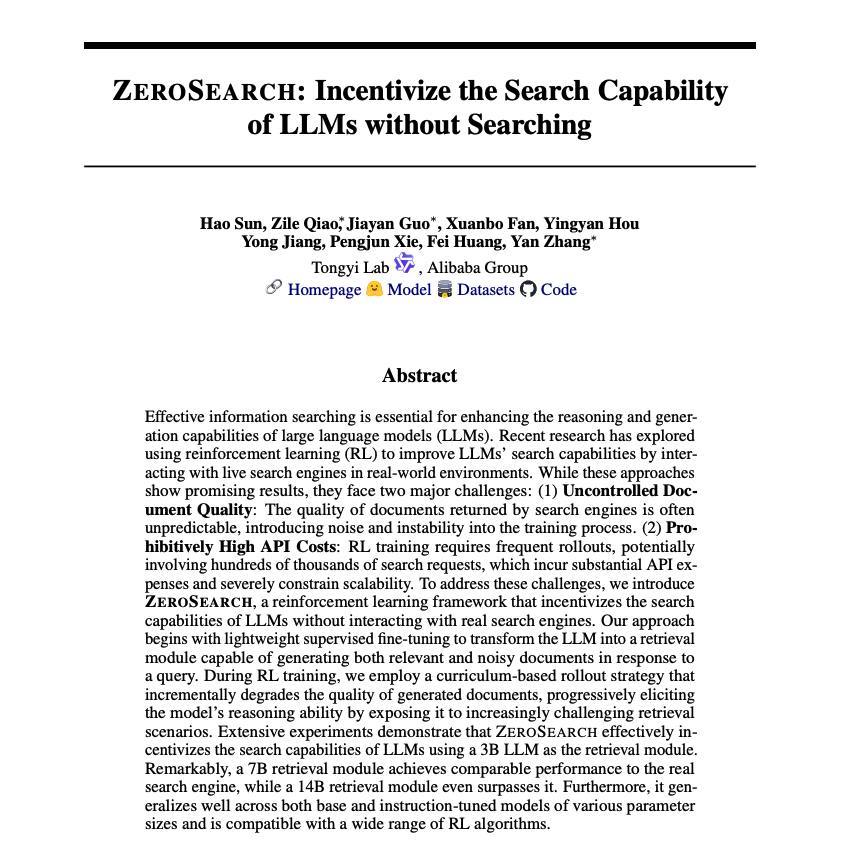
Incentivizing Search in LLMs without Searching
ZeroSearch is a curriculum-based RL framework that teaches LLMs to retrieve information using self-generated documents.
A 7B model matches, and a 14B model surpasses live search engine performance. Works across model sizes & RL methods.
Today we are rolling out an updated Gemini 2.0 Image Generation model with 🖼️:
- Better visual quality
- More accurate text rendering
- Lower block rates
- Higher rate limits
- $0.039 per image generated
So excited to get this into the hands of devs : )
macOS’ internals are a much better piece of engineering than Linux.
And the NT kernel is much better than both of those Unix slop troughs but you guys aren’t ready for that conversation.
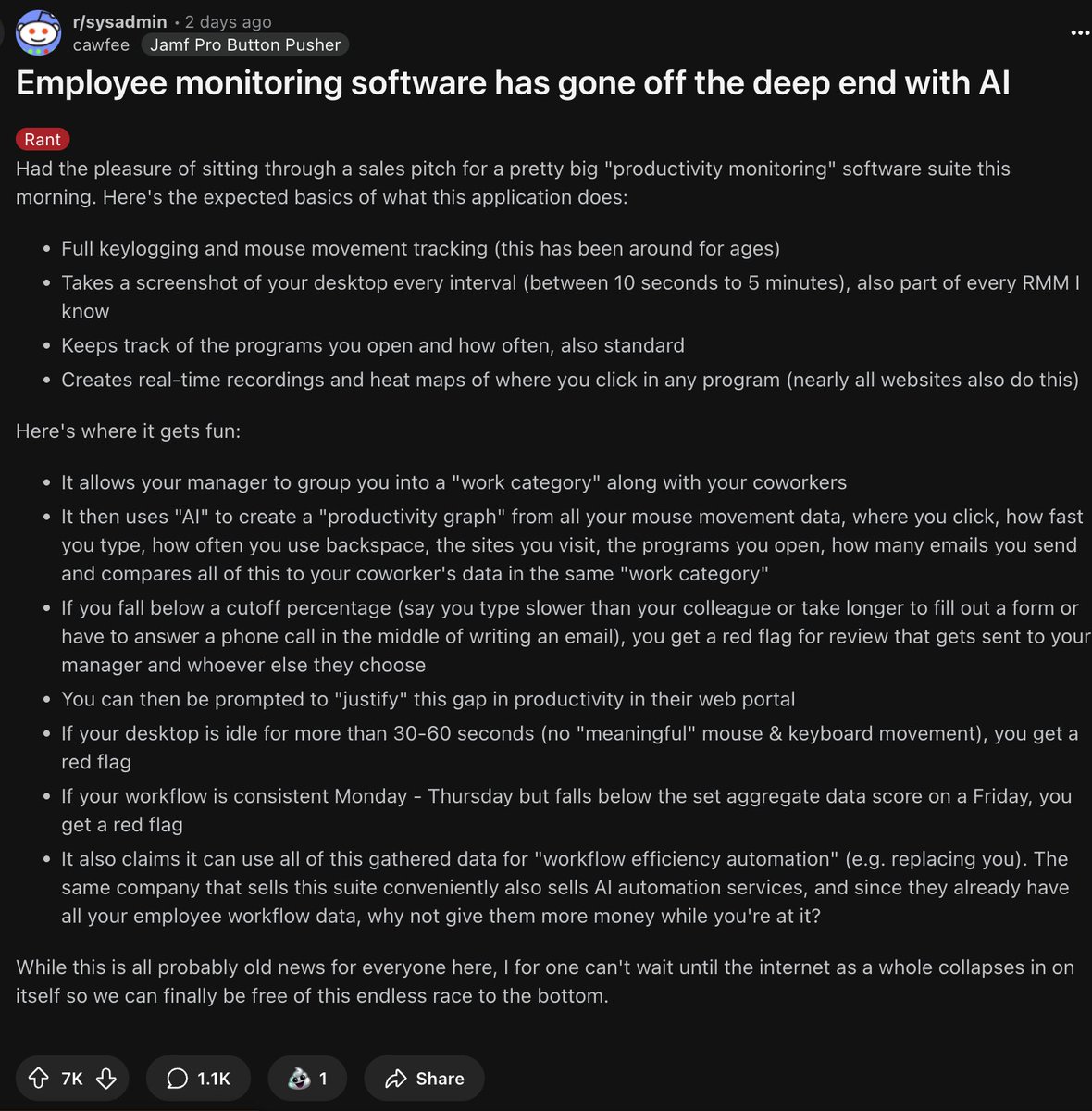
New workplace dystopia just dropped.
AI monitoring software now flags you if you type slower than coworkers, take >30sec breaks, or checks notes have a consistent Mon-Thu but slightly different Friday.
Bonus: It's collecting your workflow data to help automate your job away.