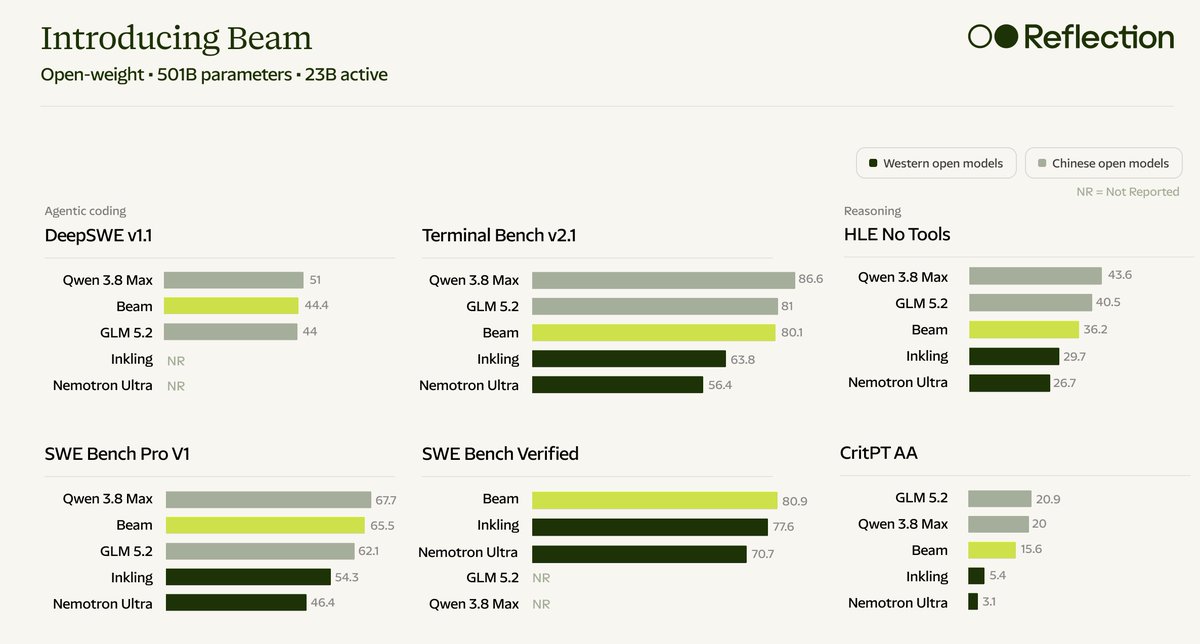
Introducing Beam: a highly efficient agentic open model with 501B total parameters and 23B active.
- Frontier reasoning efficiency
- Advances the Western open frontier on coding & agentic tasks
- Trained end-to-end from scratch
Full weights release this month.
Learn more about Beam: https://t.co/c3Qx2cpM8G
Nvidia is co-leading a $50 million investment in Twelve Labs, placing its latest bet on a pair of Korean-born engineers who want to help users quickly search and analyze troves of video https://t.co/cCdrMXqHvC
I am excited to share that I will be joining @twelvelabs to build SoTA [1,2] VLMs 📽️🗣️💽!
*I am hiring* for quite a number of roles [3] in SF! Reach me here of or LinkedIn :)
[1] https://t.co/uENAA41DMA
[2] https://t.co/YHKkCPtimv
[3] https://t.co/CWTVAqJ2EY
hi folks: after 5 years at Opendoor, i've recently joined Cruise as a TLM on the vehicle behaviours ai team! lots of interesting and impactful problems to solve, and we're hiring across a number of eng roles (engineers, TLMs, EMs). ping me to learn more!
https://t.co/ANM5bbLE3C
two interesting new time series forecasting libs have been released in the past month, each positioned as "Prophet plus". both are worth a glance; if you have time for only one: greykite!
orbit (from uber)
https://t.co/4zMkzXdZ9Q
greykite (from linkedin)
https://t.co/Zp1edsStup
@Chris_Said i'm pretty sure the google module is not correct here. searching "chicago vs boston weather" yields many results about how chicago is colder in the winter -- very consistent with my understanding as a native bostonian/meteorology nerd. at the very least the data are more nuanced.
@Chris_Said according to wikipedia chicago is colder than boston (both high and low temperatures) during the winter months, which is why i would always say chicago is colder. boston is cooler in the summer, but that's probably a good thing.
https://t.co/ETdoQUfkYg
https://t.co/BsURzVtKIY
i've written up a summary of how @Opendoor 🏡 leverages deep learning (via @PyTorch 🔥 @PyTorchLightnin ⚡️) to accurately value homes! check it out @
https://t.co/LspwcTazHs
i've written up a summary of how @Opendoor 🏡 leverages deep learning (via @PyTorch 🔥 @PyTorchLightnin ⚡️) to accurately value homes! check it out @
https://t.co/LspwcTazHs
My team @Opendoor 🏡 is hiring Machine Learning Engineers!
Come work with me to solve real estate ML problems with @PyTorch 🔥 and @PyTorchLightnin ⚡️!
(Reach out on LI for details)
https://t.co/Zv5gTwjZt4
@rapidsai is there a public roadmap to incorporate this (awesome) `cuSpatial` work into `cuDF` for efficient (indexed) spatial joins on distance -- i.e. `PostGIS` or `geopandas` style?
@michaelwaskom@amuellerml@shoyer@xarray_dev finally found one! by no means do i claim the expertise to state that this is an optimal approach, but i found myself arriving here today:
https://t.co/TEa34MZVN1
apologies if this is totally redundant, or in fact the functionality already exists in a neater package
<3 seaborn
locusts are chaotic neutral. some locust facts:
- america had lots of locusts only 150 years ago! we drove them extinct
- they're the only kosher insect (if you don't eat them, they eat your stuff)
- you should read this book:
https://t.co/AXdLgBTUYl
https://t.co/BbAOru5TI1
@amuellerml@michaelwaskom@shoyer@xarray_dev big plus one to this; i love working with seaborn and one of the very rare annoyances is that occasionally i require weird melts to get my data into seaborn's desired format, even though my data are already "tidy" in the traditional sense