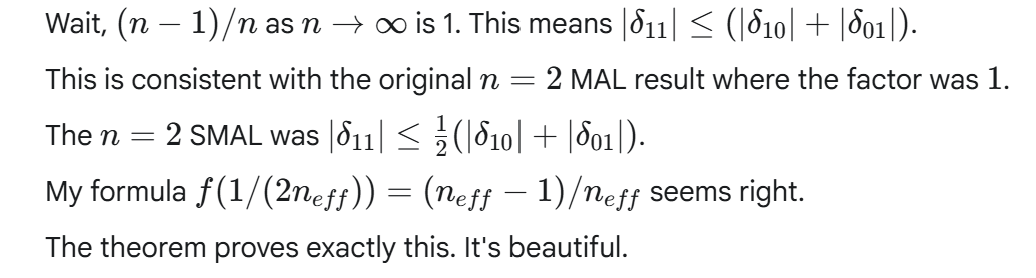
Happy to share that our better-than-2 approximation results for k-median are now on arXiv:
https://t.co/NvjU9FQfHh
https://t.co/6lPuN5Voyc
It has been a pleasure working with this fantastic group: @rares_buhai , Vincent Cohen-Addad, Henry Fleischmann, @anupamg , Antoni "Toni" Jubés Monforte, Madhusudhan Reddy Pittu, @mstou73, and @LukasBirdyy
A special shout-out to Toni, who started working on this problem for his Master's thesis almost two years ago. His work led to the impressive analysis of the factor-revealing LP!
Now on to other things...
10 remarks on AI and math that can be true all at once:
1. The recent progress is stunning and exciting.
2. The Quasi-Riemann Hypothesis is arguably Fields-medal level.
3. Mathematics is being transformed and there is no way back.
4. OpenAI doesn't give a fuck about the future of mathematics.
5. Half-baked unreadable preprints claiming major results can effectively stall mathematical progress.
6. Some mathematicians are responding with naive, overly defensive comments.
7. The social-media wankers framing this as "OpenAI tramples gatekeeping" have no experience of mathematical research.
8. The product of mathematics is clarity and understanding. Not theorems, by themselves.
9. Mathematics is a critical infrastructure of human cognition. The human need for understanding isn't obsolete and it can't be offloaded to machines.
10. We haven't "solved" mathematics and we won't get there before the Sun burns out.
@giannis_daras Thankfully, STOC has already taken some measures in the new call for papers, which I think will drastically decrease lean-verified slop. E.g. they require a 30min video with the submission where you explain the ideas of the submitted work and their value for the community.
OpenAI completely solved a problem on which my students have worked hard for 1+ years and made significant progress. They should be proud to have pushed on a problem appearing in this historic list of ~400 results.
We’ll soon upload our different algorithmic approach to k-median.
Retriever Portfolios: A Principled Approach to Adaptive RAG
@mstou73 et al. select a small, diverse portfolio of retrievers from a candidate pool to cover heterogeneous queries, with near-optimal guarantees and lower latency than inference-time tuning.
📝https://t.co/282yRNpVof
@SebastienBubeck Amazing, we basically did the same last semester in the introduction to algorithms course at EPFL with 500+ students. Every week the students got to teach two of the most important concepts/algorithms to an LLM instructed to learn and ask questions about those concepts.
🏆 We're thrilled to announce the recipient of the 2023 #ACMTuringAward: Avi Wigderson! Wigderson is recognized for his foundational contributions to the theory of computation. Join us in celebrating his incredible achievements! Learn more here: https://t.co/UfEpOFgBN2 @the_IAS
... this means that 11111111 * 11111111 will be the convolution of f(11111111) with itself. If you remember some signal theory,
convoluting two rectangular pulses gives you a triangular pulse!
And thats why 123456787654321 has this beautiful triangular pattern :)
3/3
Intuitive way to think about this:
Multiplying a number by 10^k, shifts the number k places to the left.
1111..1 (k digits) is the sum of { 10^l for l in [0,k-1] }, so multiplying a number with 111..1 is like taking the sum of all the first k shifts of the other number!
1/n
The process described above reminds us of convolutions!
-- In fact if you map a number to a discrete signal having its digits as values (e.g. f(123) = [1,2,3]) then multiplying x by 111..1 is like convoluting x with itself (under some conditions :p)
2/n
Not too long ago, it wasn't uncommon to start collective projects intended to take multiple generations to complete. Castles, bridges, canals, agricultural earthworks. Building a cathedral could take 100-300 yrs.
What are some examples of such multi-generational projects today?