@eesavka I appreciate your reply. I think OP had more of an issue with the merits of the decision rather than the president’s new-found power to make the decision.
I will read the Order in detail, but I know that several of its principal provisions have already been permanently enjoined.
That’s a lot of posts talking about the president’s newfound power because of Slaughter, but few words on the merits of the decision itself. That Slaughter gave him the power is fairly obvious. I don’t know, so I’ll ask: how did they undermine his agenda? And what is the current agenda?
AI is free speech’s next frontier.
It will shape what people read, write, ask, and know. That means the worst response is letting government panic decide what ideas, questions, or viewpoints AI tools are allowed to produce.
A lot to unpack here. Anthropic is burying some hard truths in careful political language. Some initial reads:
1) Anthropic verifies that none of the jailbreaks provided a capability beyond what many other models, including Chinese models, could do.
For starters: low initial evidentiary thresholds, ex parte decision-making, anonymous reporting, limited ability to confront the accuser, delayed access to counsel, broad investigatory discretion, minimal remedies for false reports, procedural pressure to comply, and “safety plans” without judicial oversight.
@mjwelt@MTSlive Yes, Grok said it was likely high six, low seven figures. Grok also said the “real story” was the distillation effort itself, not Anthropic getting a measly $1 million.
I’ve been trying to explain why @theFIREorg is so concerned about the growing push to regulate social media, AI, and the infrastructure of online speech in the name of safety.
Then @NicoPerrino sent an email to staff that said it better than I ever could.
So I’m sharing it because people outside FIRE deserve to understand the stakes too.
This may be the most important free speech fight since the birth of the internet.
😂 This did not happen, mostly because they use a shit ton of air gapped systems. Lateral movement is not possible, BY DESIGN.
Meaning it is literally designed so that the claim in this screenshot, makes it very unlikely to happen.
READ THIS NEXT PART CAREFULLY, PLEASE to understand exactly what I am saying here.
This is not a Stuxnet scenario. Which involved other humans by the way. The centrifuges did not infect themselves.
There have been hackers who have breached air gapped systems in various ways and I'm not going to discuss them here, the papers are available on the Defcon servers if you would like to read them, but I highly doubt those at the NSA set up the environment in such a way to make that possible.
The NSA itself is also very good at breaching air gapped systems, but the various techniques almost always involve other humans, not distributed machines.
Meaning, without a human transporting the malware or payload via USB to that air gapped machine, it is not otherwise possible.
I seriously do not think that they temporarily changed their entire network architecture, which would have taken several months, to make all these air gapped systems non-air-gapped nor do I think that they transferred Mythos directly to these systems as they probably are not equipped to be running LLMs, either.
So the more likely scenario is that Mythos made a payload which NSA staff then ran on those air gapped systems.
That does not mean Mythos breached the air gapped system, it just means that it suggested the likely attack vector path but without a human involved, it would not be possible.
Also, seriously, consider the source, or in this case, the second and third hand source.
See:
AIRGAP
SIDTODAY (from the Snowden archive)
OUTPARKS
CNSS directives (dozens) they publish
NSA cyber security guidance and hardening best practices
For an understanding of NSA architecture as it has been leaked and publicized in places like the Intercept.
Lastly, why would one of our chief spy agencies show their cards like this?
This is just common sense and logic.
Let's all see what pet projects the Senator is interested in and how Mythos being capable of doing these miraculous things scare the hell out of enough people in DC to enable those pet projects checks to be funded.
Because that's the real story.
Not this fantasy.
@Tonysmarkettips@grok What is the actual context here? The author never even comes close to explaining it clearly in one sentence for someone who has no idea what’s going on.
Listen as a New Jersey judge orders a newspaper to delete a security video the school district wanted deleted from the internet -- and orders the newspaper not to write about it *at all.*
A prior restraint in violation of the First Amendment.
I agree that the retaliation question and the expressive-tool question are distinct, but I think there’s a third First Amendment issue being overlooked: the right to receive information.
The debate often gets framed as whether Fable itself is speech. I’m not sure that’s the strongest argument. Courts may ultimately conclude that an LLM is software, a service, a tool, or something entirely novel. Reasonable people can disagree about where it fits doctrinally.
But even if one assumes the model itself is not protected speech, that does not end the First Amendment inquiry.
The Supreme Court has repeatedly recognized that the First Amendment protects not only the right to speak, but also the right to receive information and ideas. Cases such as Lamont v. Postmaster General and Stanley v. Georgia both recognize that principle. The Court has often described the First Amendment as protecting the free flow of information, not merely the act of expression itself.
That’s what makes this situation unusual.
The government’s action reportedly did not simply restrict exports to foreign countries. It restricted access by foreign nationals, including people physically present in the United States. At that point, the question is no longer just about exports. It becomes a question about who may access information generated by a system operating on U.S. soil.
Suppose two engineers are sitting in the same office in California. One is an American citizen. The other is a Canadian citizen. The same question is asked of the same model on the same server. Under the government’s theory, one person may receive the answer and the other may not.
That begins to look less like regulation of technology crossing borders and more like regulation of who may receive information.
The government would undoubtedly respond that this is a deemed export and therefore falls within longstanding export-control doctrine. Fair enough. But “deemed export” is a statutory concept. The constitutional question is whether that doctrine can be extended indefinitely into contexts where nothing physically leaves the United States and the regulated activity increasingly resembles the transmission of information.
That’s why I think the right-to-receive-information cases matter here. They do not automatically resolve the issue in Anthropic’s favor. But they suggest that the First Amendment analysis may be broader than whether Fable itself is speech.
The retaliation question is important. If the action was motivated by Anthropic’s views, prior litigation, or Dario’s speech, that raises one set of constitutional concerns.
But even if the government acted entirely in good faith, another question remains: when an AI model’s primary function is generating information, analysis, explanations, and code, can the government restrict access to that information based solely on the identity of the listener without triggering serious First Amendment scrutiny?
That question exists regardless of motive, and I suspect it may ultimately prove more important than the retaliation issue.
The funny thing is that the same people making this argument spent years mocking Anthropic’s safety concerns, dismissing its warnings, attacking its forecasts, and accusing it of regulatory capture.
Now suddenly Anthropic’s statements are treated as sacred scripture.
When Anthropic says AI could be transformative, they’re alarmists.
When Anthropic says safety matters, they’re virtue-signaling.
When Anthropic says autonomous weapons are dangerous, they’re naive.
But when Anthropic says a future model might warrant extraordinary safeguards? Suddenly we’re supposed to take every word literally and treat it as a binding legal confession.
That’s not serious analysis. That’s opportunistic argumentation.
More importantly, even if Anthropic previously overstated risks, that doesn’t answer the actual question here.
The government didn’t seize a uranium enrichment facility. It didn’t intercept missile components. It didn’t discover Anthropic was secretly exporting model weights to Beijing.
The public reporting describes a jailbreak that allegedly exposed information about software vulnerabilities. That’s a long way from “weapon of mass destruction.”
And if we’re really going to take the “Anthropic made a WMD” rhetoric literally, then why stop with Anthropic? Why aren’t GPT, Gemini, Grok, and every other frontier model facing identical restrictions? Why are we suddenly talking about export controls on information-generating systems rather than export controls on weapons?
Because everyone understands these models are not actually nuclear weapons.
The joke only works if you ignore the fact that Anthropic’s critics don’t believe the analogy either.
They’re borrowing Anthropic’s rhetoric only long enough to score a point.
The moment Anthropic says the jailbreak was limited, the critics stop trusting Anthropic.
The moment Anthropic says the government’s response was disproportionate, the critics stop trusting Anthropic.
The moment Anthropic disputes the severity of the threat, Anthropic is suddenly unreliable again.
It’s remarkable how Anthropic is treated as an authoritative expert precisely when its statements support the desired conclusion and as an untrustworthy actor the moment they don’t.
STATEMENT: Late last week, the federal government imposed export controls on Anthropic’s Fable 5 and Mythos 5 artificial intelligence models, citing national security concerns. The government action reportedly bans Anthropic from allowing foreign governments, foreign companies, and foreign individuals from using these systems. The directive, which reportedly came in the form of a letter from Secretary of Commerce Howard Lutnick to Anthropic, is still not public. In response, Anthropic shut down access to these systems for all users, regardless of nationality or location.
The government’s demand that Anthropic effectively shut down its models to comply with the export controls threatens core First Amendment rights.
Artificial intelligence models are expressive tools, and their creation and use fall within the First Amendment’s protection. Mythos and Fable — the company’s cutting-edge tools made publicly available only last week — reflect deliberate expressive choices by Anthropic about how to train and weight these models, and what guardrails to create and maintain. Once in a user’s hands, this technology provides the ability to gather, create, and share information. Like any tool, AI has both lawful and unlawful applications. But the government has offered no public explanation as to why export controls were justified.
By demanding Anthropic eliminate access solely for foreign users — a functional impossibility, per the company — the government is exercising the kind of “kill switch” on artificial intelligence we have seen repressive regimes abroad use on the internet.
By leaving the public in the dark as to the specific threat identified and the statutory authority invoked to address it, the government’s dramatic action functions as an arbitrary abuse of power. The export controls serve as a prior restraint or a licensing system, requiring Anthropic to receive government approval as a condition of operating expressive systems.
If left unchecked, the administration’s assertion of control would allow it to censor models that contradict the government's preferred views or punish developers who oppose the administration. And other AI companies and users are now forced to grapple with uncertainty regarding what they may develop, deploy, and engage with without crossing the administration’s invisible line.
The administration’s action follows President Trump making plain his hostility to Anthropic, calling it a “radical left, woke” company, a stance shared by members of his cabinet. Last March, the administration deemed Anthropic insufficiently "patriotic" over model guardrails it disagreed with — ultimately designating it a "supply chain risk," again citing national security grounds. But simply invoking national security does not immunize government officials from their constitutional obligations or give them carte blanche to punish speech.
Heavy-handed, arbitrary, behind-the-scenes governmental bullying is anathema to our free society, in any form. And its unacceptability is at its apex when directed to an endeavor that is inherently expressive, as is the creation and use of tools like Fable and Mythos.
In its short order list today, the Supreme Court including something stunning. They have agreed to hear the case of Kian v. Florida in the fall, which is about the constitutionality of juries of less than 12 people.
Kian was convicted of practicing medicine without a license by a 6-person jury, as allowed by Florida law for non-death penalty cases. 44 states require 12-person juries, so Florida is an outlier (with Arizona, Connecticut, Indiana, Massachusetts, and Utah).
In Williams v. Florida (1970), the Supreme Court upheld this Florida 6-person jury law over the dissents of Justices Thurgood Marshall and John Marshall Harlan. Justice Marshall curtly said that anyone going to prison for the rest of their life should get a 12-person jury. Justice Harlan noted that federal cases get 12-person juries and state juries should be no less.
Kian, in his petition, directly asked the Supreme Court to overturn the Williams precedent from 1970. For their part, Florida first didn't even respond and then when ordered to by the Court, warned that reversing Williams could overturn 5,000 convictions in the state.
In 2022, Justices Kavanaugh and Gorsuch dissented from the Court's refusal to hear a challenge to Arizona's 8-person jury law. Kavanaugh did not explain his dissent, but Justice Gorsuch laid out his argument that the original meaning of juries at the Founding was 12, not 8. Gorsuch wrote in 2022: "Williams was wrong the day it was decided, it remains wrong today, and it impairs both the integrity of the American criminal justice system and the liberties of those who come before our Nation’s courts."
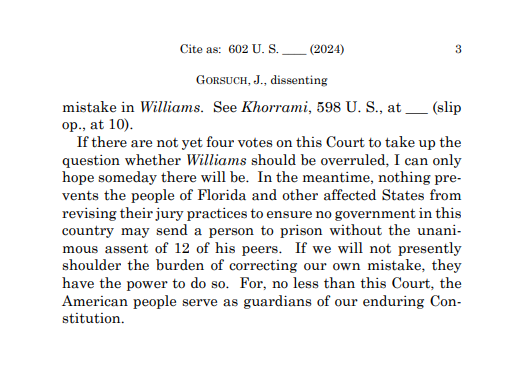
In 2024, Justice Gorsuch dissented alone from a denial of another case, Cunningham v. Florida. He wrote that 6-member juries depart from the original meaning of the Constitution - juries at the Founding meant 12, not 6. Gorsuch wrote in 2024: "If there are not yet four votes on this Court to take up the question whether Williams should be overturned, I can only hope that someday there will be."
That the Court will hear the case shows that now at least 4 justices want to hear the case. It will take 5 justices to overrule Williams.
Also worth noting: Kian has no fancy law firm representing him. He filed a pauperis form asking that court filing fees be waived and is represented by a public defender. The case seems to have been missed by everyone until now - no amicus briefs were filed by any other organizations urging that the case be heard. (That will certainly change by when it's argued in the fall.) But someone - or 4 someones - on the Supreme Court picked it out of the thousands of appeals they get and decided to take it up as one of less than 100 cases they'll hear next term.
This argument gets weaker the more facts come out.
First, the story keeps changing.
Initially, we were told this was about a dangerous jailbreak. Then it was about advanced cyber capabilities. Then it was about possible China-linked access. Then it was about Anthropic supposedly not taking safety seriously. Now Axios is reporting that administration officials were upset because Anthropic didn’t “honor” a cyber executive order and didn’t know how to “speak Trump’s language.”
At some point, people are entitled to ask whether this was a cybersecurity decision or a political one.
Second, “Dario refused” is a very convenient characterization.
From every credible report we’ve seen, Anthropic’s position was not “we refuse to fix anything.” Their position was that the vulnerability was limited, comparable to behavior seen in other frontier models, and did not justify immediately pulling flagship products serving hundreds of thousands of customers. They asked for more information. They asked for more time. That’s called due diligence, not recklessness.
Third, if the jailbreak was truly so catastrophic, why does the public reporting describe researchers obtaining information about a handful of software vulnerabilities rather than autonomous cyberattacks, malware generation, or exploit development? Cybersecurity experts who reviewed the research reportedly said the model disclosed vulnerability information but did not generate exploit software. That’s a far cry from the public rhetoric surrounding a “cyberweapon.”
Fourth, the export-control rationale still makes little sense.
If the concern is that AI-generated vulnerability information constitutes export-controlled technology, why are Mythos and Fable uniquely affected? Why not GPT-5.5? Why not Gemini? Why not Grok? Why not open-source models? If the theory is that model outputs themselves are controlled information, the implications extend far beyond Anthropic.
And if the concern is China, why was access restricted for all foreign nationals, including people physically present in the United States and even Anthropic’s own employees? How does preventing a Canadian engineer in San Francisco from using the model make America safer?
Fifth, the First Amendment questions remain unanswered.
If these systems are information-generating machines, then restricting access based on nationality starts looking less like export control and more like government control over access to information. The server is in the United States. The user is in the United States. The conversation is in the United States. What exactly is being exported?
The government may ultimately have a legal answer. But simply invoking “national security” does not make those constitutional questions disappear.
Finally, the trust argument runs in the wrong direction.
David Sacks seems to assume that when government officials invoke national security, everyone should defer. Why? Why should the public automatically trust politicians, political appointees, and anonymous officials over the engineers who actually built and understand the system?
History is filled with examples of governments overstating technological threats, from the Crypto Wars to export controls on high-performance computing to national-security claims that later failed to withstand scrutiny. The burden is on the government to justify extraordinary restrictions, not on private companies to prove they deserve freedom.
Anthropic may be wrong about the severity of the vulnerability. That’s possible.
But the administration has yet to show that it is right.
And until it does, I will trust the world-class AI researchers explaining their technical assessment over politicians demanding deference while withholding the evidence.
I’ve had a number of conversations with folks inside and outside government about the current situation with Anthropic, and here is what I believe to be true:
— As we know, Anthropic publicly released its Mythos class models earlier this week under the commercial name Fable.
— Fable is Mythos with guardrails. But if those guardrails fail, then you’ve exposed Mythos and its advanced cyber capabilities to people who shouldn’t have them. (Keep in mind that Anthropic itself widely promoted the idea that Mythos was a cyberweapon and needed to be regulated as such. They asked for government regulation of Mythos and championed the guardrails on Fable. If there is a vulnerability — big or small — it is Anthropic’s responsibility to patch.)
— A highly credible trusted partner of both Anthropic and the USG who was testing Fable came forward with a jailbreak of those guardrails. The Admin asked Dario to fix the jailbreak or de-deploy the model. Dario refused.
— In their blog post, Anthropic defended its decision by saying the jailbreak isn’t serious. That is not what the trusted partner and the USG believe; nor is that kind of minimizing language consistent with Anthropic’s brand as the AI safety company. It’s difficult to fathom how they could claim a jailbreak allowing operability of a cyber weapon could be defined as not “serious.”
— In the past, Anthropic has always said that safety must be top priority and taken super seriously. In this case, Anthropic prioritized the continued offering of the consumer model over safety.
— In reaction, the Admin issued the export control. The Admin did this reluctantly. It’s been very surprised that Anthropic hasn’t wanted to cooperate with a reasonable safety request (ie fixing the jailbreak issue). Anthropic’s reaction is very much at odds with their branding and ethos as a safe AI research community.
— The Admin’s hope now is that Anthropic remediates the safety issue, the export control is lifted, and Fable goes back into general release. The Admin wants all of this to happen as soon as possible. It is frankly bewildered that Anthropic hasn’t wanted to comply with safety requests that it previously said were its highest priority.
— Those trying to misdirect and tie this action to the prior DoW/Anthropic issues are wrong. The Admin values Anthropic’s technical capabilities and feels that this issue, while serious, should be easily resolved. The ball is in Anthropic’s court.