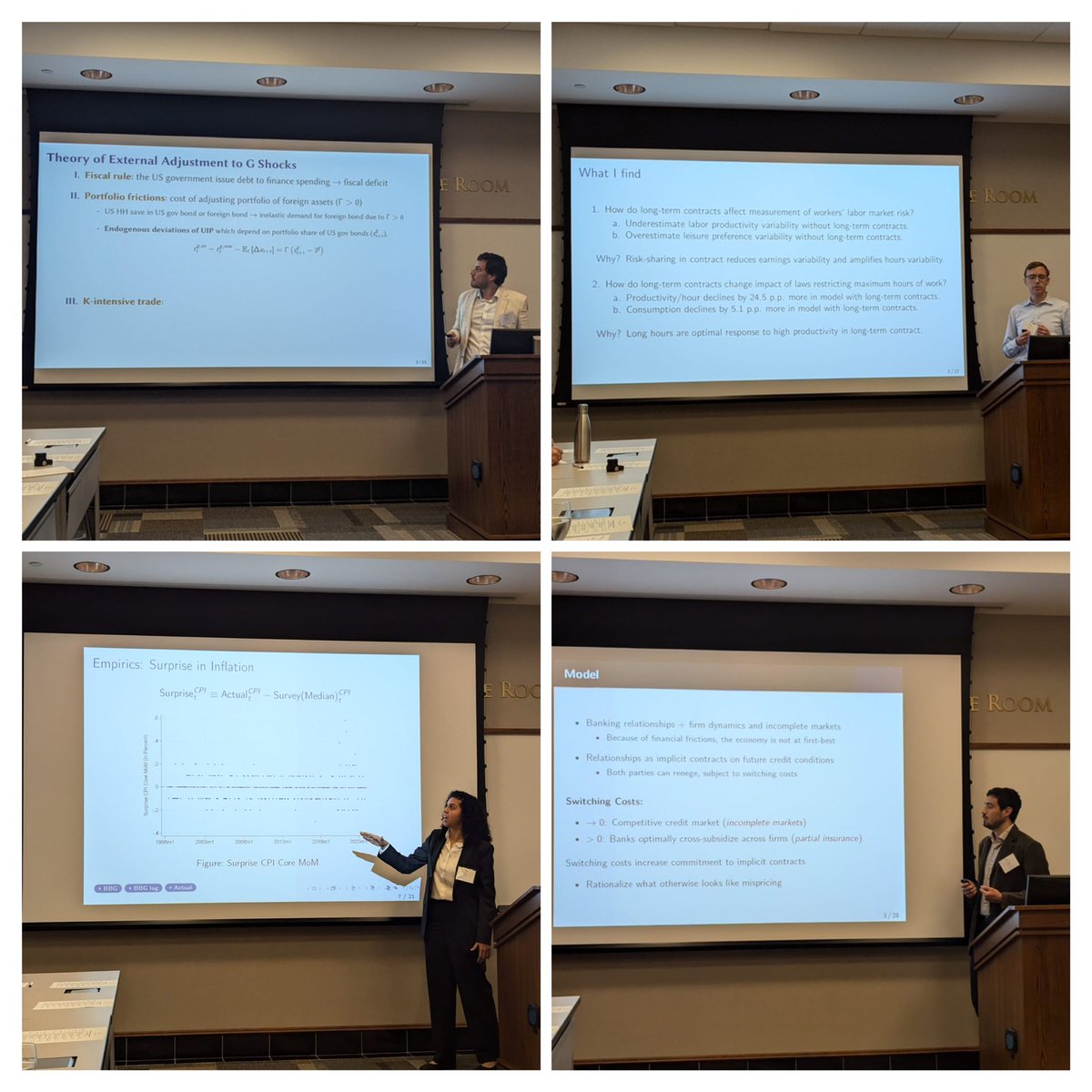
@julipulgamboa’s JMP studies how external borrowing shapes public and private investment in developing countries. She shows that its benefits depend on countries’ initial capital. Really great work, check her JMP!
https://t.co/FSjFylorsC
Should IMF limit foreign borrowing by governments of developing nations?
@UMN_Econ JMC Juliana Gamboa-Arbelaez @julipuligamboa argues any such restrictions need to depend on conditions in the country and how the government spends borrowed funds.
https://t.co/iVJ85CphNF
Carlos JMP studies how firms adjust their input suppliers in a multi-country, multi-industry trade model with changing transport costs and risk. He’s a great economist and an amazing coauthor. Check out his work!
https://t.co/LrlWBQ8CUe
How do global value chains evolve over time?
@UMN_Econ JMC Carlos Bolivar analyzes how firms change intermediate input suppliers in 43-country, 56-industry world trade model with changing transportation costs and stochastic country-industry productivity.
https://t.co/ofdxWJGBo6
@scott_sommers56 has a great JMP showing how land regulations and climate risk shape agricultural productivity and misallocation. Really impressive work, check his job market paper!
https://t.co/VaMSoXYe0D
Why is agricultural productivity in India so low?
@UMN_Econ JMC Scott Sommers @scott_sommers56 argues weather shocks magnify land market restrictions as source of misallocation in agriculture. He uses micro data to build model of heterogeneous farmers.
https://t.co/GPr4FM1oJl
How does IMF intervention after sovereign default help debtor country?
@UMN_Econ JMC Teresa Balestrini @mtbalestrini evaluates differences post default for countries that restructure within IMF program versus those that directly negotiate with creditors.
https://t.co/tuDcjB22Pv
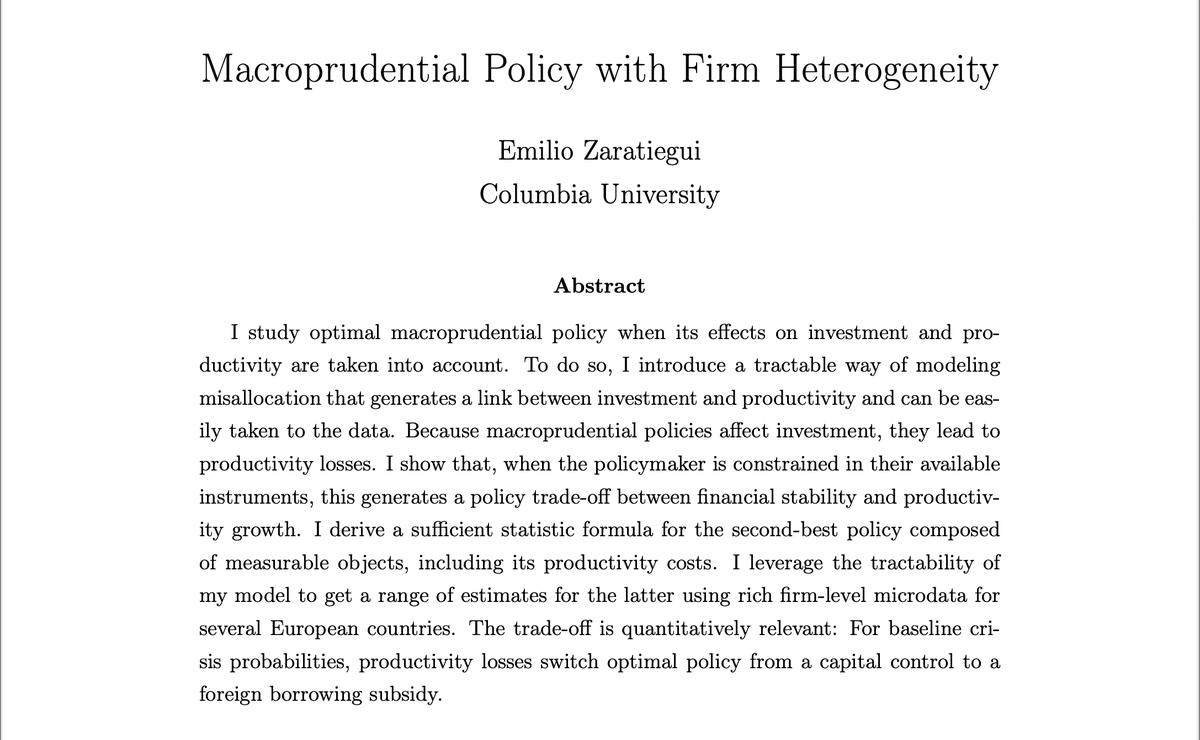
Emilio is a Columbia University JM candidate. His JMP studies macroprudential policy and its trade-offs between financial stability and productivity. He shows productivity losses can shift optimal policy from k controls to foreign borrowing subsidies.
https://t.co/r1FHtO5VCJ
I am on the Job Market!
In my JMP, I study optimal capital controls considering previously overlooked effects on investment and productivity using a sufficient statistic approach
Estimating productivity losses using microdata, I find that capital flows should be incentivized
🧵
Gabriel @gaboto94 , a @UMN_Econ JMC, studies how inflation affects household savings, aggregate capital, and informality. Using a model calibrated to Latin America, he shows rising inflation increases informality and reduces capital.
Check his website: https://t.co/82pKqLIn69
Why does Latin America suffer from high inflation, high informality, and low financial intermediation?
@UMN_Econ JMC Gabriel Devoto's @gaboto94 hypothesis: Government’s use of inflation as fiscal tool causes informality and low financial intermediation.
https://t.co/0nKsVYuWY1
Mauricio is a UMN job market candidate. In his JMP, @ba_mauz studies how climate impacts food prices and income distribution. He shows trade frictions amplify local price increases, and better roads could help mitigate welfare losses.
Check his website: https://t.co/LLRf9tJcUA"
How will climate impact poor households in developing countries?
@UMN_Econ JMC Maurico Barbosa-Alves @ba_mauz constructs a model of Brazil in which high temps lower crop yields and agricultural incomes but poor road networks also increase food prices.
https://t.co/2GMS9SUJFE
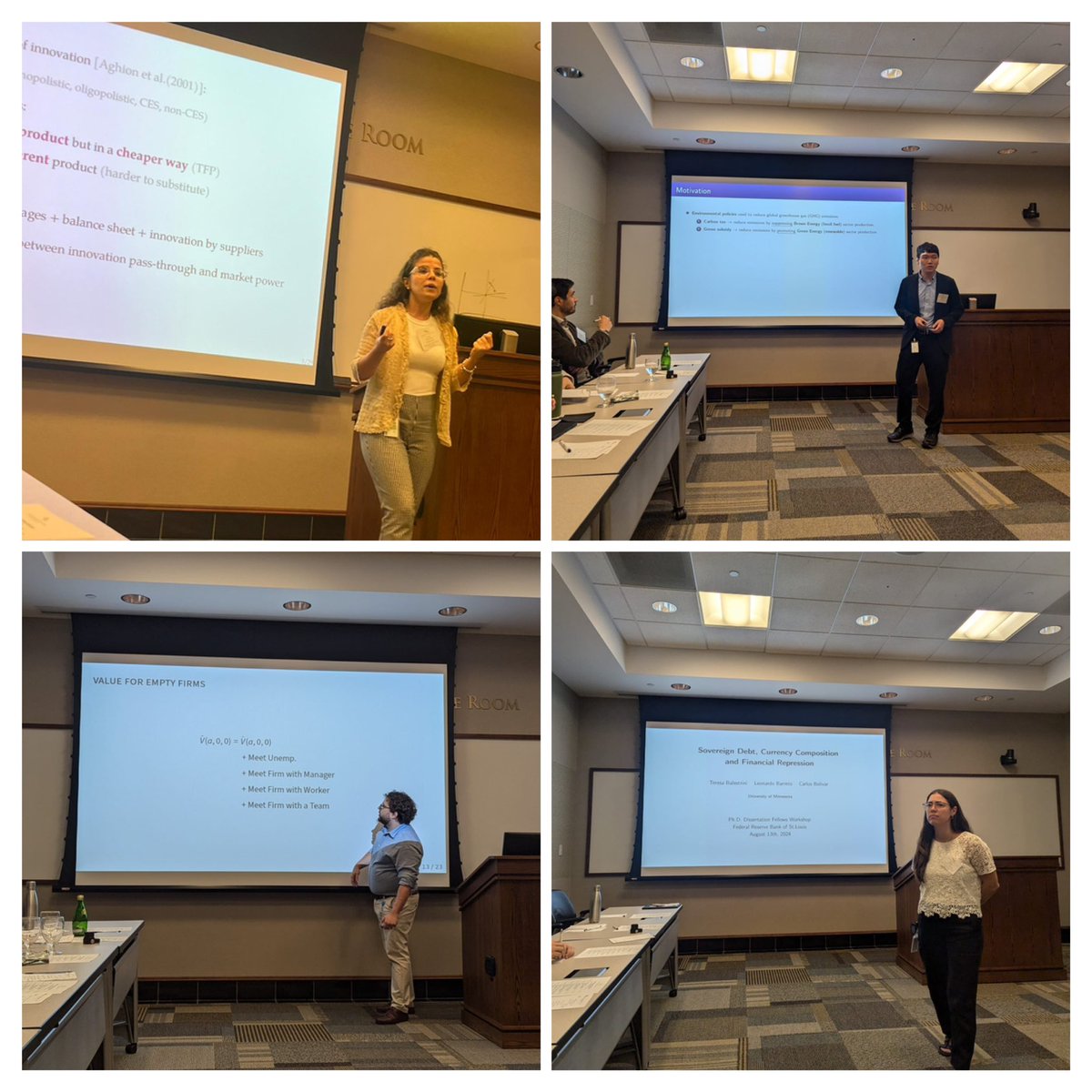
Had a great month at @stlouisfed ! Grateful for the opportunity to present our research, for all the helpful feedback, and the chance to meet and learn from other PhD fellows.
📢 Happy to share an update on “A Debt Crisis with Strategic Investors: Changes in Demand and the Role of Market Power”
🔗: https://t.co/0b5Vck55Fa
🧵A thread:
On June 26 UMN will confer its Outstanding Achievement Award on Andreu Mas-Colell. Andreu earned his PhD here in 1972.
We honor him for achievements as economic researcher, builder of academic institutions, and leader in graduate education in economics.
https://t.co/3KW9YADkgh
Marta , a JMC at UAB and BSE, studies the role of wage expectations in the labor market in her JMP. She finds that in expan periods, agents underestimate future wages increasing the effect of prod shocks on the labor market.
Check @Marta_g_rguez webpage
https://t.co/hQjJX6Aq4h
Can small deviations from rational expectations make large differences in macro models?
@IDEA_UAB JMC Marta García-Rodríguez @Marta_g_rguez shows search & matching model with internally rational agents fits US labor market data better than RE model.
https://t.co/Jb6qPUCXks
Simeng @zeng_simeng , UMN JM candidate, studies resource misalloc's impact on tech investments and trade gains in developing countries. Trade lib promotes innovation but may reduce welfare gains due to distorted R&D. She stresses need for structural reforms to max trade benefits.
In what order should government of developing country do policy reforms?
UMN Econ JM candidate Simeng Zeng @zeng_simeng candidate argues that taxes and subsidies that distort firm structure in countries like China decrease or eliminate gains from trade.
https://t.co/dUPxJCDpNw
Entian is a UMN job market candidate. In his JMP, @EntianZ explores the impact of financial frictions on trade. He finds that these lead firms to source from countries where they can make small and frequent orders.
Check Entian’s website
https://t.co/V9gP31yNRo
How do firms form international value chains?
UMN Econ job market candidate Entian Zeng @EntianZ argues Chinese manufacturing firms that face financial constraints source imports of intermediate goods from suppliers who make small, frequent shipments.
https://t.co/H8amR4dwpq
He finds that in repeated auctions, especially with default risk, the uniform price model offers better government prices via improved borrowing incentives and investor protection, outweighing the insurance mechanism of the discriminatory protocol.
Braulio is not just an exceptional economist but also the most generous friend you'll ever have. His JMP is about the interplay between climate change and international migration, revealing intriguing findings from Guatemala.
Braulio is a UMN job market candidate. In his JMP, he explores how climate change impacts international migration. He finds that climate change increases the appeal of migration as rural productivity falls, but credit constraints lead to a short-term decrease in migration rates.
Why do caravans of immigrants from Central America cross Mexico to try to enter U.S.?
Braulio Britos @BritosBraulio, a UMN job market candidate, argues climate change in countries like Guatemala makes agricultural workers need to look for work elsewhere.
https://t.co/2rD7mqULJT