Spinal extradural arachnoid cyst surgery. Profound redundant arachnoid, mercifully small dural defect. Mysterious that some pts have orthostatic HA and others compressive myelopathy.
Dilemma addressed by @MarkMamloukMD@Niklas_Luetzen recently PMID 40441881
@francisdeng@issclsociety Wish I hadn’t forgotten to hit record on the scope… amazing how redundant and billowing the arachnoid was from a relatively small rural opening. Bone thinning (on CT from 5 yrs earlier) attests to chronicity/congenital nature, just tipped over the symptomatic ledge.
Contemplated this case while traveling to inaugural @issclsociety mtg. Pt in 20s w numb/weak BLE with bend/twist. Never HA.
Spinal extradural arachnoid cyst
Analagous to a Type II CSF leak
Straightforward OR... Resect extradural arachnoid, close small dorsal dural defect
@CWong94262 Nice tool, not available here in the US. Not sure I agree about critical stenosis with minimal gradient and normal SSS pressures
Tendency to stent-adjacent stenosis could be another distinction between extrinsic (where it def happens), intrinsic, and CVST-induced IIH
Curious about experiences stenting IIH post-CVST?
Despite diffuse stenosis and irregular walls, even crossing jugular bulb, I've had great results in pts w recalcitrant papilledema.
Route92 half-cath w Tenzing delivery assist is transformational technology for sinus stenting.
@kasireddy398 Thanks! With CVST, they’re often on anticoagulation at baseline.
I still use DAPT, simple asa325 and plavix75 daily for 3mos. No p2y12 testing, eventually taper down to asa81
@visishs@BAFOUND@cvsection@SNISinfo I thought terminus/A1 looked most suspicious on DSA, but ACoA bled with minimal manipulation. You’re right I could have inspected/clipped the basilar but there was so little post fossa blood that I was pretty convinced it hadn’t bled
Which of these aneurysms do you think ruptured? Based on imaging? Based on intra-op findings?
I'm still not certain. I initially deferred the basilar, ultimately took hybrid approach to cure all
@BAFOUND@cvsection@SNISinfo
Seeing some great new studies for the first issue of JNIS Advances, from stroke to surgery and from new devices to outcome prediction. Submit your work now for rapid, expert peer review and a chance to be included in vol. 1 no. 1! https://t.co/g4TJW37UmV @SNISinfo@JNIS_BMJ
@visishs@PennNSG@cvsection@YoungNIR I can count on one hand the number of times I’ve used multiple arterial access points. Are you using that approach often? Allcock maneuver and a big injection could also capture it
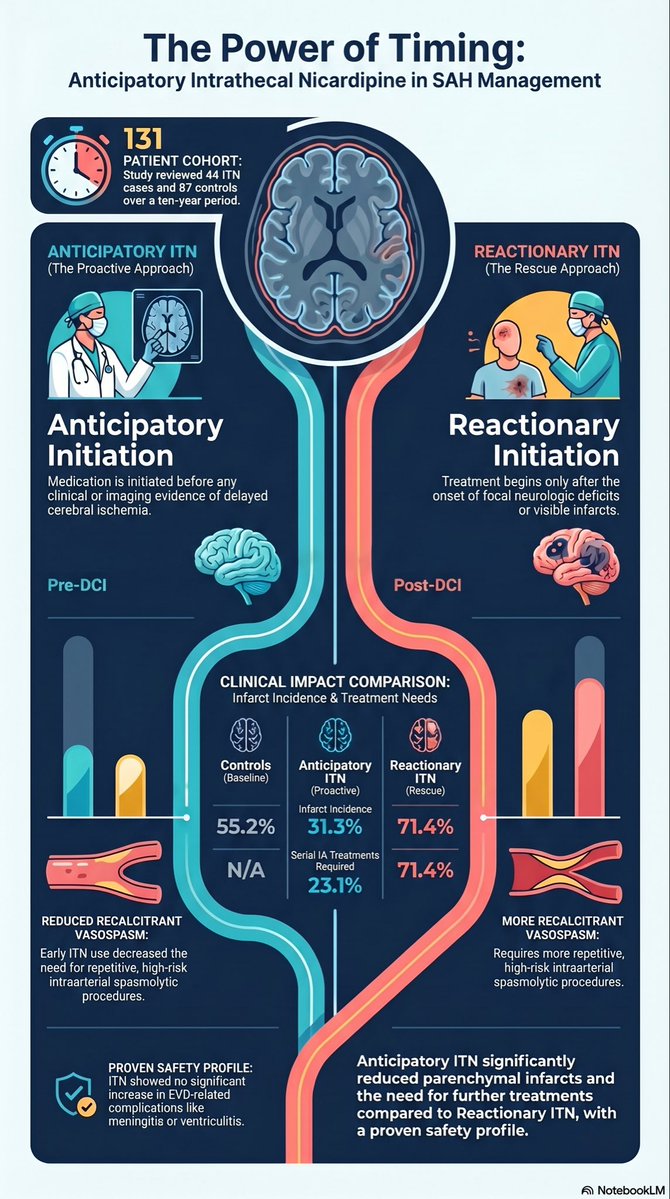
🚨 New study in Clinical Neurology and Neurosurgery on aneurysmal subarachnoid hemorrhage (aSAH) management 🩸 🧠
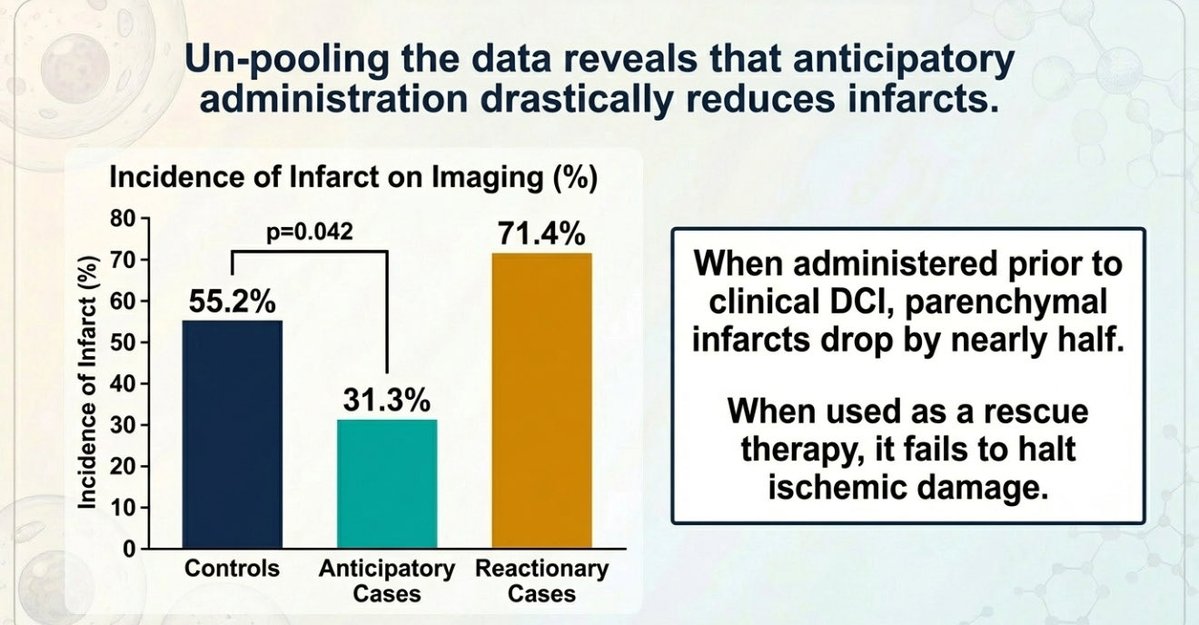
Anticipatory initiation of Intrathecal Nicardipine (ITN)—given before clinical or imaging evidence of delayed cerebral ischemia (DCI)—significantly reduces DCI parenchymal infarcts compared to controls (31.3% vs 55.2%).
Key findings:
📉 Starting ITN prior to intra-arterial (IA) spasmolytics significantly lowers the need for serial IA treatments for recalcitrant vasospasm from 71.4% down to 23.1%.
🛡️ It is a safe intervention with no increased risk of EVD-related complications or meningitis.
⚠️ Timing is everything, because reactionary ITN given after DCI onset did not reduce the rate of additional infarcts or the need for serial IA treatments.
Question: Does this article change your practice?
#NeuroTwitter #NeuroCriticalCare #SubarachnoidHemorrhage #Vasospasm #NeuroSurgery
https://t.co/t09vQGuY3W