Hard problems have a way of pushing innovation further.
Frank Ostojic, SVP and GM of our ASIC Products Division, shares why tackling complexity with creativity can lead to differentiated solutions—and lasting advantage for customers.
Thanks to @Skift for naming Archer the winner in the Travel Technology category at this year's IDEA Awards.
Good recognition of the important role electric air taxis play in the future of travel.
Today, we signed definitive agreements to acquire @WiskAero, @skygridai, and @Insitu_Inc from @Boeing, with Boeing taking a stake in Archer and becoming a strategic partner. We anticipate closing the transaction by year end.
Wisk will accelerate our Halo/Thunder dual-use aircraft platform. Deploying nascent tech early in defense benefits our entire business. Wisk has some of the most advanced autonomy, flight controls, and sensor technologies in the industry. We plan to deploy that technology on Halo first, so that we can harden it and then bring it back to the air taxi platform when the FAA is ready to certify autonomy for passenger air taxis.
Insitu is an incredibly trusted and reputable intelligence, surveillance, and reconnaissance drone manufacturer. They operate a profitable business with over $200M in annual revenue across 35 countries and they’ve manufactured 4,000 Group 2 & 3 UAS to date. For us that means an immediate revenue base to grow plus data from 2M autonomous flight hours.
SkyGrid is complementary to ZEE, our new foundation AI model for aviation that we recently announced. SkyGrid has been in use as next-generation airspace management solutions since 2018 and we believe that when combined with Zee it can become a “must have” air traffic management product that helps modernize airspaces around the world.
This transaction will help accelerate our evolution into becoming a diversified aerospace and defense platform. After closing, our product portfolio will span piloted air taxis, unmanned aircraft systems (UAS) in Groups 2 through 5, purpose-built AI for aviation, and the vertical technology stack for autonomous flight.
https://t.co/qI8O4sNKs6
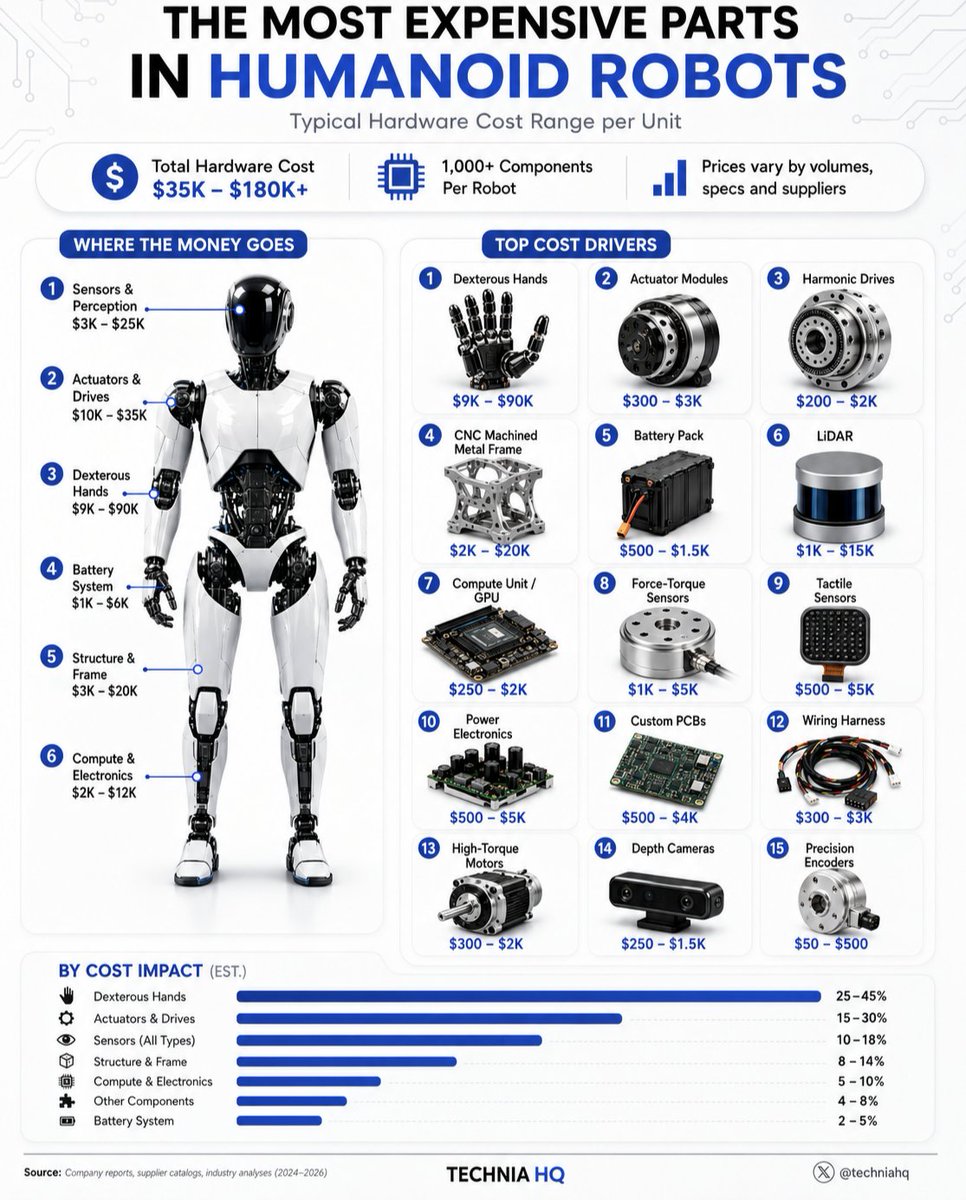
The most expensive parts in humanoid robots are not the cameras.
The real hardware cost is hidden in the parts that move, carry load, survive impact and repeat the same motion thousands of times without failing.
Typical hardware cost range per humanoid robot:
• Dexterous hands
➝ $9K–$90K
The hardest part to make cheap. Each hand needs small actuators, tendons or linkages, tactile sensing, finger joints, wiring and control boards packed into a very small space.
• CNC metal frame
➝ $2K–$20K
The skeleton must hold motors, batteries, electronics and impact loads. Low volume machining makes this expensive, especially for torso, hip, shoulder and leg structures.
• LiDAR
➝ $1K–$15K
Used for mapping, navigation and obstacle detection. Cost depends on range, resolution, scan type and whether the robot needs outdoor reliability.
• Force-torque sensors
➝ $1K–$5K
Critical for balance, manipulation and safe contact. These sensors help the robot measure pressure through wrists, ankles or joints.
• Tactile sensors
➝ $500–$5K
Needed when a robot must grip soft, fragile or uneven objects. The cost rises fast when sensors cover fingers, palms or large skin-like surfaces.
• Actuator modules
➝ $300–$3K each
One of the biggest cost drivers. A humanoid can use dozens of actuators across legs, arms, waist, neck and hands. Torque, cooling, gearbox quality and control electronics change the price fast.
• Battery pack
➝ $500–$1.5K
The battery must deliver high current while staying compact. Weight is a major constraint because every extra kilogram makes the legs work harder.
• Compute / GPU
➝ $250–$2K
The robot needs onboard compute for vision, control, planning and sensor fusion. Higher autonomy requires more compute, better thermal design and more power.
• Harmonic drives
➝ $200–$2K each
Used where compact high torque is needed. They are expensive because precision, backlash and durability matter in knees, hips, shoulders and wrists.
• Power electronics
➝ $500–$5K
Motor drivers, converters, protection circuits and power distribution decide how stable the robot is under heavy motion.
• Wiring harness
➝ $300–$3K
Humanoids have cables moving through arms, legs, torso and neck. Bad routing means broken wires, noisy signals and hard maintenance.
• Precision encoders
➝ $50–$500 each
Every joint needs position feedback. Better encoders give smoother motion, better balance and more accurate manipulation.
A serious humanoid robot can still carry $35K–$180K+ in hardware before software, assembly, testing, repair stock, certification and support.
That is why the cheapest demo robot is not always the cheapest robot to deploy.
Archer Aviation’s battery powered air taxis aren’t likely be certified by year-end, according to people familiar with the matter, meaning passenger flights won’t occur before the start of 2026 https://t.co/uPSBy9DeY2
Join our next spectrometer webinar on October 2!
We’ll explore our spectrometer roadmap, dive into real-world use cases, and share design best practices for industrial integration.
See how our technology can be seamlessly integrated into your solutions: https://t.co/p3SZnrzJ7z
Looking forward to hosting our next webinar on October 2 that explores the Broadcom Spectrometer roadmap, use cases, and design best practices. We offer a full suite of industrialized compact UV/Vis & NIR Spectrometers and we will have product line managers leading the conversation and an opportunity for Q&A.
I hope you can join us!
Link to register: https://t.co/8OjNzVsGk1
Playing around with an idea for a connectorized version of the ARK 4IN1 ESC. MR30's for the motors and threaded M2.5 surface mount standoffs for battery.