In case you were wondering, NVIDIA semiconductors are critical to industrial offshore wind infrastructure. They are used by Siemens Gamesa and GE Vernova, companies integral to US offshore wind development.
The following projects use NVIDIA technology:
Vineyard Wind
Revolution Wind
Coastal Virginia
South Fork Wind
Sunrise Wind
So, what happens when something goes Huang?
Jensen Huang resigns as Nvidia CEO amid affair allegations; Colette Kress named interim CEO
https://t.co/Dvw7c84Jbm
Scumbag politicians and union heads LIED to rank and file blue collar workers, and children who were recruited for work in the industrial offshore wind sector.
The promise was thousands of good paying union jobs. The reality: dozens of temporary nonunion jobs.
People like Chuck and Sheldon and heads of IBEW, LIUNA and ironworker locals lied their asses off as they pocketed money from the foreign offshore wind companies.
The US offshore wind manufacturing boom that wasn’t
https://t.co/3jKQboiXJz
That misstates what the science found. Menhaden were not found to be overfished, and overfishing was not occurring.
The 50% quota reduction figure concerned meeting an ecological reference point target, calculated through a model to leave enough menhaden as food to support striped bass at the Board’s population goal.
Exceeding that target does not mean menhaden are being overfished.
Peer reviewers approved the model but also called for further testing of assumptions about fish populations, predator diets and how predators switch to other prey. Those assumptions help determine the target and how much catch the model recommends. Approval did not mean that work was finished.
The Board approved 170,000 metric tons for 2027 and 155,000 for 2028, roughly a 9% reduction followed by another 9% reduction.
The larger cuts discussed were about meeting the model’s target, not a finding that halving the quota was necessary to save stripers and ospreys from menhaden overfishing.
Striped bass recovery also requires addressing the fish being caught directly. ASMFC reports that recreational fishing accounted for about 82% of estimated striped bass deaths caused by fishing in 2025, counting both fish kept and fish that died after release.
That mortality has to be considered alongside food supply.
ASMFC’s own explanation says that even ending all menhaden fishing would not, by itself, rebuild striped bass to their population target.
Offshore wind is an energy source that disappoints at every turn.
South Fork Wind nameplate capacity 132 MW. Never achieved more than 60 (less than 50%).
https://t.co/wd4QL1V1wj
Credit: @KenAd60
@Barbarajdurkin@SenBlumenthal@SecMullinDHS@FCC Skyborn is Blackrock, they purchased Global Infrastructure Partners two years ago and put their head of their board Bayo Ogunlesi, on the board of Blackrock. Fink and Ogunlesi both started at First Boston together.
The Jersey Shore has seen whales and dolphins thriving in our waters since the departure of Industrial energy giant Orsted in 2023.
@RobertKennedyJr@POTUS
American farmers and fishermen work their asses off. It’s dangerous, dirty, difficult work that literally feeds America.
There’s nothing about industrial offshore wind that should ever be mentioned in the same breath as farming.
Commercial fishermen across all fisheries need to stand united. When one group is targeted by unfair decisions and regulations not backed by science, it affects us all. We must stand together and make our voices heard for the future of our industry.
Join us at the ASMFC Annual Meeting!
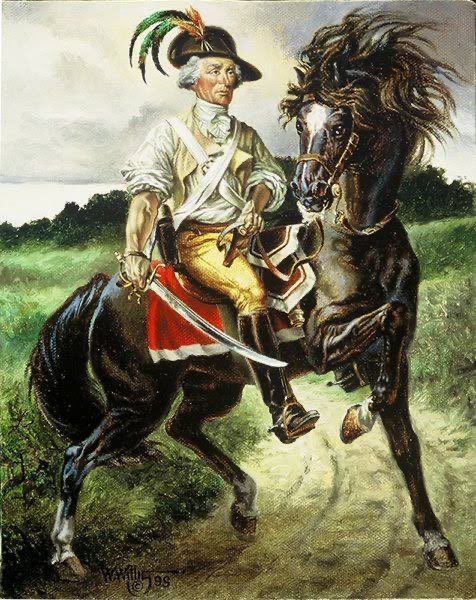
The South Carolina Gamecocks are named after a Revolutionary War general the British couldn’t catch.
In 1780, the British captured Charleston and seemed to have South Carolina beaten. Thomas Sumter, a retired militia officer, was out of the war until the British burned his plantation.
Sumter raised his own band of backcountry fighters and went to war. He was a master at guerrilla warfare. He raided, ambushed, struck British outposts. Then vanished, again and again.
According to tradition, the British gave him his nickname, saying he fought like a gamecock, the fighting rooster that never quits.
At Blackstock’s Farm in November 1780, he fended off Banastre Tarleton himself.
The name stuck. Around 1900, a Columbia newspaper started calling the University of South Carolina’s football team the Gamecocks after him and it became official.
The university carries on his legacy every Saturday on the football field.