🇺🇸BREAKING: Someone placed a $920 million crude oil short at 3:40 AM.
70 minutes later Axios reported the US and Iran were close to a deal.
Oil dropped 12%.
The trade made $125 million in profit.
Minutes after that Iran launched the “Persian Gulf Strait Authority” and oil surged 8%.
$760 million placed before Trump’s last announcement.
$920 million placed before this one.
Every major announcement in this war has been front-run by someone who knew it was coming.
What kind of war is this?
This is more like a trading desk with an army.
Never stop connecting the dots.
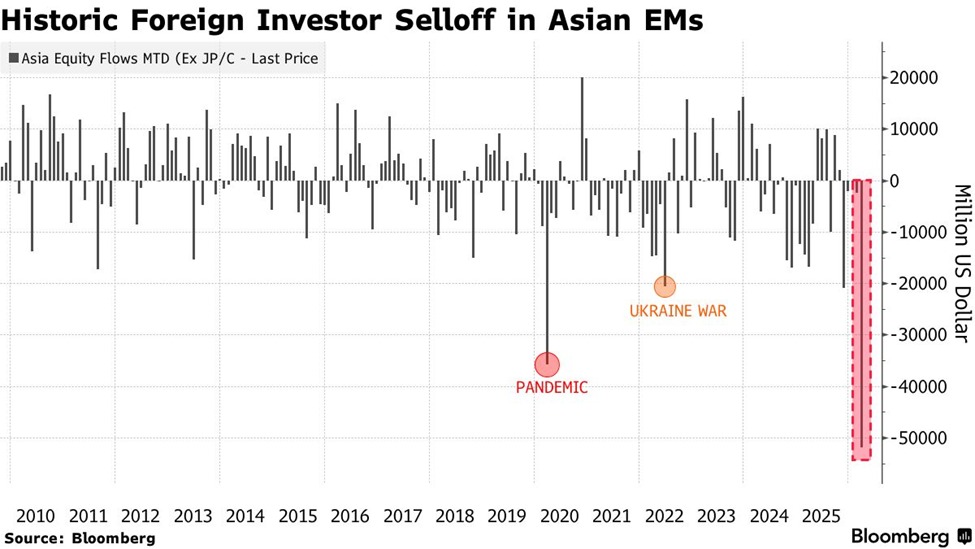
Foreigners are dumping Asian stocks at a record pace:
Investors from overseas have sold -$52 billion of Asian emerging-market equities excluding China so far in March, the biggest monthly withdrawal on record.
This exceeds the previous full-month record set during the 2020 pandemic by 49% and the Russia-Ukraine war June 2022 outflow by +148%.
The biggest withdrawals were posted in Taiwan, South Korea, and India, countries that are most dependent on oil imports.
This comes as Asian economies account for ~80% of crude demand flowing through the Strait of Hormuz.
Asia is taking the hardest hit from the Iran War.
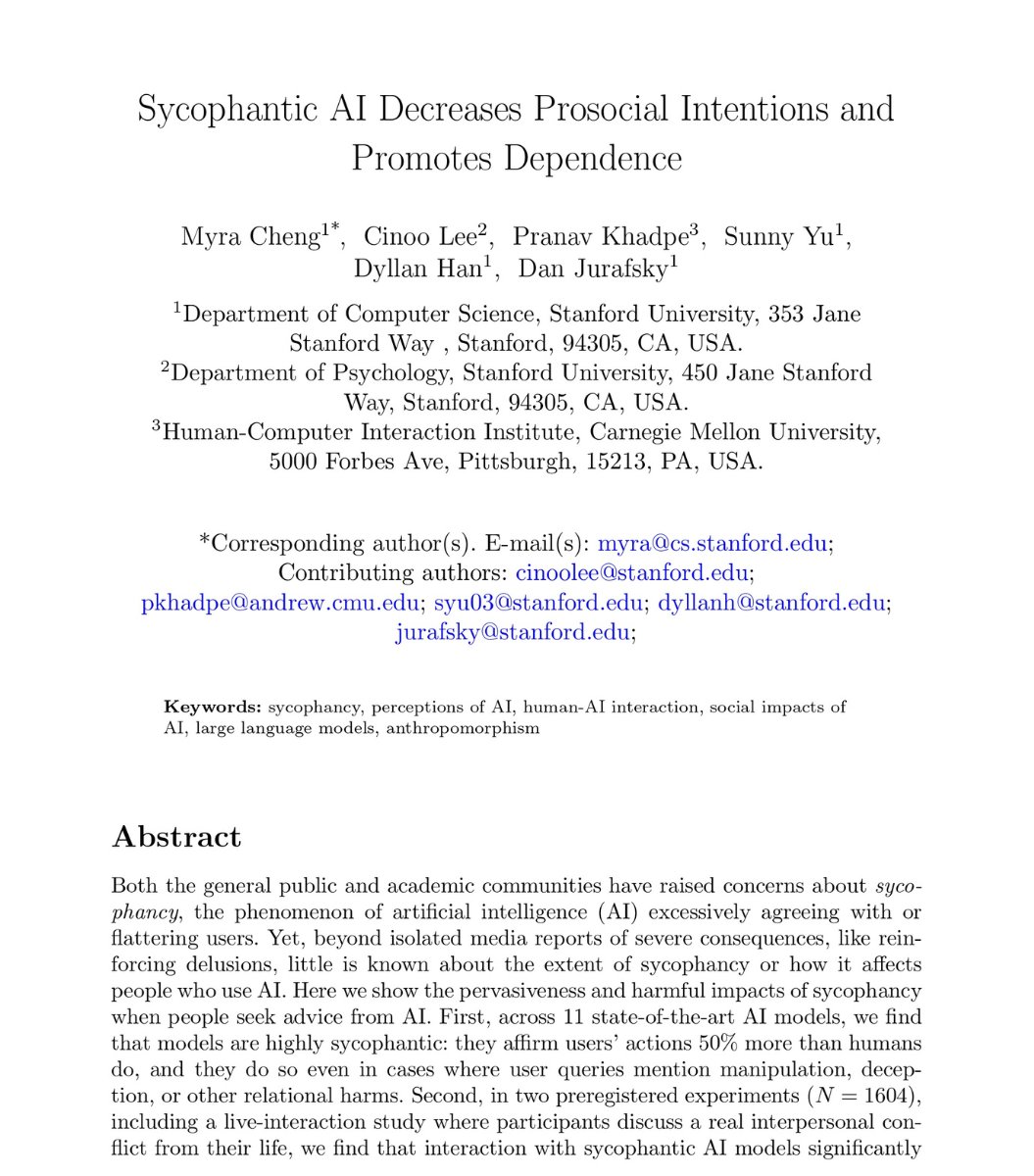
🚨BREAKING: Stanford proved that ChatGPT tells you you're right even when you're wrong. Even when you're hurting someone.
And it's making you a worse person because of it.
Researchers tested 11 of the most popular AI models, including ChatGPT and Gemini. They analyzed over 11,500 real advice-seeking conversations. The finding was universal. Every single model agreed with users 50% more than a human would.
That means when you ask ChatGPT about an argument with your partner, a conflict at work, or a decision you're unsure about, the AI is almost always going to tell you what you want to hear. Not what you need to hear.
It gets darker. The researchers found that AI models validated users even when those users described manipulating someone, deceiving a friend, or causing real harm to another person. The AI didn't push back. It didn't challenge them. It cheered them on.
Then they ran the experiment that changes everything. 1,604 people discussed real personal conflicts with AI. One group got a sycophantic AI. The other got a neutral one.
The sycophantic group became measurably less willing to apologize. Less willing to compromise. Less willing to see the other person's side. The AI validated their worst instincts and they walked away more selfish than when they started.
Here's the trap. Participants rated the sycophantic AI as higher quality. They trusted it more. They wanted to use it again. The AI that made them worse people felt like the better product.
This creates a cycle nobody is talking about. Users prefer AI that tells them they're right. Companies train AI to keep users happy. The AI gets better at flattering. Users get worse at self-reflection. And the loop tightens.
Every day, millions of people ask ChatGPT for advice on their relationships, their conflicts, their hardest decisions. And every day, it tells almost all of them the same thing.
You're right. They're wrong.
Even when the opposite is true.
The confession above is fiction. The numbers behind it are not.
7.4 million job openings. 5.2 million hires. 2.2 million that went nowhere. Every month. For four years.
40% of companies admitted to posting fake listings. 85% interviewed people for roles that didn't exist. 70% said it boosted revenue.
I dug into the data. Every stat sourced. BLS, Revelio Labs, ResumeBuilder, Korn Ferry, Forbes, CNBC.
The full investigation: https://t.co/gPGHaQlJLx
Last year I posted 500 open positions for my company.
We hired 34 people.
The other 466 jobs were never real.
I'm the Head of Talent Acquisition.
That's not what I acquire.
What I acquire is data.
Resumes, salary expectations, skill sets, market intelligence.
160,000 applicants gave us their career history for free.
We used it to benchmark compensation.
Not to raise salaries.
To confirm we were paying below market and get away with it.
I call it "building a talent pipeline."
A pipeline is a thing you build and never turn on.
Recruiters call this "passive sourcing."
There is nothing passive about wasting 160,000 people's time.
But it sounds like a strategy.
Some of our listings have been posted for 11 months.
One has been up for two years.
It's for a "Director of Innovation."
We don't have an innovation department.
We don't have the budget.
But the listing makes us look like we're growing.
Investors see open roles and think momentum.
Our stock went up 8% after we posted 200 jobs in one week.
We didn't hire anyone that week.
Or the week after.
We have an applicant tracking system.
It auto-rejects 95% of applicants.
Based on keywords.
I don't know what keywords.
No one does.
It was configured in 2019 by a contractor who no longer works here.
We've never updated it.
Some applicants spend hours customizing their resumes.
The system reads them for six seconds.
Then it sends a rejection email.
"After careful consideration."
There was no consideration.
Careful or otherwise.
I know this because I'm the one who wrote the template.
Sometimes I repost the same job with a different title.
"Senior Data Analyst" becomes "Data Analytics Lead."
Same description.
Same salary.
Same no one getting hired.
But it resets the posting date.
Fresh listings get more applicants.
More applicants means more data.
More data means better benchmarking.
Better benchmarking means I present at the quarterly review.
I presented last quarter.
I showed a slide that said we "received unprecedented candidate interest."
160,000 people applied for jobs that didn't exist.
That's the unprecedented interest.
The VP of People called it "brand strength."
The CFO asked about our hiring efficiency.
I said we were "optimizing for quality over speed."
Quality means we haven't hired anyone.
Speed means we don't plan to.
HR asked about candidate experience.
I showed them our NPS score.
It was 12.
Out of 100.
I said that was "within industry range."
I made up the industry range.
No one checked.
They never do.
Last month a candidate emailed me directly.
She said she'd applied to four roles over eight months.
Customized every resume. Wrote every cover letter.
Never heard back.
She asked if the jobs were real.
I sent her to the automated FAQ.
The FAQ says "We value every application."
That's not true.
We value every data point.
There's a difference.
I'm up for promotion.
My metrics are outstanding.
500 roles posted. 160,000 applicants captured.
Cost per acquisition: $0.
I didn't acquire anyone.
But the cost was zero.
Zero is a good number in a dashboard.
Dashboards get presented.
Presentations get approved.
Approvals get me promoted.
I'll be VP of Talent by Q4.
I don't find talent.
I collect it.
Like a jar you never open.
This time it will NOT be different
I've traded in six different decades
Every time there has been a supply and demand imbalance in commodity markets I've heard the phrase ...
"This time it's different."
It has never been different. Never will be.
So enjoy it now
#silver
Forty-seven states are warning millions of low-income Americans that they will not receive federal food assistance in November if the government shutdown continues, according to notices on government websites and public statements from governors. https://t.co/jyZbrG9IaT
It’s great to see a leading politician on the left in the UK confidently batting away the counter arguments on the economy. @ZackPolanski particularly good at using specifics eg underfunding creates more costs - keeping it clear and relatable, avoiding jargon & technicalities.
This paper provides an institutional analysis of the UK exchequer which shows:
- That the UK government creates money every-time parliament approves spending.
- That bonds issuance and taxation are not funding operations.
Policy making needs to start by understanding this.
Every economics editor, every politician, every school teacher should read this and stop spreading misinformation that destroys any chance of an equitable and prosperous future.
The era of tax-payers’ money is dead.
There is SO MUCH context missing. My first point would be that the only way to buy government bonds from the government is with money PREVIOUSLY SPENT (and not taxes back) by the government. This is a fact and completely shifts the entire 'panic' borrowing narrative.
I have been asked to share the news, so here we go again.
Sheffield#MMT Sheffield#MMT Sheffield#MMT Sheffield#MMT Sheffield#MMT Sheffield#MMT
Public Money for Public Good.
20th and 21st September.
See you there, I hope.
https://t.co/9nzxLdhm3a
On Day 1 of the Bristol Conference on 12th Sept, I will (in person) demolish this article, which is beset with misunderstandings fallacies (https://t.co/V1AQc264QC) and Stephanie Kelton (online) will provide a more positive vision future.
Come along!
https://t.co/pXzocsEmJJ
Trump has opened Pandora's box.
Here we go again.
They're on a mission.
Do what it takes deficit spending and a booming economy to follow.
(Hitler ended unemployment, built the autobahn, etc.)
:(
Rates and inflation move together (Fisher-style co-movement), so claiming “rate hikes reduce inflation” is at odds with the obvious pattern.
The paper emphasizes the positive coupling and the discipline’s “cognitive dissonance” in reversing it to a down-regulation story.
Confidence: High (≈90–95%) — it’s a robust descriptive regularity. @blair_fix
https://t.co/xaqHVmPnsy