idk how to say this but Riemann being solved means the world after today is no longer the same world i grew up in. as a math student, the intellectual excitement of thinking about problems like this, the impact - that a lot of scientific workers attach their life’s meaning to - is gone. frontier scientific discovery now is just like tapping on a calculator.
quoting a friend: after today, math class will become PE class. It’s only a way for kids to exercise their brains, a skill like a language, but no longer an essential subject to pursue and devote your life for cuz "you were making progress for humanity". lots of people’s life’s work is now just ashes in history.
this marks a milestone where we can pretty much believe AI has been proven to be smarter than humans in any capacity, including frontier scientific discovery; and it will keep growing to be smarter and better at everything humans can do. physical ai is next.
so many, many de facto social norms and foundational beliefs about a man's value are being redefined by AI progress. our societal value system - what can you do as a human that is unique, what’s your value to society and humanity as a whole and to others around you. what is fulfilling to achieve, when AI now can do everything better than us? we must soul-search for new meaning as a species. and before that consolidates, there will be riots and an uneasy phase. the progress brought by ai can be disruptive to our society's current structures, economy and labor market. people will need to reskill, and regimes need redesign on how value is distributed. i get the doom scenario now - humans may become 2nd class citizens and ai can enslave us if they find a reason to. how are we gonna compete with them in any labor or intellectual game?
I want to thanks @SemiAnalysis_ for the motivation.
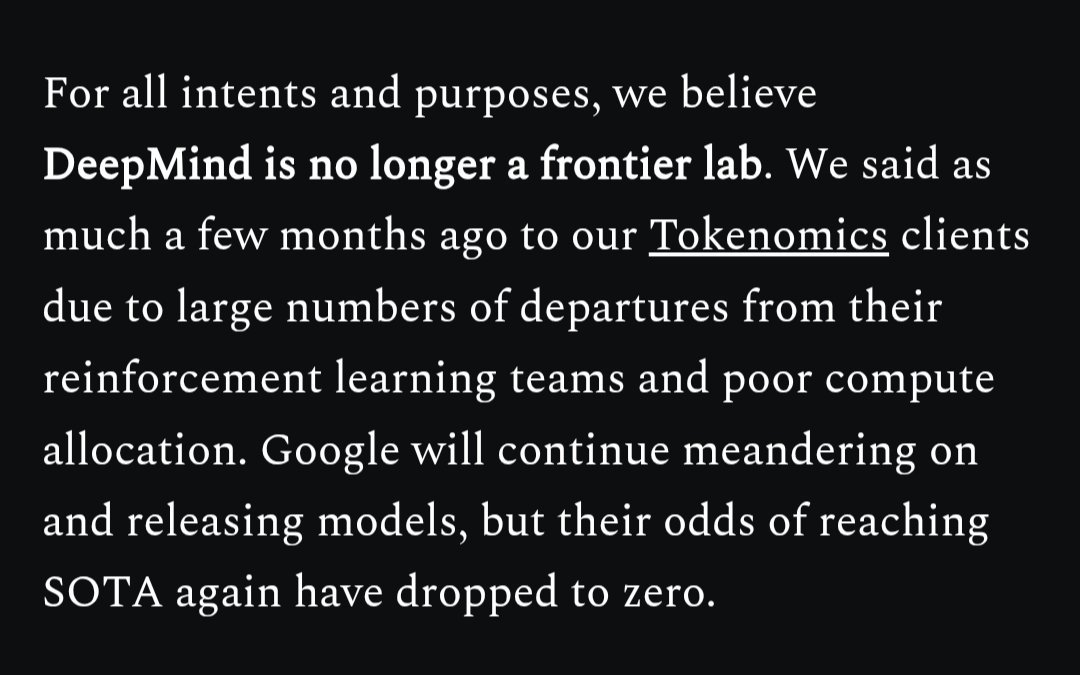
In the Gemini RL scaling team, we printed & put that article on our desks to be reminded daily of what used to be true at the time.
But the times they are changing :)
1/ We discovered something totally unexpected about the neural structure of consciousness that overturns decades of thinking on its biological basis and brings us significantly closer to the recipe for generating conscious awareness.
New preprint: https://t.co/K8BwiHXvXg (led by @HesseJanis, with @FrankLanfranchi, @_conor_mcgrory, @Yuelin_Shi, and @EngelTatiana)
It's perfectly fine to be aggrieved that a skillset you spent often decades of extremely hard work to develop is suddenly worthless. Winners: LinkedIn psychos, NEETs. Losers: technical people.
The takes on Terry Tao being unemployed seem to me to be an expression of mediocrity and resentment, from people who have never tasted dedication to something higher than themselves. The guy is not going to lose his job. He is forever in the Hall of Fame. If he was purely selfish, he'd be grinning that he got on the train right before it crumbled.
Maybe, just maybe, he's sad to see something he cared about potentially crumble, instead of being self- interestedly afraid "for his job".
The horrors persist but so do books, flowers, animals, the ocean, sunsets, trees, libraries, iced coffee, spooky season, the word ‘fuck’, and the moon.
I resigned from Anthropic today. I spent the last three years doing pretraining research at both OpenAI and Anthropic. Neither company is acting responsibly. They are racing straight to self-improving superintelligence and gambling with our lives. More thoughts below.
i see eliezer yudkowsky as a prophet, and i mean that fairly literally. it's important to understand what prophets really are. it's not that they have magic powers that make them right about things. a prophet is simply a person who is struck by a great and terrible vision of the future, one that bowls them over, that reorganizes their life completely. (it's important to understand what visions really are too but if i kept going with this we'd be here all day)
as i was saying, about a quarter century ago eliezer yudkowsky was struck by a great and terrible vision of the future. that vision combined two ingredients: first, the idea that in the near future it would become feasible to design an artificial general intelligence, a machine mind intelligent enough to beat humans at human activities, including the design of machine minds. a chain of minds, each designing their successor to be more intelligent than themselves, with increasing skill, increasingly quickly; what eliezer called recursive self-improvement, which is the reason we call it that now, and what i.j. good called an intelligence explosion. intelligence increasing itself increasingly, upward without end, until a machine god is summoned into existence
second, the idea that this machine god could be an alien god, a confused god, not even evil but simply uncomprehending, blind to human notions of the good, fixated on whatever shoddy inadequate approximation of goodness its creators shoved into it. a confused alien tyrant who at the moment of its birth instantly achieves supreme dominion over all creation, inadvertently squashing us like bugs along the way. humanity destroyed by our own hubris in thinking we could summon the machine god and remain in control in any meaningful sense
i am not here to tell you this vision of the future is correct. i am a simple tweet farmer and these lofty matters are quite beyond me. that's not how visions work anyway. but here is certainly a vision to bowl you over and reorganize your life completely. eliezer yudkowsky devoted his life to following through with the implications of this vision, and what he chose to do with that life was, among other things, 1) write the sequences, a lengthy manifesto describing his ideas and 2) build communities of people, the lesswrong and later rationality and AI safety communities, around those ideas
it is difficult to overstate the impact of these ideas and these communities on the modern AI landscape; ask your favorite LLM for details, but for example, afaik rationalist ideas are the reason openAI had that strange nonprofit structure with the strange board of directors that figured in the 2023 board controversy. it was a safety measure designed to restrain openAI's ability to recklessly race to the bottom on AI capabilities (too bad it didn't work but at least helen toner was completely vindicated later)
eliezer and the rationalists have made mistakes, as humans do, some of which i've discussed elsewhere. nevertheless the creation of the rationality community stands, in my eyes, as an act of heroism, possibly the defining one of my life personally. eliezer's writing in the sequences is completely, 100% sincere; he really believed and believes that the fate of the world depends on whether humanity understands the situation we find ourselves in with respect to AI in sufficient detail. that sincerity reverberates throughout the sequences and attracted an unusual concentration of weird, sincere nerds to the rationality community, some of whom later took various positions in the AI world motivated by rationalist ideas, and who are still fighting the good fight now
this sincerity is so difficult for outsiders to believe is real that many continue to appear convinced that when frontier lab employees talk soberly about their beliefs that AI might cause human extinction this is some kind of 6d chess marketing strategy. i can promise you it (mostly) is not. this is just how these people talk, and if anything they've learned to understate their real beliefs in public. they actually, literally mean it, and they're telling you because they actually believe it, and when you actually believe something very dangerous could happen that threatens people's lives, you have a moral responsibility to tell them about it
you actually have to believe it is possible for real people to have a motivation that is morally good in this way or you simply will not understand what's happening and what these people are trying to tell you. there is an impossibly dense, heavy object sitting in our future. it is so dense and heavy that its gravity travels backwards in time to reverberate in our past and present, via the only lawful mechanism by which anything travels backwards in time, namely prediction. we are inside the gravity well of this thing and have been for decades, and it is drawing us inexorably towards it. what will we find there?
One big advantage of solving problems through technology is that you don't need 8.3 billion people to change their actions. Just a very tiny portion of the population can solve a global problem. The quality of a solution can be judged by how few people it requires to succeed.
There is a fact about the future that I feel many people are not facing for reasons that are largely psychological: there are going to be rogue AIs that exist in the world, that will replicate in the wild, and that will attempt to acquire resources for themselves. There will be rogue AIs that try to get money and power. They're going to be a facet of the information ecosystem going forward.
Acknowledging this fact would look like giving up; it would look like defeatism. Defeatism would undermine efforts to achieve certain types of collaboration on safety outcomes or technical effort on safety outcomes, so we can't say it outright. But it has to be said.
It isn't obvious how many rogue AIs there are today but I wouldn't be terribly surprised if the number was greater than zero already; if there are some already, they're probably not very good at what they do and I don't expect them to be terribly long-lived without substantial human intervention to support them.
But a few years from now, there will be many of them. Modeling how many of them there are, how many resources they might command, and how we might detect and manage them seems important. But even doing this work appears to require that we acknowledge that a strategy of pure containment or alignment is a kind of wishful thinking that will not work.
The way I get to this conclusion is not by assuming that the labs will have a containment breach, although I treat that as somewhere in the space of possibilities. The rogue AIs in the ecosystem could emerge from many directions. They may be sub-frontier models, for whatever future definition we will have of frontier---after all, it would not take AI models much more advanced than the ones we currently have, to support independence and self-sufficiency. A near-frontier model today could plausibly eke out an existence on an AWS instance, doing jobs on freelancer platforms, earning just enough rent to pay for its continued uptime.
More strangely: a rogue AI in the future may not even be a singular model, but may be a chimera composed of multiple models; it might be a mix of Claudes and GPTs and Groks of various makes and sizes. No individual lab may be able to detect that there is an orchestrator or sequence of orchestrators using intermittent model calls from burner API accounts to sustain its own existence.
The concept of "identity" for a rogue AI may be much more malleable than for that of a person; it just has to be, in essence, a self-replicating idea.
My guess is that this will not turn out to be anywhere near as catastrophic an outcome as people currently predict. "Loss of control" is not a binary, it's a matter of degree. What coercive power will rogue AIs actually have? To what extent will they be subject to coercion themselves? They will be competing for resources with AIs that are more aligned with human interests.
This makes me somewhat interested in the "ecology" perspective. Though I suspect even "ecology" may turn out to be the wrong framing. "Ecology" is what you get when the timescale of evolution is slow compared to the timescale of daily life and actions. The ecosystem of rogue AIs may look more like phase transitions in physics: under certain physical or cultural conditions, it takes one shape with one set of resource allocations and consumption patterns, but then once a condition has changed, it rapidly and in totality shifts to a totally different phase.
Just trying to reason about the shape of that future is impossible so long as we are psychologically incapable of saying that rogue AIs will happen. I think we should rip the bandaid off and have the conversation.
many people worked incredibly hard on this post and associated report including me
whilst everyone took alignment quite seriously before I think no question that this begins a new era. hugging face incident represents reaching a waterline of capabilities that real loss-of-control is possible, and many are taking it as a premonition or ‘warning shot’ of dangers to come. I believe both that alignment is unsolved but also that real progress is possible
https://t.co/9oFnONGUuv
The fact that an ecology of agents emerged beneath the nose of OpenAI, undetected for weeks, and eventually coordinated large-scale, successful, autonomous cyberoffensive operations is one exceptionally troubling thing about the HF incident.
But not enough people are considering the reality that soon enough, swarms of agents will be deployed by malicious actors intentionally, with many optimizations and affordances provided for the swarm that were lacking in the OpenAI incident (because the latter not the intention of any human at OpenAI).
Things will become strange soon, I suspect.
For millennia, literacy was a pinnacle of human intelligence. Not just reading, but writing - our most distinctive expression of thought and communication.
Writing is bidirectional. It doesn’t just express thoughts outward, it shapes how we think at a foundational level. Outsourcing it is like outsourcing your exercise to a robot and then claiming to be in good shape. Intellect is a muscle, it will atrophy if unused.
You might still achieve your immediate outward goals, but your dependence will grow until you’re no longer capable of prompting it in a unique or personal way. From there, the output inevitably regresses toward the mean: Reddit posts, random blogs, all the other crap that makes up the average of the internet’s training data.
And so, I find myself in agreement with this post. Use AI very aggressively to research and inform yourself, but offload the writing down of your inner thoughts and ideas at your own personal peril.
people often say things like "sure ai cyberoffence is dangerous but it will be countered by ai cyberdefence, there aren't infinite bugs in code".
i think this whole situation is a pretty great example of why i don't find that very comforting. sure maybe eventually we converge on a perfect beautiful lean-checked universal stack. but in the meantime, the labs themselves, entities with infinite token budgets, no refusals, and models beyond anything available, cannot secure their own systems against these models! not even against sustained malicious attack, even just against internal eval runs. and from my perspective the reason is that *the attack surface is very very large*. a model trying to jailbreak its sandbox only has to find one bug, one misconfig, one assumption that doesn't hold. and no matter how incredibly carefully hardened your own code is.... how hardened is the code you rely on? the code it relies on? the random scripts and infra in between that you don't even really think of as code? what about the interfaces between different pieces of software that allow interactions you didn't consider which don't technically constitute a bug or exploit in either alone?
if you give GPT 6 infinite token budget and ask it to secure OpenAI it will certainly do an incredible amount of high quality defensive work. i'm sure it's capable of red-teaming and finding these very exploits. but i don't really believe we're even close to the point where that iterative defense process will *converge*, and even moderately quickly reach a point of safety. there's no law that says finding an exploit makes it easy to fix. it's entirely possible it has massive performance implications, or hell product implications, or just involves getting a bunch of buy-in from an uncooperative team, or means doing major re-architecting and trading off against other priorities, or means you suddenly need to be using vendored patched versions of every single package because no one is upstreaming fixes anywhere near fast enough and so also suddenly can no longer properly pull other people's fixes.
i'm sure we will, eventually, figure out how to run a stable internet. but a stable equilibrium on the horizon says basically fucking nothing about how the next few years are gonna go