🛠️ ODC1 Structural System
The foundation that keeps everything safe and strong in space.
- Primary Structure: The backbone supporting all subsystems and payloads through launch and orbital operations.
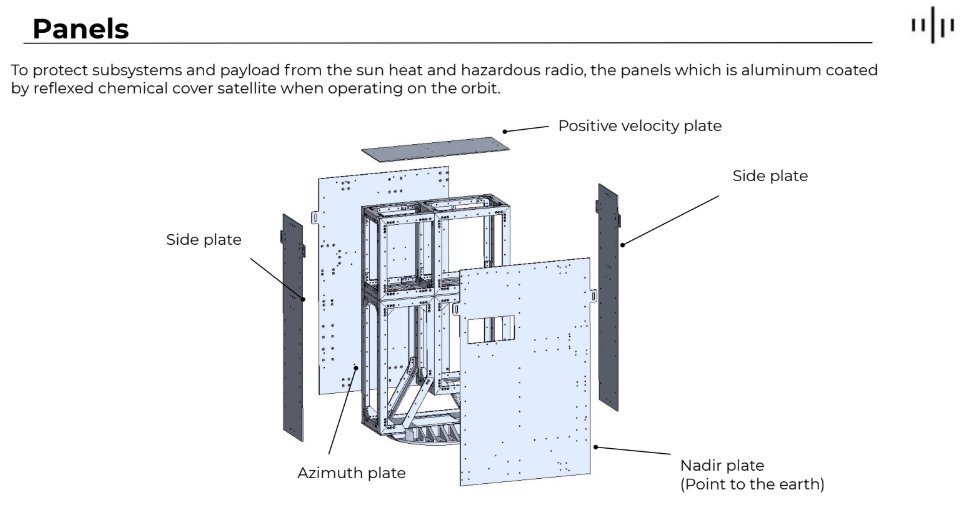
- Panels: Aluminum panels with special reflexed chemical coating that protect against intense solar heat and hazardous radiation. (Nadir plate points to Earth)
- Joint & Truss: Precision truss and joint design engineered to carry extreme loads and survive the harsh space environment.
Built for strength, protection, and reliability
ODC1 is our communication satellite designed with a high power density objective.
This compact yet powerful platform integrates advanced subsystems including high-speed communication antennas, electronic & optical modules, solar power systems, precision attitude control, and efficient propulsion all optimized for reliable performance in space.
📡 Main Electronic Module for the preliminary ODC-1 satellite structure is now complete!
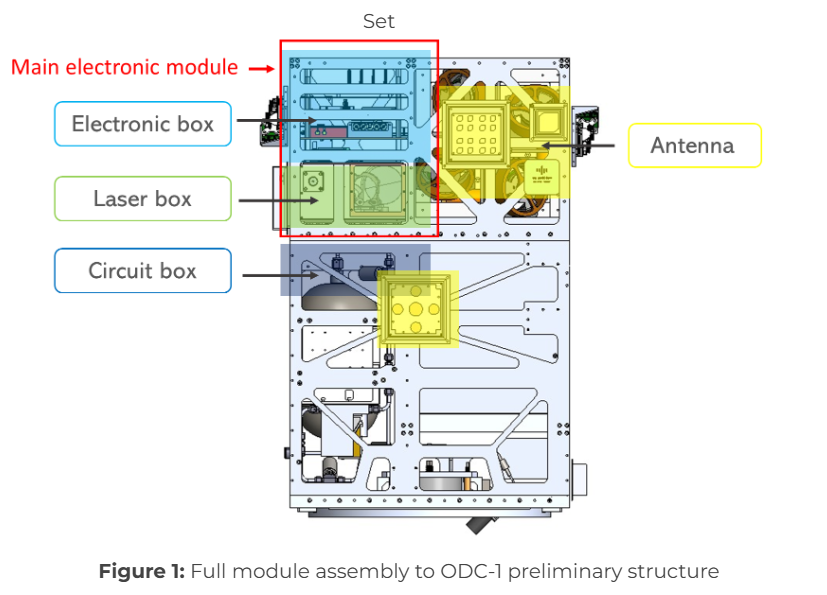
This main electronic module is responsible for housing and protecting the electronic components of the satellite subsystems. It consists of four main parts:
- Electronic Box
- Laser Box
- Circuit Box
- Antenna (5 units)
The structure is manufactured from Aluminum 7071-T6 using high-precision CNC machining.
The main module is located at the top left of the satellite structure, with the Electronic Box and Laser Box connected together. The Circuit Box is positioned below the Laser Box near the propellant tank, while the five antennas are mounted on the ODC-1 structure panel.
🚀 mu Space signs MOU with ispace to prepare for future lunar missions.
We have a clear target: the Moon. Together we will develop orbital and lunar surface payloads and plan to send small satellites and landers up to 100 kg.
Our goal is to establish a presence on the Moon by 2028.
A major first step for mu Space into the cislunar economy 🌕
#muSpace #LunarMission #Moon #SpaceThailand
🚀 Technological Breakthrough at mu Space Corp
What if we could solve the challenge of depth estimation using only a camera and vision?
We turned that question into reality.
At mu Space Corp, our AI team developed a complete system that delivers accurate depth perception without specialized depth sensors.
From collecting high-quality labelled data and fusing image processing with inertial navigation, to training powerful models on the NVIDIA DGX A100 using Self-Supervised Learning, GANs, and CNNs — and finally deploying real-time inference on embedded systems with RGB cameras.
Another example of how we’re pushing the limits of AI to solve real-world problems.
#muSpaceCorp #AI #ComputerVision #DepthEstimation
It seems more likely that a Moon colony could become a reality between 2040 and 2050. The first priority is to focus on NASA Moon base partnerships, building capabilities, and learning what we don’t yet know in the next decade from Moon base projects.
mu Space is exploring the next frontier of data. Here’s the blueprint for their future space-based servers:
• Solar Powered: 24/7 clean energy from the sun.
• Space Cooled: Passive cooling in a vacuum.
• Laser Fast: Data transfer at the speed of light.
• Edge Processing: On-site computing to minimize Earth-bound traffic.
The future of data isn't just on Earth it's in the stars. 🚀
Full Story: https://t.co/dcmZ8b1T01
🌌 The future of data is heading to space!
Tired of Earth’s energy-hungry, overheating data centers? Imagine datacenters powered by nonstop clean solar energy, naturally cooled in the vacuum of space, connected by lightning-fast laser links, and processing data right where satellites collect it.
Read the full intro here: https://t.co/dcmZ8b1T01