So @SafaricomPLC is upset with and trying to block @Starlink in Kenya.
This is funny and ironic because there was a time when Safaricom disrupted everyone else (copper lines and banks), and always said they just wanted a fair playing field.
As the only CMO to rebrand 3 public companies, I consider myself somewhat of an expert on the subject.
This is the Zoolander of rebrands—it reads like a parody. That it's not makes it beyond cringeworthy.
The tagline is "copy nothing" but somehow it already feels tired and outdated... based on a cultural point-in-time that has passed.
You want to be avant-garde? I’m here for it!
Try this:
Create the modern version of this car. Make it over-the-top retro-futuristic. Take a picture of it. There’s your ad.
P.S. @jaguar, HMU.
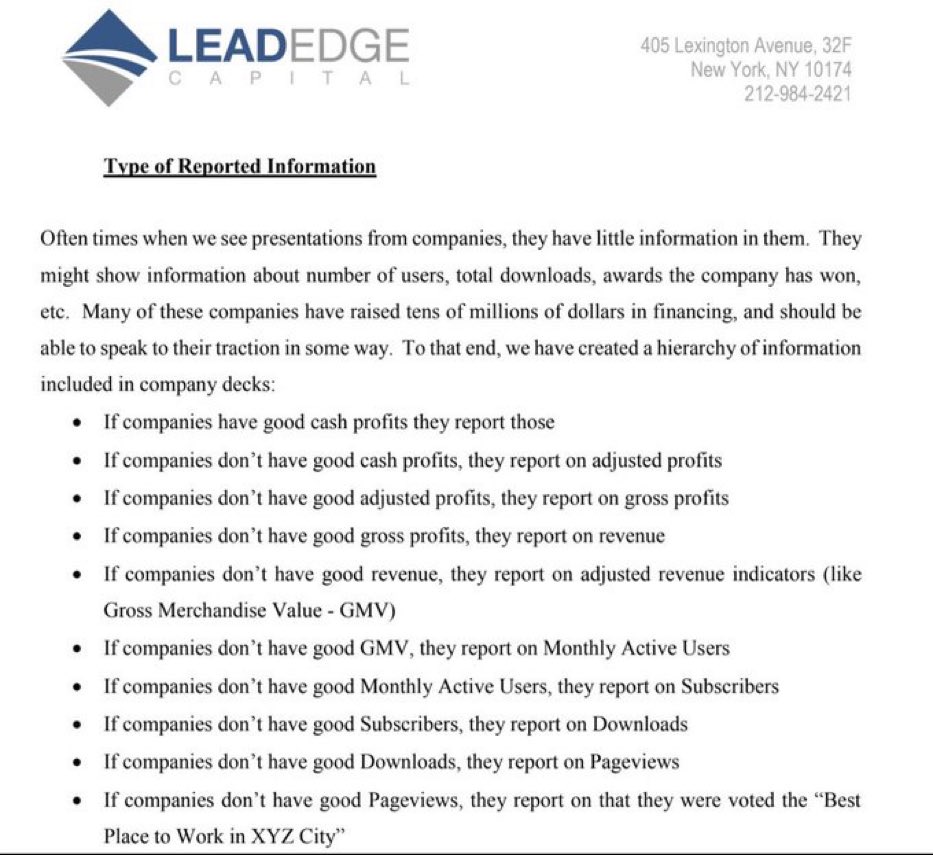
This remains one of the best investment memos of all time
Especially true in startups too.
(For example: They’re not burying the revenue number because it’s too good!)
In a paragraph, Bridgewater’s view is that Africa’s workforce is massive and super affordable, but relatively unhealthy and unskilled, and poorly governed within highly-indebted economies running on underdeveloped infrastructure…
Bridgewater Associates, a US hedge fund established by Ray Dario, has put together a piece on sub-Saharan Africa.
It would have benefited from the authors reading The Time Travelling Economist. Their table could be improved.
But it’s good that they’re interested in Africa
Mario Draghi's new report on EU competitiveness doesn't mince words.
"Across different metrics, a wide gap in GDP has opened up between the EU and the US, driven mainly by a more pronounced slowdown in productivity growth in Europe. Europe’s households have paid the price in foregone living standards. On a per capita basis, real disposable income has grown almost twice as much in the US as in the EU since 2000."
"First – and most importantly – Europe must profoundly refocus its collective efforts on closing the innovation gap with the US and China, especially in advanced technologies. Europe is stuck in a static industrial structure with few new companies rising up to disrupt existing industries or develop new growth engines. In fact, there is no EU company with a market capitalisation over EUR 100 billion that has been set up from scratch in the last fifty years, while all six US companies with a valuation above EUR 1 trillion have been created in this period. This lack of dynamism is self-fulfilling."
"There are not enough academic institutions achieving top levels of excellence and the pipeline from innovation into commercialisation is weak. [...] However, while the EU boasts a strong university system on average, not enough universities and research institutions are at the top. Using volume of publications in top academic science journals as an indicative metric, the EU has only three research institutions ranked among the top 50 globally, whereas the US has 21 and China 15."
"Regulatory barriers to scaling up are particularly onerous in the tech sector, especially for young companies. Regulatory barriers constrain growth in several ways. First, complex and costly procedures across fragmented national systems discourage inventors from filing Intellectual Property Rights (IPRs), hindering young companies from leveraging the Single Market. Second, the EU’s regulatory stance towards tech companies hampers innovation: the EU now has around 100 tech-focused laws and over 270 regulators active in digital networks across all Member States. Many EU laws take a precautionary approach, dictating specific business practices ex ante to avert potential risks ex post. For example, the AI Act imposes additional regulatory requirements on general purpose AI models that exceed a pre-defined threshold of computational power – a threshold which some state-of-the-art models already exceed. Third, digital companies are deterred from doing business across the EU via subsidiaries, as they face heterogeneous requirements, a proliferation of regulatory agencies and “gold plating” of EU legislation by national authorities. Fourth, limitations on data storing and processing create high compliance costs and hinder the creation of large, integrated data sets for training AI models. This fragmentation puts EU companies at a disadvantage relative to the US, which relies on the private sector to build vast data sets, and China, which can leverage its central institutions for data aggregation. This problem is compounded by EU competition enforcement possibly inhibiting intra-industry cooperation. Finally, multiple different national rules in public procurement generate high ongoing costs for cloud providers. The net effect of this burden of regulation is that only larger companies – which are often non-EU based – have the financial capacity and incentive to bear the costs of complying. Young innovative tech companies may choose not to operate in the EU at all."
More: https://t.co/x1d1ApvG2Z.