I think I’ve figured out what British culture is…
It’s tolerating being taken for absolute mugs while those in power fleece us through systemic corruption.
Jeez! Asked in an @ITV interview tonight how he changed the culture in No10 when he became Prime Minister @RishiSunak replied
“I make sure everyone is honest”
NOW WATCH THIS AND TELL ME YOU BELIEVE HIM!
Jeez! Prime Minister @RishiSunak just bull****ed his way through tonight’s interview with everything from nurses got a good pay rise to blaming doctors for NHS waiting lists to how great he’s doing on his pledges!
If you are as sick of this boll**** as I am RT this widely
Here are 88 examples of things Brexit took from us all, and which we might stand to gain again if we were to ever rejoin the EU, subject of course to the agreement of existing members.
[Long read, out of necessity. Please expand tweet to see the whole list.]
- Full unfettered access to the largest trading bloc in the world. Not merely no tariffs, but no non-tariff barriers either. Bristol, Berlin or Barcelona all equally accessible. Sling your goods into a van, and go. No queues, no reams of paperwork.
- Free trade deals with over 70 countries around the world, including Japan, Canada, South Korea, New Zealand and soon the Mercosur bloc in South America.
- Frictionless borders (no more nasty queues) allowing for just-in-time manufacturing, and supporting millions of jobs in the auto industry, aerospace etc.
- Wide open borders between Northern Ireland and Ireland, and between NI and GB, with no customs checks or extra paperwork needed.
- Support for the Good Friday Agreement and the Irish peace process (NI benefitted from over 1.5 billion euro of PEACE funding from the EU between 1995 and 2020).
- A stronger united front against the dangers of the modern world, such as a resurgent Russia. (Friends don’t tend to fight friends; this striving for peace was one of the founding impulses behind the precursor to the EU.)
- Freedom for UK citizens to travel, work, study and retire anywhere in the EU. No more long queues at airports and ports. No more worries about keeping track of 90 days in every 180. No more worries around business travel. (Also solves the problems bands and musicians are experiencing when trying to tour since Brexit.)
- Freedom for EU citizens to travel, work, study and retire in the UK.
- Participation in the EU Single Energy Market, enhancing the resilience of our energy supply.
- Intense scientific and academic collaboration, including access to grants, and knowledge pooling. Participation in Horizon 2020’s successor programme (Horizon 2020 was the world’s largest multinational research programme, and provided funding and assistance for over 10,000 collaborative research projects in the UK.)
- Collaborative space exploration, and participation in the Galileo GPS satellite cluster, including access to its high quality military signal.
- Driving licenses valid all over the EU. No need for international driving permits, or to carry an insurance green card. Car insurance valid all over the EU.
- Multi-year pet passports which make travel with pets easy and cheap.
- A simple, generous system of fixed compensation for flight delays and cancellations thanks to EU passenger rights.
- European Health Insurance Card (EHIC) that grants access to healthcare in the EU free or at reduced cost, plus prescriptions at local rates.
- EU-wide roaming (voice, texts and data) at home rates. No surcharges like the majority of mobile carriers have imposed since Brexit.
- Access to your home content on streaming services (Netflix, Amazon Video, Spotify etc.) wherever you travel in the EU.
- Participation in Erasmus student exchange programme, involving more than 4000 universities across 31 countries. In the past, more than 15,000 UK students a year took advantage of this.
- Study in EU universities at cheaper local rates.
- Enhanced consumer protections, including protections on cross-border shopping (i.e. ordering online from the EU and/or EU customers ordering from the UK).
- Simplified VAT filing for firms selling to EU customers.
- Cross-border tax collaboration, aimed at holding massive firms like Amazon and Facebook to account more than any one country acting alone could hope to.
- Training courses for the unemployed, funded from the European Social Fund.
- Disaster relief funding, such as the 60 million euro the UK received for flood relief in 2017.
- Access to a court of last resort (the ECJ) that provides EU citizens with a means of holding their government to account.
- Significant environmental protections (which act as a floor rather than a ceiling, i.e. individual EU members can’t diverge below EU standards, but can enhance them further).
- Quicker access to safe/new medicines, thanks to a one-stop pan-EU medical testing regime.
- A single system of chemical regulation (REACH) to improve human, animal and environmental safety around chemicals. (Since Brexit, firms have to register chemicals in parallel with both REACH and UK REACH if they want to sell to the UK and EU markets, adding cost and complexity to the process.)
- Cooperation on security issues, and access to shared crime and terrorism databases.
- Participation in the European arrest warrant, allowing for the speedy capture and extradition of criminals.
- Participation in the EURATOM programme to ensure the ongoing availability of vital medical isotopes, including very short half-life radiologicals.
- Financial support for rural areas (too long ignored by successive UK governments).
- Better food labelling regulations, including from April 2020 the requirement to identify the country of origin of the primary ingredient in processed food, as well as the country of manufacture of the finished product.
- EU funding to support the British film industry, theatre and music.
- Free movement for musicians and instruments, bands and equipment, artists and materials etc., enabling a flourishing European culture scene.
- Participation in the European Capital of Culture programme, which has previously given a boost to cities such as Glasgow and Liverpool.
- The ability for service providers (e.g. freelance translators) to offer their services all over the EU on the same basis as to UK clients.
- EU citizenship. It’s a real thing, separate to UK citizenship, and conveys certain additional rights and protections. All citizens of individual EU countries are also EU citizens, by virtue of their citizenship of an EU member state.
- No additional VAT or duty payable on goods imported from the EU (so no unpleasant surprises when receiving packages purchased online).
- Substantial venture capital funding, and access to startup loans.
- Legal protection of minority languages (e.g. Welsh).
- Mutual recognition of academic and many professional qualifications, meaning anyone qualified in the UK or in an EU country can rely on their qualification anywhere within the EU.
- EU-wide protection of foods of geographic origin (e.g. Melton Mowbray pork pies can only be made in Melton Mowbray). Since Brexit, a dual regime operates, so producers have to seek protection in the UK and separately in the EU, introducing new cost and complexity to the process.
- No surcharges on credit card and debit card transactions (illegal under EU law). Since Brexit, UK customers have been subject to additional charges when purchasing from the EU (May be hidden by vendors, but still act to drive costs up).
- EU structural funding (e.g. Liverpool received £2 billion for regeneration in the past) including the requirement to raise matched funds in order to boost effectiveness further.
- Support for and encouragement of democracy in post-Communist countries.
- A bigger presence on the world stage when facing economic giants such as the USA and China (the EU as a whole is a worthy third opponent in that triangular fight, and would be more so were the UK to ever rejoin).
- Products made or grown in the UK can be sold in over 30 countries without needing type approval, phytosanitary certificates or other costly red tape. (These are some of the processes UK exporters have faced since Brexit, driving up costs and extending delivery times.)
- Strong legally enforced food hygiene standards, including prohibitions on chlorinated chicken, hormone-raddled beef, and GM crops. (Like the EU’s environmental protections, these are a floor not a ceiling. Individual EU states can go further. They just can’t erode their own standards below the EU minimum.)
- Objective 1 funding for deprived areas and regions.
- Financial passporting, allowing firms in the City of London to service clients all over the EU without having a local presence.
- A legally enforced 14-day cooling off period on new timeshare agreements.
- Mandatory minimum 2-year warranty period against goods being faulty.
- Consular protection in countries outside the EU available from any EU embassy or consulate (if there’s no UK embassy present in the country).
- Protection against discriminatory treatment when working in other EU countries: all EU staff from across the EU must be treated the same as local staff.
- A secure baseline of worker protections, including limits on maximum hours worked, maternity leave periods etc. (We’re free to improve on them as much as we like, we just can’t erode local conditions below the EU minimums. Indeed, in many cases the UK has already gone further than EU law required. But there would be no danger of losing rights conferred by the EU, no matter what the UK government of the day decided.)
- Minimum of 4 weeks of paid leave a year (introduced by EU in 1993, taken up by UK in 1998, and later extended to 28 days in 2009).
- Right to land fish in any EU port (EU countries used to buy more than half of all fish caught by UK fishermen before Brexit), along with an easy process for declaring catches.
- Access to a willing seasonal workforce to pick our fruit and vegetables (rather than heartbreaking scenes of millions of pounds of crops rotting in British fields during the cost of living crisis).
- Guaranteed supply of medicines (we import over 30 million packs a month from the EU).
- A major say in the running of the EU, with MEPs representing the UK in the European Parliament, British judges on the ECJ panel, etc. And of course the right to propose and amend new EU legislation.
- A say in the setting of the multi-year EU budget, and on steering the EU’s priorities and its focus.
- More influence on environmental issues, since EU law governs the behaviour of 27 countries.
- Cleaner air, backed by the EU Air Quality Directive. In the past, the EU has successfully taken the UK Government to court for failing to meet its obligations. (The system’s not perfect, but it provides a lot more protection than our post-Brexit homegrown one claims to.)
- Strong pan-EU intellectual property protection, including potential participation in the upcoming unified patent system which will enable firms to obtain a single patent valid across 24 (at first) EU countries.
- Some of the highest toy safety standards in the world.
- Protection of 500 bird species under legislation dating back to 1979, and enhanced in 2009.
- Cleaner beaches, with stronger penalities for untreated sewage discharges than the toothless post-Brexit system.
- Pan-EU regulators (food, chemicals etc.) that offer simplified testing regimes, since a single test is valid for all EU countries. Since Brexit, the UK has had to duplicate these functions locally, adding cost and complexity.
- A more powerful presence on the world stage, thanks to 27 countries acting in unison. Not all the time or on all matters. But when it counted most, EU countries have shown a willingness to set aside differences and band together.
- The right to vote (and stand as a candidate) in local and European elections in any EU country you happen to live in, under the same conditions as local candidates and local electors.
- Right to communicate with EU institutions in any of 24 official languages.
- The right to petition the European Parliament, either singly or jointly with others, on any matter within the EU’s fields of activity. This right extends to companies headquartered in EU countries, as well as to individuals.
- Support for people with disabilities, including the European accessibility act (which mandates the accessibility requirements of various products and services) and the EU parking card.
- The right to purchase services (e.g. hotel bookings, car rentals) online from anywhere in the EU at the same price as local buyers. Firms cannot discriminate their pricing by geography.
- Ability to bring home anything you buy in another EU country without a customs declaration, so long as it is for your own personal use. (Think booze cruises, for one.)
- Right to cancel and return the order of any product bought outside of a shop (e.g. online or by telephone) within 14 days, for any reason.
- Strong data protection laws such as GDPR, that protect personal data maintained in any format (online, on paper, etc.) Include right to withdraw your consent for the processing of your data, and right to object to receiving direct marketing. Even firms based outside of the EU must abide by GDPR rules when processing the information of EU citizens.
- Right to know what personal data a firm holds on you, within a month of requesting it. Info should be free of charge and in accessible format.
- Strong right to be forgotten, obliging organisations to delete the personal data they have stored about you upon request.
- Banks must charge the same for payments in euro across the EU as they do for the equivalent national transactions.
- Insurance firms can sell their products all across the EU, without having to be established in every EU country they service.
- EU citizens and firms can register .eu domain names (over 300,000 were lost to UK entities as a result of Brexit).
- Enhanced human rights protection (especially against the State) through the Charter of Fundamental Rights of the European Union.
- Broadcasters can obtain a single broadcasting licence that is valid across the whole of the EU, negating the need for TV networks to obtain licences country by country.
- Regulation and reporting of CO2 emissions in new vans and lorries, with a monitoring and enforcement system that includes fines for manufacturers that fail to meet the specified targets.
- Participation in the EU emissions trading scheme, which establishes total caps on emissions while allowing individual companies to buy and sell their emission allowances to meet changing requirements. This is more flexible than the post-Brexit system where there’s an EU trading scheme and a separate scheme for the UK market only.
- Participation in the EU pandemic Early Warning and Response system (EWRS) that ties together governments and key agencies to combat cross-border health threats.
Phew! Congratulations on making it this far. The above is not a definitive list, but it gives you some idea of the stakes involved.
Here’s the bottom line…
As a political entity, the EU is NOT perfect. No sensible commentator has ever claimed it was.
But it operates to try and maximise the long-term interests of 27 member countries, rather than to further the electability of whatever political party happens to be in power in one.
This means that, all other things being equal, the decisions it takes end up being less damaging to fewer people than those taken by uncaring national governments (does that scenario sound familiar?)
Like it or loathe it, we are trapped by geography. Grab any globe, and you’ll see the UK hovering just off the EU mainland. EU countries are always going to be our nearest neighbours. So it makes all the sense in the world to try to take full advantage of that proximity.
Unfortunately, politicians of all stripes seem singularly lacking in sense right now. Let's hope that will change. And, beyond mere hope, let's strive to see that it does.
The Prime has sent this country a Happy New Year message
For the millions now living in poverty, destitution & using food banks I’ve broken this boll**** down
If you think every UK news show should do the same RT it widely
@BBCNews@SkyNews@itvnews@Channel4News
To carry on the Christmas spirit, we're giving one person a chance to win a @seagategaming FireCuda 540 1TB NVMe SSD and a Seagate Goodie bag! Plus, the runner-up also gets a Seagate Goodie bag!
All you have to do is like and reshare this post!
This is UK entry only!
I can no longer contain my rage at this - millions of children are living in poverty, destitution & using food banks & all the LEVELING UP SECRETARY is asked about is how we can deport more migrants!
If you share my rage RT this widely. I make absolutely no excuses for my anger
If @UKLabour@LabourLordsUK abstain on the Fatal Motion moved by @natalieben next week they will not only allow the Government to continue decades of attacks against Trade Unions & workers' rights they will expose Trade Unions for at least a year (until the next general election) to being liable to pay damages of up to £1 million, force Trade Unions to act as enforcement agents on behalf of employers & rob many of the right to strike altogether. The excuse being offered up by many that labour will repeal the regulations in office is ridiculous. With an election at least a year away smaller unions could be bankrupted in the meantime
Please everyone, send this video to all your unions, your reps, to show them the damage to #WorkersRights that can be stopped on Weds.
Does @GMB_union@unitetheunion@TheBMA etc think it's ok to let these measures run for poss more than a year until @Keir_Starmer repeals them?
The theme of my speech to the Youth Parliament was integrity in politics.
I gave last week’s #GazaCeasefireNow debate - called by the SNP - as an example. The reaction from the youth parliamentarians was incredible. Have a watch.
Link to full speech:
https://t.co/Yv3u1xCW9p
🔔 ICYMI 🔔
Just before he was appointed Environment Secretary last week, Steve Barclay accepted a donation from a Conservative Party peer who has funded the climate-sceptic Global Warming Policy Foundation.
Catch up here 👇
https://t.co/CsEcWO3knb
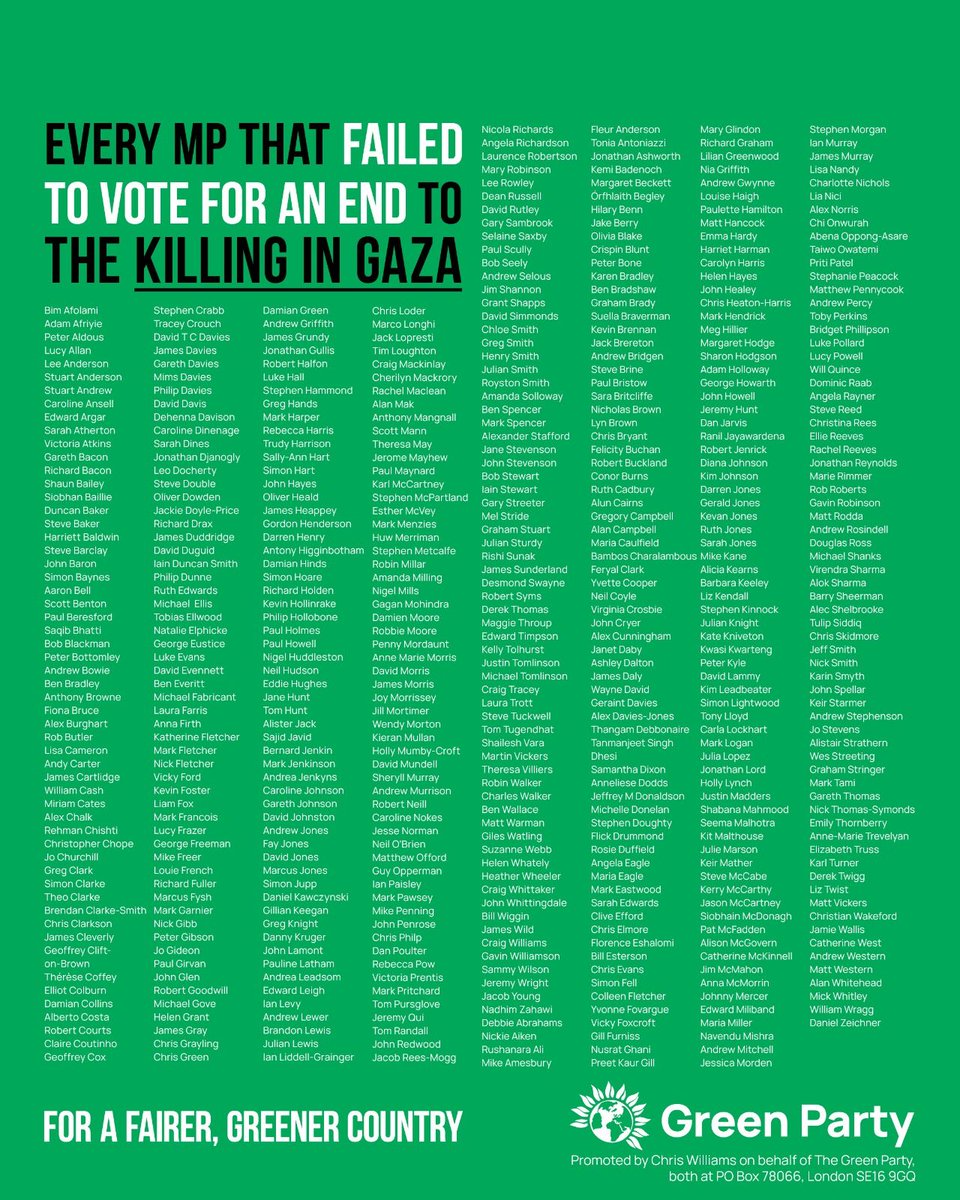
Last night Parliament had the opportunity to vote to support a ceasefire and the release of hostages in Gaza.
Sadly, the Labour party is in chaos and is failing to deliver what constituents are demanding.
Is your MP on the list?
#CeasefireNowInGaza
🚨LET’S BE CLEAR. The Prime Minister just said he plans to introduce emergency legislation to disapply human rights laws & has actually threatened to join Russia & Belarus outside of the European convention on human rights.
THE COUNTRY SHOULD BE IN UPROAR!
🚨PLEASE WATCH AND RT!!
It’s clear from the Prime Ministers statements in Parliament today that his Government is willing to come for our human rights
Should that happen lawyers across the country, MPs, the trade union movement & every one of us must STAND TOGETHER TO STOP IT