US futures are surging after news that Iran’s security chief met the Supreme Leader to discuss ending the war.
S&P 500 futures are up 0.40%
Nasdaq futures are up 0.60%
If this were regular trading hours, $350 billion would have been added to the US stock market in just 25 minutes
THE AI TRADE IS FACING A CRITICAL TEST:
The world's four major memory chipmakers, SK Hynix, Samsung, Kioxia and CXMT, report earnings this week,
This puts a near-$1 trillion industry and more than $2 trillion in combined market value in focus.
The industry is benefiting from semiconductor shortages and soaring prices, with the supply crunch expected to persist, yet rising financing costs and concerns over future returns are increasingly challenging the outlook.
Samsung and SK Hynix shares are already down roughly -50% from their June peaks as investors increasingly question whether AI demand will generate sufficient returns to justify the enormous cost of data centers and computing infrastructure.
The two Korean giants together account for ~60% of global DRAM revenue and over 80% of high-bandwidth memory revenue, while their combined operating profit is estimated to reach 1,571 trillion won ($1.2 trillion) across 2026 and 2027.
This week's results could determine whether the AI chip stock selloff has further to run.
One of China’s biggest copper traders has been sentenced to life in prison, according to people familiar with the verdict.
He Jinbi, founder of Maike Metals International, was sentenced over fraud, bribery and other offenses after a court found the company guilty last month. The ruling found Maike’s conduct exposed several Chinese banks to more than $1 billion of potential losses.
At its peak, Maike handled one in every four metric tons of copper imported into China.
The company filed for bankruptcy in November 2023. He has appealed the verdict, and the judgment has not been made public.
Source: Bloomberg
In 67 days, the Pentagon’s restriction on NdFeB magnets will cover the entire supply chain, from mining of neodymium, iron and boron through production of finished magnets.
Today it covers melting and the later stages of magnet production.
From January 1, 2027, Pentagon contractors may not deliver covered material mined, refined, separated, melted or produced in China, Russia, Iran or North Korea.
The same change reaches back to ore for samarium-cobalt magnets, tantalum and tungsten. The clause allows exceptions, including a nonavailability determination by the agency.
The US-China truce suspending China’s October 2025 rare earth export controls was extended to January 10, 2027, nine days later.
Source: China Briefing
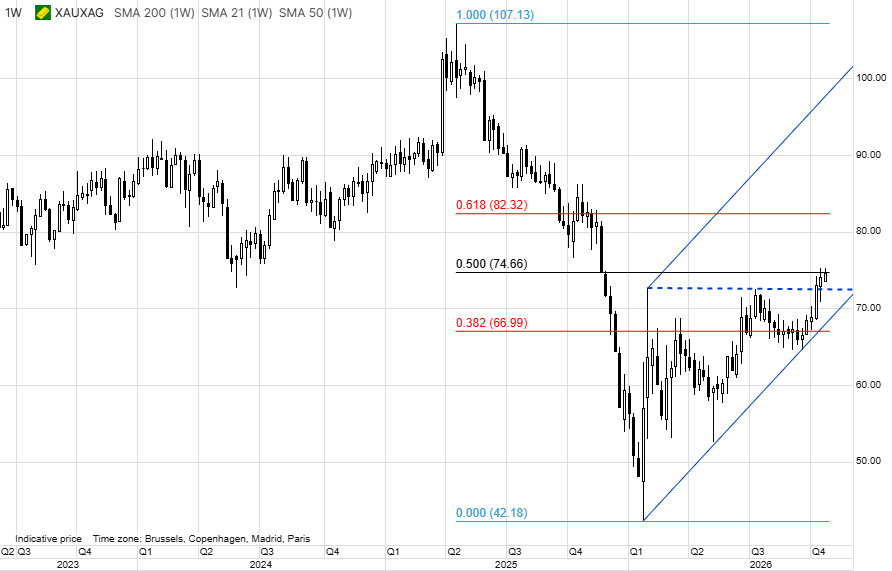
Silver continues to trade on a softer footing, hovering near an 11-month low, while gold’s ability to hold around USD 4,000 has pushed the gold-silver (XAUXAG) ratio higher towards 74.50. A sustained break above the 50% Fibonacci retracement at 74.66 could signal further relative weakness in silver, potentially opening the door to 82.30, the 61.8% retracement of the 2025–26 decline.
In a more pronounced downside scenario, a continued rise in the ratio towards the high 90s would imply silver trading in the low USD 40s, assuming gold remains near USD 4,000. While such an outcome is not our base case, silver has clearly lost some of its earlier momentum, with concerns about economic growth and fading speculative appetite weighing on sentiment. Silver’s tendency to amplify gold’s moves has also become a headwind as momentum-driven buying subsides.
As with gold, much of the recent selling appears to have been driven by momentum-focused hedge funds, reflected in a decline in the managed money net long to a 32-month low of just 3,746 contracts. In contrast, ETF demand has remained relatively resilient, with holdings rising to 25.1k tonnes, a seven-month high, from a July low of 24.3k tonnes. This divergence suggests that while speculative positioning has weakened considerably, longer-term investor interest remains intact.
For now, the key technical level to watch is 74.66 on the ratio, with a sustained break potentially pointing to further silver underperformance. Conversely, a rejection at this level could provide some near-term relief, with initial support around 72. Ultimately, gold remains the main source of directional guidance, while a sustained recovery in silver will likely depend on renewed momentum across the broader precious metals complex.
World copper mine production fell 0.9% in the first eight months of 2026 while refined output rose about 1.7%, according to preliminary International Copper Study Group data.
Mine output change by country
• Mongolia concentrate, +20% (Oyu Tolgoy)
• Peru, +1.3% (Antamina)
• Chile, -7% (El Teniente, Escondida, Spence)
• Australia, -10% (Mount Isa)
• DRC concentrate, -26% (Kamoa)
• Indonesia concentrate, -29% (Grasberg)
ICSG puts the apparent refined surplus at 218,000 metric tons, against about 158,000 a year earlier.
Source: International Copper Study Group
Gold’s next test is the #Fed.
US 10-year real yields have dropped from 2.95% to 2.66% this month. But #gold still remains under pressure near the key support of $3,950-$4,000. The October 28 Fed message could shape the next move.
UBS says $4,000 is where dip buyers step in for gold.
“Still, we think gold has proved notably resilient to the sharp rise in yields,” strategist Giovanni Staunovo said in a note on Friday.
“In the near term, gold may retest support around USD 4,000/oz, where we expect structural dip buyers to establish a floor.”
UBS kept its forecast of 750 to 1,000 metric tons of annual central bank buying and sees gold resuming its uptrend toward year-end and into 2027.
Source: https://t.co/87lw4cSBQ6
Japanese investors are DUMPING foreign bonds at the fastest pace in years:
Japanese investors sold -¥3.43 trillion, or -$21.9 billion, in foreign long-term bonds over the last 5 weeks, their longest selling streak in 4 years.
So far in 2026, they dumped -¥5.18 trillion, or -33.0 billion, the biggest sale for this period of the year since 2022.
This comes as Japan's 10-year government bond yield has risen by more than +80 basis points this year, making domestic bonds increasingly attractive and encouraging investors to redirect capital toward the home market.
Meanwhile, foreign investors bought +¥1.45 trillion in Japanese long-term bonds this week, marking their 3rd consecutive week of purchases.
Rising bond yields in Japan are making foreign bonds and equities less attractive to Japanese investors.
Sharp shadows on the quarterly candle for Q3 suggest a negative trend in Q4 for #Gold.
However, December is expected to be a positive month seasonally.
Therefore, gold might be attempting to form a final bottom of the year before the next rally.
This correction from $5,600 strengthen the bullish outlook and offers good opportunities for long-term investors.
The last rebound from the $3,950–$4,050 support zone lifted prices 17.1% over the summer.
Now gold is back, with its daily RSI at 33 approaching oversold territory.
But prices remain below the 100-day moving average
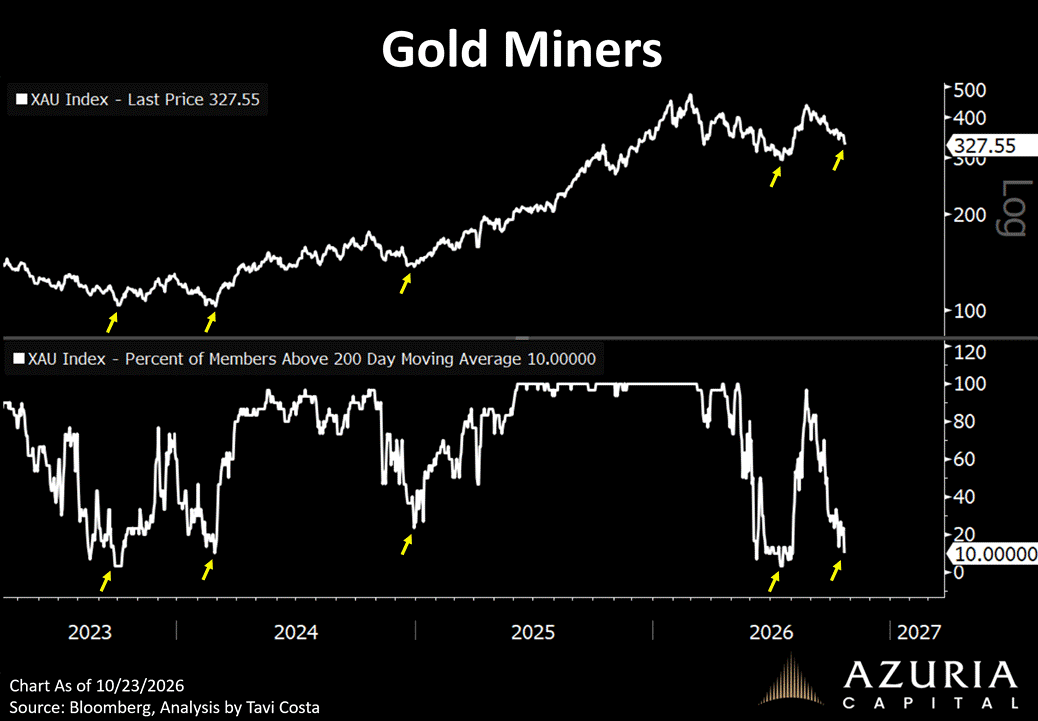
Only 10% of miners remain above their 200-day moving averages.
Historically, readings this low have coincided with important bottoms for the industry.
Long-term-minded investors know what to do here.
https://t.co/PXKGwBqrto
AI spending binge is pushing US tech credit risk to RECORD HIGHS:
5-year credit default swaps (CDS) tied to Meta, $META, surged to a record 119.3 basis points on Thursday.
At the same time, CDS spreads on Oracle, $ORCL, Microsoft, $MSFT, and Broadcom, $AVGO, also widened to record highs.
This comes as Meta raised its 2026 capital expenditure outlook by $5 billion at midpoint, to a range of $135 billion to $145 billion and increased its future spending commitments to $825 billion, up from nearly $700 billion in July.
Furthermore, Meta’s free cash flow turned negative in Q3 for the first time in 13 years, reaching -$2.12 billion.
As a result, the extra yield investors demand to hold Meta’s 2036 bonds instead of comparable US Treasuries widened to a record 121 basis points.
Investors are increasingly questioning how Big Tech will finance the AI infrastructure buildout, as massive capital spending plans raise expectations for further debt issuance in an already saturated credit market.
The AI arms race is fueling a surge in demand for protection against corporate tech defaults.
Canaccord Genuity says ex-China NdPr prices are up 23% this year while the rare earth producers it covers are down 28% on average.
NdPr is above the $110 a kilogram price floor.
Developers are down 17% on average this year, and producers trade at 0.57 times net asset value.
Canaccord says equity performance has been driven more by global macro factors than by rare earth fundamentals.
#Silver’s correction continues, with $48–$50 in focus as a key support zone along the rising trendline. Holding this area would help keep the upward structure intact.
Electric vehicles are forecast to account for 76% of global lithium demand by 2050, up from 55% today, according to Benchmark Mineral Intelligence.
Total lithium demand is expected to more than triple to nearly 7 million metric tons of lithium carbonate equivalent, from 2.11 million metric tons in 2026.
Batteries already account for 92% of lithium consumption, up from about 70% in 2020.
Demand from stationary energy storage has grown by more than 60% a year over the past two years.
Benchmark expects growth to moderate to roughly 5% a year through the end of the decade.
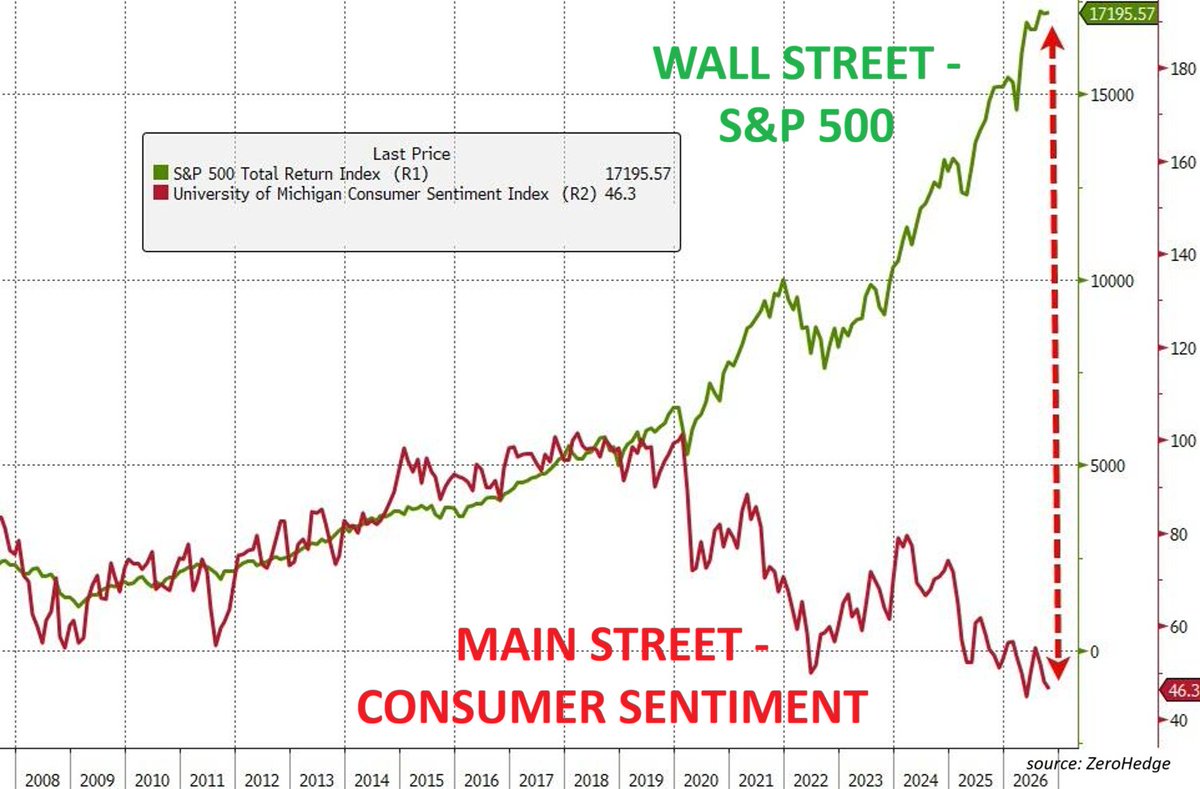
THE GAP BETWEEN WALL STREET AND MAIN STREET HAS NEVER BEEN WIDER:
The S&P 500 total return index is up 276% since the 2020 Crisis, trading near its all-time high.
Over the same period, the University of Michigan Consumer Sentiment index has fallen over -50%, to 48 points, its 2nd-lowest level in history.
This comes as higher income households own a disproportionate share of equities, so rising markets benefit them far more.
At the same time, the cost of living for middle and lower income households continues to rise, with housing, food, insurance, and other essentials more expensive than ever.
Wall Street is getting richer, while Main Street is getting more pessimistic by the day.
This is not healthy.
#Silver is back at the line that capped major rallies for decades. Holding this former resistance as support would strengthen the case that the breakout remains intact.