🌟 Leading and Supporting Reformers 💪 in and out of 🏛️ Government to Design and Implement 📊 Public Sector Reforms 🚀 that Improve Public Service Delivery 📚
IMPORTANT: Today, I attended @ProfIsaPantami’s tafseer at the Annur Mosque in Abuja. The tafseer was on inheritance in Islam, as prescribed in the Holy Qur’an. He took time to carefully explain the important aspects surrounding it. So let me share some of the key lessons I learned from the tafseer here, in Islamic law of inheritance (Ilm al-Fara’id), the distribution of a deceased person’s property follows specific rules laid down in the Qur’an and the Sunnah. These rules determine fixed shares for certain relatives before the remaining portion of the property is distributed among other eligible heirs.
Let us consider a situation where a person dies leaving behind his father, mother, one wife, one son, and one daughter, and the total property he leaves is N1,000,000. We assume that all debts have already been settled and there was no will affecting the distribution.
The Qur’an assigns specific portions to some heirs when the deceased leaves children.
1.The Wife
According to Qur’an 4:12, a wife receives one-eighth (1/8) of the property if the deceased left children.
2.The Mother
According to Qur’an 4:11, the mother receives one-sixth (1/6) of the property when the deceased has children.
3.The Father
The father also receives one-sixth (1/6) when the deceased has children. In some situations the father may also inherit part of the residue, but in this case the remaining property will go to the children.
4.The Children
After the fixed shares are allocated, the remainder of the property goes to the children. The Qur’an states that a male receives the share of two females (Qur’an 4:11). Therefore, the son receives twice the portion of the daughter.
Step-by-Step Calculation
1. Wife’s share (1/8): N1,000,000 ÷ 8 = N125,000
2. Mother’s share (1/6): N1,000,000 ÷ 6 ≈ N166,666.67
3. Father’s share (1/6): N1,000,000 ÷ 6 ≈ N166,666.67
Total: 125,000 + 166,666.67 + 166,666.67 = N458,333.34
Remaining: N1,000,000 − N458,333.34 = N541,666.66
The remaining amount goes to the children and in Islamic belief, the son receives twice the share of the daughter. So the remainder is divided into three equal parts:
Son = 2 parts
Daughter = 1 part
Value of one part: N541,666.66 ÷ 3 ≈ N180,555.55
Therefore:
Son: 2 × 180,555.55 ≈ N361,111.11
Daughter: 1 × 180,555.55 ≈ N180,555.55
Final Distribution
Wife: N125,000
Mother: N166,666.67
Father: N166,666.67
Son: N361,111.11
Daughter: N180,555.55
This is the most exciting thing I've written in one million years. And while the story appears to centre one man, he's only a small cog in a big, big machine we all inhabit.
Read, maybe 🔫
I invite you to Islam. With submission to the only One true God, you will find peace, tranquility and happiness. With the wealth He has given to you, you can do much good, abstain from all sins as much as you can and find a place in Jannah.
I invite you to accept Islam and the One true God Who created you and everything.
Government is harder than rocket science, @DrJoeAbah reaffirmed at @HadizaBalaUsman’s 50th birthday celebration. He recalled how he was often abused online whenever he made that assertion. Many dismissed it as an exaggeration, until one of the world’s finest rocket scientists entered government and exited, openly acknowledging how complex, frustrating and demanding governance truly is.
According to Abah, the experience finally validated what practitioners of public service have long known, governing people, systems, interests and institutions is far more complicated than solving equations or building rockets.
The Muslim Business Formula
1. Tahajjud = The Innovation Lab
Tahajjud brings IDEAS.
While the world sleeps, the "noise" of the market disappears. This is the time of Basirah (divine insight).
Don't just pray; listen. The clarity you get at 4 AM is sharper than any brainstorming session at 4 PM.
LET’S BE SERIOUS FOR A CHANGE THIS MORNING. Not every time cruise. 😀
A lot of the time, people focus on monitoring rather than evaluation. The public sector likes monitoring because it helps determine whether funds allocated to a project were actually used for that project. Was the school or hospital built at all or did people just take the money without even clearing the site?
Monitoring visits are also very popular in the public sector because it is an avenue to earn duty tour allowances (and to be “warmly received” by those being monitored…if you know what I mean 😉.
In the private sector, people new to working with targets will tell you that the solution to all the problems in the world is KPIs (Key Performance Indicators). Once you set key performance indicators and monitor them rigorously, everything will work. They say that that is what the public sector should adopt and all its problems would go away.
However, the Nigerian public sector introduced KPIs in 1974, before many private sector consultants even knew what they were. The problem is that a private sector KPI to sell 100 crates of soft drinks or 20 insurance policies every month is not the same as a public sector KPI to deliver social protection or ensure that child adoption policies are robust.
The public sector worker has to factor in lack of funds, ethnicity, religion, geopolitical balance, politics, welfare of the children, suitability of potential parents, etc, most of which the private sector worker does not have to care about.
Anyway, beyond monitoring, we tend not to do enough evaluation both in the public and private sectors. Evaluation essentially asks whether the world has changed as a result of that intervention.
For the public sector: Yes, we monitored and saw that you indeed dug the borehole but a year later, is there water in it? Has it reduced the incidence of waterborne diseases in the area?
Because the primary purpose of going into business is to make money, the private sector tends not to care about any sort of evaluation. Yes, you met your target of selling 100 crates of ‘soft drinks’ but what is its effect on children’s teeth or on adult obesity? Nobody cares. Indeed, the more “soft drinks” you sell, the better you perform.
Even when they do Corporate Social Responsibility (CSR) projects, most of the private sector behaves much like the public sector. The joy is in the announcement that the borehole has been dug. People hardly ever go back to check whether it made a blind bit of difference.
Some of the bigger philanthropies are beginning to take shape evaluation more seriously now though. The billionaire is beginning to ask whether the wealth that he has devoted to doing good is making any sort of difference. This is a good thing.
Overall, when we design projects and interventions, we should design evaluations into them. It is not enough to monitor. Beyond the big announcement, we should also evaluate whether we are really making any sort of difference in the world.
I am Ezemmuo. I know things.
Kaduna launches Nigeria’s first ever OC4IDS infrastructure data portal
The Governor of Kaduna State, Senator Uba Sani, represented by the Commissioner for Planning and Budget Commission, Mukhtar Ahmed, launched Kaduna State’s Infrastructure Portal. This is the first platform in Nigeria to publish data using the OC4IDS data standard.
The state has also issued a Formal Disclosure Mandate to enhance compliance with data publication in the state. This launch took place at CoST’s event at the Open Government Partnership Global Summit.
The World Bank supported states in Nigeria to have data platforms, with Kaduna publishing data on 1300 projects using the Open Contracting Data Standard (OCDS). But as a CoST member, Kaduna went one step further through their CoST membership, following civil society organisations highlighting gaps in data.
Learning from their experience of applying the OCDS, Kaduna aligned their data to the OC4IDS. OC4IDS expands data publication, combining contract level publication using with project-level publication from the CoST IDS. CoST Kaduna became validated as an OC4IDS publisher earlier this year.
Since then, they have been working hard to undertake training for uploading the data, proceeding to upload data from almost 1500 projects to the new platform, and ensuring that the portal is accessible. Kaduna’s Formal Disclosure Mandate will help to solidify data publication.
Today, Mukhtar Ahmed said: “Kaduna’s infrastructure data is now open to the world, empowering citizens, civil society, private sector and development partners to monitor progress which opens the door to trust, innovation, and inclusive development. We invite the world to explore, engage, and emulate. The future of infrastructure is open, and Kaduna is leading the way.”
CoST Kaduna manager, Tara said: “This new portal means that more data will be available in priority sectors such as healthcare, education, agriculture and transport. Publishing and reviewing data in these sectors are vital for improving quality of life for over 10 million people living in Kaduna. We’re proud of how this work and has enabled us to work with a wide range of stakeholders.”
The creation of this platform also supports Nigeria’s Open Government Partnership commitment, as well as the several of the aims in CoST Kaduna’s annual plan. It also builds on CoST Kaduna’s achievements, including a recent affirmation of government commitment; training civil society, government, and media; and participation in events like OGP Africa.
Take a look at the portal here: https://t.co/qEob3a094D
Our free tools and standards to promote infrastructure transparency are available for any local or national government to use.
CoST, the Infrastructure Transparency Initiative (CoST) a leading global non-profit improving transparency, participation, and accountability in infrastructure to deliver quality infrastructure that improves lives and strengthens economies. Stay up to date with our latest work through our newsletter.
https://t.co/AMLz4uzR3H
📢 The Federal Government’s settlement of over N2 trillion in outstanding capital budget arrears from the 2024 fiscal year is commendable. The news also has it that States’ fiscal surplus has increased from N2.8 trillion in 2023 to N7.1 trillion, providing subnationals with more fiscal space to invest in critical areas such as infrastructure, healthcare, and education.
As the focus shifts to 2025 capital releases, this momentum must be sustained. Citizens should also take ownership by checking https://t.co/FfdcoujOwa and https://t.co/3YLuqJOFhS to monitor disbursements and track how these funds are being used in their states and communities.
We want to see public funds work for the people. Increasing revenue should translate to increasing development across all states, LGAs, and communities.
#AskQuestions
In memory of Buhari: a paragon of integrity and candor, devoted to a fair Nigeria. My father always spoke of you as one of the rare incorruptible leaders he knew. #BuhariLegacyLivesOn#RIP
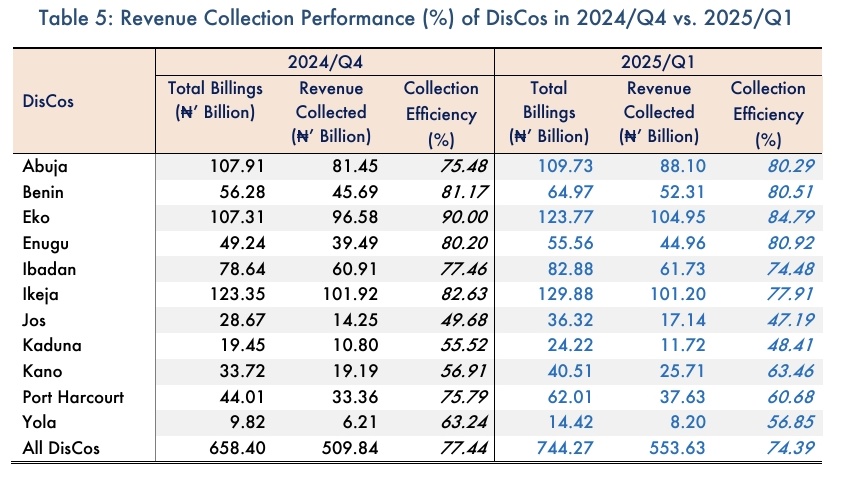
In Q1 2025, DisCos billed Nigerians ₦744.27 billion for electricity. But they only managed to collect ₦553.63 billion.
That’s a ₦190B gap, and it’s bigger than just unpaid bills.