Running away is easy. Staying back, taking responsibility, and fixing the system, that’s what actual governance looks like.That’s what real leaders do when they truly care about their people. They don’t run. they fix. We stand with a Prime Minister who alwys puts the nation first
"Tahir Hussain organised Delhi riot."
"No. He's framed for his religion."
"There's a video proof."
"Video is fake."
"Police probe indicts him."
"Police Amit Shah ki hai."
"He confessed."
"Daraya gaya hoga."
"Court also convicted him yesterday."
"Court bhi Modi ke control me hain. No justice for innocent MusIims in India."
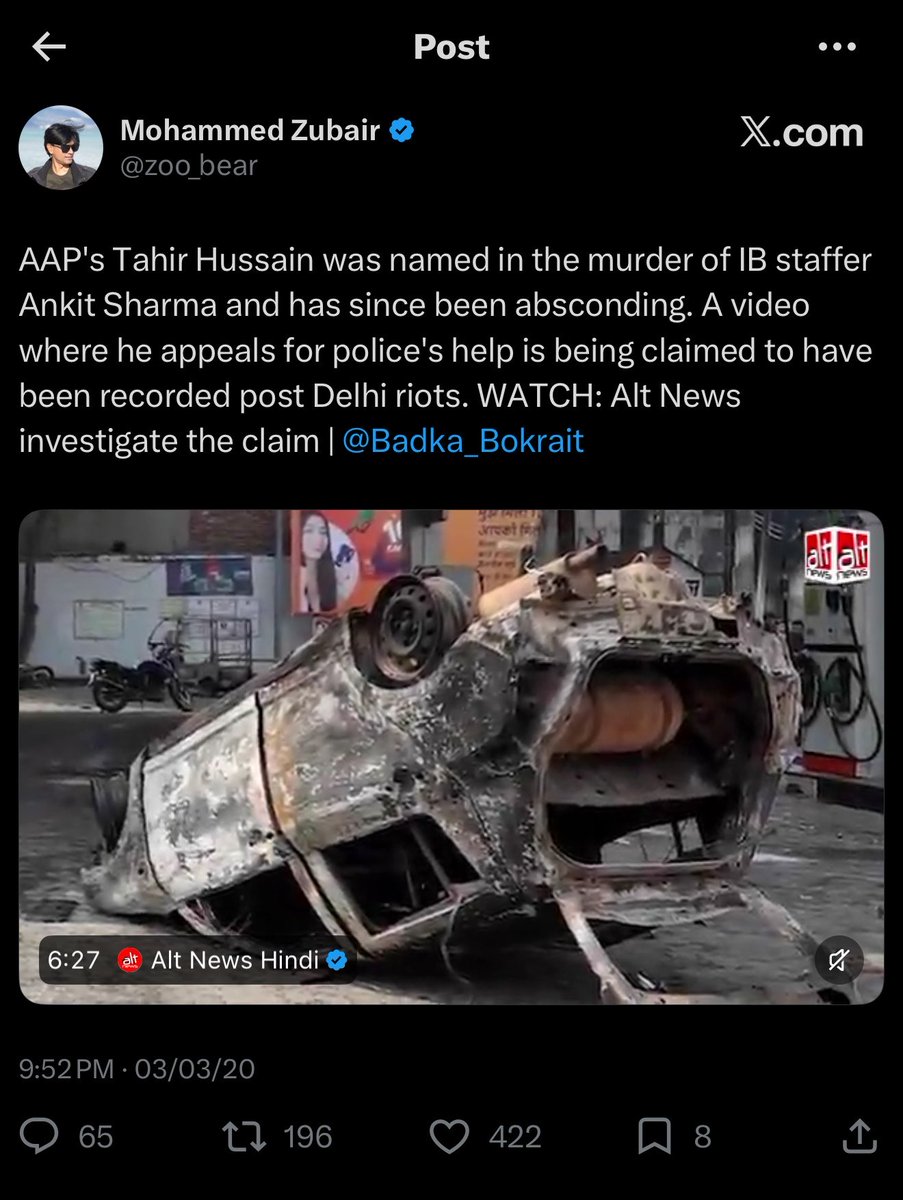
Ankit Sharma’s body was recovered from the Chand Bagh drain on 26th February 2020. He was stabbed so many times that his intestines lay out of his body.
On the 27th, @sardesairajdeep was defending Hussain.
Today, 6 years later, Tahir has been convicted of the murder.
This is the condition of the Punjab mansion of Hindu businessman Todar Mal who paid 7,800 gold coins and bought 4 yards of land from the Mughal emperor Aurangzeb to bury the bodies of the 2 young sons and mother of Guru Gobind Singh on December 13, 1705.
The Mughal faujdar Wazir Khan had ordered the two young children be bricked alive as they refused to accept Islam. When they died, their grandmother died of shock
The Mughals did not want to allow the cremation to humiliate the martyrs. They stipulated that the buyer can take only as much space as he could cover with give gold coins for the land. All the Sikh chiefs just stood helplessly
That's when Todar Mal produced the coins and bought the piece of land, and cremated the three bodies.
This is biggest irony of life, India is only country where its true heritage is hidden from next generation and falsehood Is taught.
Pakistan had infiltrated 3 lifelines of India
Politics : Maino
Cricket: Azhar
Bollywood: Khans
It’s a miracle we survived.
What Modi did in politics & Ganguly did in Cricket
Dhar did in Bollywood
Liquidated Pakistan’s assets
India is one of the best countries in the world period. Ethical, strong, safe (inside and out). 🇮🇳
Yes, we are relatively poor, but we will get there in a generation. Everything else will follow.
Ah - the fallacy of the inapt analogy. GDP is a flow variable. Market Cap is a stock variable. GDP is national income. Market cap is the aggregate value of all the shares of a company. You don’t compare a stock variable to a flow variable - apples and oranges. It’s a bit like someone saying “My house is worth more than your annual salary so I am better off than you”. If you want to compare Google to India then compare Googles revenue to India’s national income. Googles revenue is USD 400 bill. Its market cap is roughly 10x of that which is approx. USD 4 trillion. If countries could be listed and have a market cap then applying the same multiple India’s market cap would be USD 40 trillion around 10x of it’s GDP
India is working on all 5 layers of the AI architecture: application, model, chip, infra and energy. We are building the foundation for global AI services.
📍 World Economic Forum, Davos
Number of Jobs created by Blinkit : 1,85,000+
Number of Jobs created by Zepto : 1,20,000+
Number of Jobs created by Big Basket :80000+
Number of Jobs created by Zomato : 5,50,000+
Number of Jobs created by Swiggy : 6,90,000
Number of Jobs created by Urban Company : 40000+
Number of Jobs created by OLA : 1 million+
Number of Jobs created by Uber : 1.4 Million+
Number of Jobs created by Rapido : 8,00,000+
No of jobs created by Kunal Kamra : 0
No of Jobs created by Raghav Chadda : 0
No of Jobs created by Ravish Kumar : 0
People who have created 0 jobs are questioning people who have created million of Jobs in India!!
Last one on this topic, and I have been holding this in myself for a while.
For centuries, class divides kept the labor of the poor invisible to the rich. Factory workers toiled behind walls, farmers in distant fields, domestic help in backrooms. The wealthy consumed the fruits of that labor without ever seeing the faces or the fatigue behind it. No direct encounter, no personal guilt.
The gig economy shattered that invisibility, at unprecedented scale.
Suddenly, the poor aren't hidden away. They're at your doorstep: the delivery partner handing over your ₹1000+ biryani, late-night groceries, or quick-commerce essentials. You see them in the rain, heat, traffic, often on borrowed bikes, working 8–10 hours for earnings that give them sustenance. You see their exhaustion, their polite smile masking frustration with life in general.
This is the first time in history at this scale that the working class and consuming class interact face-to-face, transaction after transaction. And that discomfort with our own selves is why we are uncomfortable about the gig economy. We want these people to look our part, so that the guilt we feel while taking orders from them feels less.
We aren't just debating economics. We are confronting guilt. That ₹800 order might equal their entire day's earnings after fuel, bike rent, and app cuts. We tip awkwardly, or avoid eye contact, because the inequality is no longer abstract. It's personal.
Pre-gig era, the rich could enjoy luxury without moral discomfort. Labor was out of sight. Now, every doorbell ring is a reminder of systemic inequality. That's why debates explode. It's not just policy. It's emotional reckoning. Some defend the system (“they choose it”), others demand change (“this isn't progress, its exploitation”).
And here’s the uncomfortable twist: the unsaid ask of clumsy ‘solutions’ isn’t dignity. It is about returning to invisibility.
Ban gig work and you don’t solve inequality. You remove livelihoods. These jobs don’t magically reappear as formal, protected employment the next day. They disappear, or they get pushed back into the informal economy where there are even fewer protections and even less accountability. Over-regulate it until the model breaks, and you achieve the same outcome through paperwork instead of slogans: the work evaporates, prices rise, demand collapses, and the people we claim to protect are the first to lose income.
And then what happens?
The rich get their old comfort back. Convenience returns without faces. Guilt dissolves. We go back to clean abstractions and moral posturing from a distance. The poor don’t become safer, they become invisible again: back in cash economies, back in backrooms, back in shadows where regulation rarely reaches and dignity isn’t even debated.
The gig economy just exposed the reality of inequality to the people who previously had the luxury of not seeing it. The doorbell is not the problem. The question is what we do after opening the door.
Visibility is the price of progress. We can either use this discomfort to build something better (which we keep doing continuously as delivery partners are our backbone), or we can ban and over-regulate our way back into ignorance. One of those choices improves lives. The other simply helps the consuming class feel virtuous in the dark.
I am a resident of Anil Maitra Road, Ballygunge, Kolkata. There is no electricity here for the past 32 hours now, shortage of drinking water, phones almost drained out of battery. Completely inhumane! There are so many children and elderly in my area. @kmc_kolkata@CESCLimited
I am a resident of Anil Maitra Road, Ballygunge, Kolkata. There is no electricity here for the past 32 hours now, shortage of drinking water, phones almost drained out of battery. Completely inhumane! There are so many children and elderly in my area. @kmc_kolkata@CESCLimited
You know what actually dragged India into its weakest phase despite having two “world-class” economists at the helm, PM Manmohan Singh & FM P. Chidambaram? Oil Bonds. After 2008, UPA kept oil prices artificially low, diesel was just ₹47/litre even when crude was above $100/barrel. Instead of passing the real cost to consumers, they pushed it to the future by issuing ₹1.44 lakh crore of Oil Bonds (2005–2010). Usually, a healthy CAD for an emerging economy should stay around 2% of GDP or less. But it had exploded to 4.8% of GDP in FY2012–13. That’s almost equal to the entire GDP growth rate at that time, which had collapsed to 4.5%. The money you earn as a country is almost equal to the gap you run on imports vs exports 🤡… The rupee collapsed to ₹68/$ and India was branded among the “Fragile Five.”
When NDA took charge in 2014, no new oil bonds were issued. They repaid over ₹1.2 lakh crore of principal while still paying ₹9–10k crore interest annually till 2027. Diesel was deregulated, LPG subsidies moved to DBT, and excise duty hikes during the crude crash ($40–50/barrel in 2015–16) built fiscal stability. By 2018, fiscal deficit was down to 3.4% and forex reserves topped $400 billion India moved from “fragile” to the bright spot of BRICS.
Indian elites are disconnected from reality:
Since their kids don’t join the army, they think we exaggerate the threat from Pakistan.
Since they interact only with Pakistan’s elites, they assume the average Pakistani loves India.
Since their kids don't get mauled by stray dogs, they think it's not a public problem.
Since they don't travel in public transport, they feel cutting a few trees (though replanting many) for newer transport for masses isn't needed.
Since they stay in secure posh areas and don't become victims of attacks by illegal infiltrators or demographic change, they feel it's not even an issue.
Since they don’t celebrate festivals in the traditional way, they preach and guilt-trip commoners into not doing it either.
The elites neither represent the masses nor understand their struggles, which is why the moment they speak on issues that don’t concern them, they must be put in their place.
GST burden down
Income tax burden down
Inflation burden down
Fiscal Deficit down
Interest rates down
Sovereign ratings up
GDP growth up
Dear Middle class, can you now stop whining about Fin Min please ? :)