This song is called Tres impoli (You are impolite) by Franco Makiadi, the leader of TPOK Jazz.
The song is 42 years old. It was recorded in 1984 in Gabon.
It is about an impolite, mannerless man.
The truth about this song is that Franco was impatient with a band member called Papa Ndombe Opetum, whom he sent to police remand for stealing a piece of meat.
Opetum was a stubborn, mannerless band member who, whenever he was sent to buy meat, sliced a portion for himself.
In fact, one of the songs composed for him by Simaro Lutumba, called Mbongo (Money), was later recorded by another obedient member, Djo Mpoyi, because Opetum had misbehaved.
When he sliced Franco's meat, Franco called the police on him. After staying in remand for 2 weeks, Opetum took off and rejoined Tabu Ley's band, Afrisa International.
He is seen here with Tabu Ley's band in a London Live concert, dancing like a comedian in Beyou Ciel's song Embouroumounkoue at 0:04 - 0:08 (https://t.co/isiWn6836M)
It is after Opetum left that Franco composed this song, Tres Impoli (Why are you impolite?)
My favourite verse in the song: 3:25
Chaussette etoboka - (Your socks are torn.)
Okoti na ndako ya bato oti makolo na mesa. Nzoka ezali mesa bato ba lelaka. - (You enter someone’s house and put your legs on the table. Yet people use that table to eat.)
This was Opetum's character.
Later, in 1988, when Franco was sick in Belgium, Opetum sneaked back to TPOK, where he composed two hits, ANGELA and TAWABA (https://t.co/aolQYdYCAe.)
Opetum collapsed and died in Kinshasa on 24th May 2012, aged 68 years.
Day 5 of 365.
Confidence day.
A friend of mine an i lost Ksh 80,000 in one morning by underestimating chicken demand.
In December i received An order from a popular Nairobi joint for 100 Kienyeji Njogoo.
Offer price. Ksh 2,000 per bird.
My farm lacked capacity to supply. I talk to a friend and he was willing to partner buy from farmers and supply.
Simple math.
-Buying price target. Ksh 1,500
-Selling price. Ksh 2,000
-Gross margin. Ksh 500 per bird
-Expected profit on 100 birds. Ksh 50,000
We settled to go to the market where we could buy all Njogoo at once.We drove to Ishiara market, Embu, Kwa Wamuthende.
We arrived early with a lot of Confidence.
We met a farmer with over 100 Njogoo.
I opened the market with Ksh 1,200.
The farmer countered at Ksh 1,700.
We laughed and walked away. MAKOSA.
Before even moving to the next farmer.
A pickup reversed and they started loading the birds.
Apon asking how much he sold ,We were told the buyer offered Ksh 1,800 per head.
Do the math.
-Market clearing price. Ksh 1,800
-Selling price locked. Ksh 2,000
-Net margin per bird. Ksh 200
-Profit on 100 birds. Ksh 20,000
-Missed revenue. Ksh 180,000
-Missed opportunity. Priceless
We ate roasted goat meat.
We drove home empty.
Here is the lesson for you in 2026.
-Mature chickens hold value.
-Demand stays ahead of supply.
-Price pressure favors the farmer.
-Delay costs money.
-Hesitation feeds competitors.
-There is nothing like chicken meat has flooded the market.
Protect your birds.
Prevent theft.
Control disease.
Keep Chicken equal to printing Money.
If Fred delays, John pays more.
Happy New Year 2026.
#LetsGrowTogether
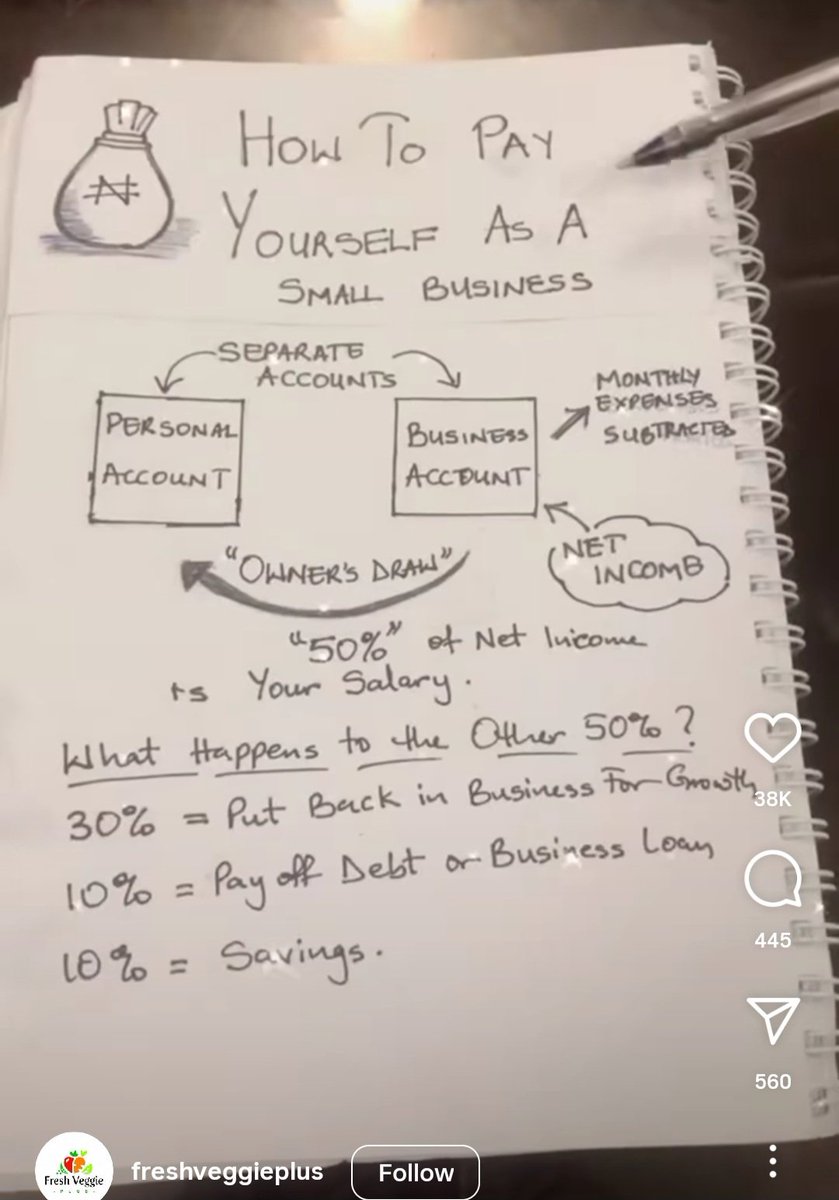
HOW TO PAY YOURSELF AS A SMALL BUSINESS OWNER
I came across this online, and since I’ve tried it myself, I can confidently recommend it to any small business owner (SBO) struggling with cash flow.
One major mistake most SBOs make is running business transactions through their personal accounts. This rookie mistake often leads to overspending and poor financial control. To avoid this, you must have two separate accounts: one for your business and one for personal use.
All business expenses should be paid strictly from the business account. This makes it easier to monitor expenses and accurately determine your profit margin at the end of a given period.
I also recommend using a simple Excel template to record and track your revenue and expenses daily. This way, you can easily assess the financial health of your business at a glance.
At the end of the month, after deducting all expenses, such as staff salaries, raw materials, supplies, staff motivation, transportation, marketing, taxes, miscellaneous costs, etc., from your revenue, whatever remains is your income.
This is where many SBOs become lazy and undisciplined. They start spending the income recklessly because they believe they can always make the money back and don’t answer to anyone. After all, it’s “their money.”
You can not have this mindset if you plan to grow and expand your business.
Instead, do this:
1. Pay yourself 50% of the income as an employee
There is you, and there is your business. Treat your business as a separate entity. When closing your books for the month, pay yourself a salary just as you pay your staff. Transfer this 50% into your personal account. This should cover your personal savings, expenses, and enjoyment.
2. Reinvest 30% of the income back into the business
This does not have to be spent immediately if there’s nothing urgent to purchase. You can set it aside until it’s enough to acquire new equipment or fund business growth. Just ensure the money is strictly reserved for the business.
3. Use 10% to pay off debt or business loans
If your business is debt-free, you can add this percentage to your business savings.
4. Save 10% in an interest-yielding platform
This savings is for your business, not your personal savings. Over time, it helps build financial stability and future expansion capacity.
I hope this helps someone out there. Financial discipline is especially challenging when you run a business that brings in daily income, but it’s also what separates sustainable businesses from struggling ones.
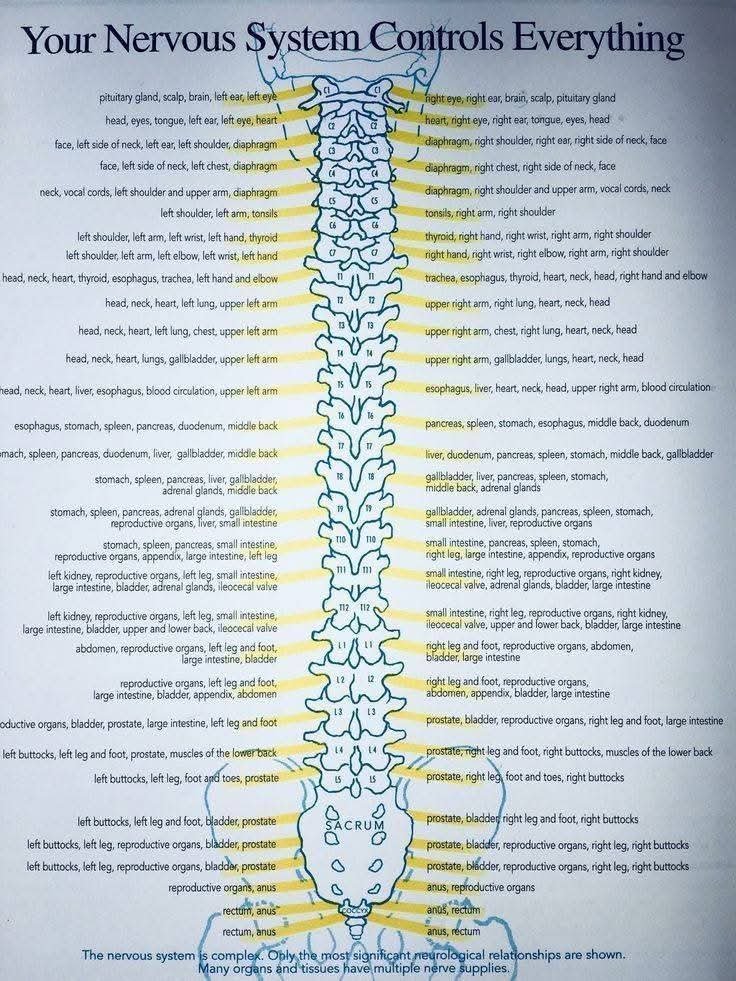
Your spine isn’t just a backbone, it’s your body’s "wiring harness."
Your spine isn’t just a stack of bones.
It’s the main cable connecting your brain to every organ, muscle, and sensation in your body.
Each level of your spine sends out branches (spinal nerves) that control specific regions.
That means:
• A nerve in your neck can affect your shoulders, arms, or even your diaphragm.
• A nerve in your mid-back can influence digestion.
• A nerve in your lower back can change how your legs feel or move.
• Pelvic nerves can affect bladder, reproductive organs, and bowel function.
Here’s why this matters:
🔹 Poor posture compresses nerves → headaches, tingling, tightness
🔹 Weak core or glutes shift spinal load → lower-back pain, hip issues
🔹 Stress changes muscle tone → tightening around the spine, altered nerve signals
🔹 Sedentary habits reduce blood flow to spinal tissues → stiffness, inflammation
🔹 Injuries can irritate nerve roots → pain that radiates far from the spine
When a nerve is irritated, the organ or muscle it serves can’t communicate as well with the brain.
That doesn’t mean one vertebra controls your entire life—but it does mean the quality of your nerve signaling affects how well your body functions.
Your nervous system really does control everything you do -
movement, breathing, digestion, heartbeat, hormones, reflexes, pain, emotion.
Protecting your spine means protecting every system that depends on it.
If you’ve ever felt pain in one place but the issue was somewhere else
I can see this post has gone international. One day I'll take time and talk about these things like the Willow Bark tree used to make aspirin, the Acacia specie used as contraceptive, actually it's still being used in Turkana counties and Egypt, Dawa ya wazee, Prunus africana, used as a Viagra within the Rift Valley,Solanum incanum, locally known as Senetwet or Sosiot, ile inawekwangwa kwa Mursik inakaa makaa and the East African sandalwood whose exploitation was banned in 2007 by President Kibaki. Sandalwood is useful from leaves to roots. It was used to treat ulcers and making perfumes. The famous aromatic heartwood. It's very very valuable ( See the post below). Apart from being an active citizen on matters governance, I am also a degree holder in Natural Resources Management that's why on my advocacy for good governance I have been extending to calling out the looting of mineral resources, environmental degradation,forest encroachment and water resources because these are topics I am well informed on.
Let me jog your mind kidogo. When we were kids, we watched a film called Gods must be crazy. In this film, the bushmen(the san) are seen chewing a succulent plant called hoodia to quench thirst and hunger. This plant is what the Council for Scientific and Industrial Research (CSIR) of South Africa has been using to make slimming pills, the ones people are swallowing all over the world. In 2003, the bushmen petitioned CSIR, mtu aliwachanua, and they won the petition in the grounds that they are the inhabitants of the forest this tree is made. On 28th March 2023, they signed a benefit-sharing agreement in the Northern Cape, in terms of which the community was to receive between R8-million and R12-million from the sales of slimming pills. I read about it in campus. The concept behind calling herbalists witches was to keep Africans from herbal drugs so that the resources could be exploited for pharmaceutical companies.
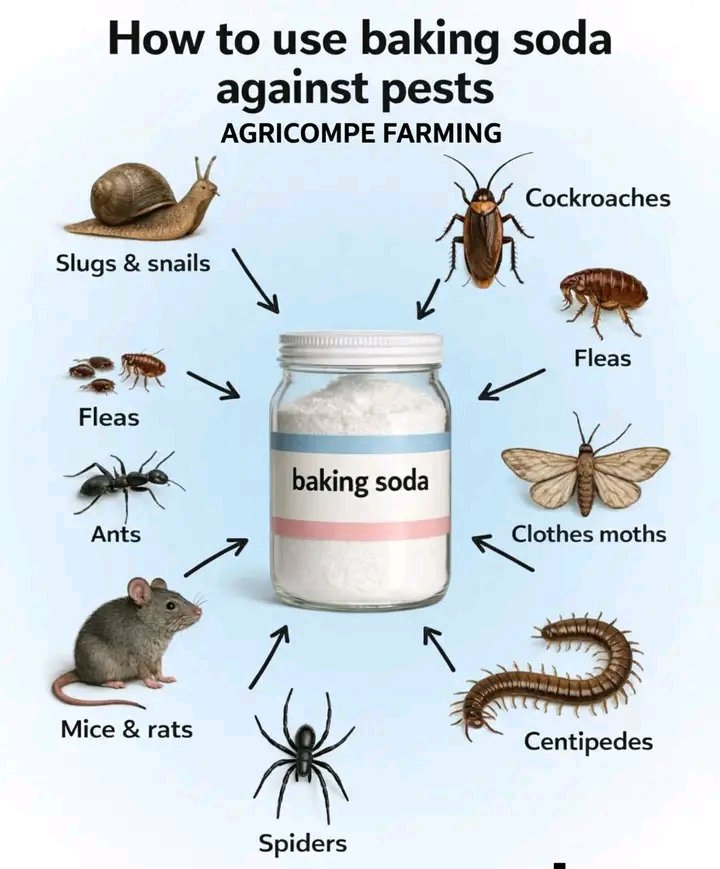
BAKING SODA FOR PEST CONTROL 🌿
Baking soda is cheap, safe, and handy. With a few simple tricks, it can help keep pests away without using strong chemicals.
1️⃣ Cockroaches
Mix equal parts baking soda and sugar. Sprinkle behind fridges, stoves, and in dark corners.
2️⃣ Fleas
Blend baking soda with fine salt. Spread on carpets, rugs, and pet bedding. Leave for hours, then vacuum well.
3️⃣ Ants
Combine baking soda with powdered sugar. Place near ant trails, doorways, and nest spots.
4️⃣ Clothes Moths
Keep an open bowl of baking soda in wardrobes or storage boxes to reduce smells and discourage moths.
5️⃣ Mice & Rats
Mix baking soda with flour. Put small amounts along walls, holes, or places where rodents roam.
6️⃣ Spiders
Dissolve baking soda in water. Spray lightly into corners, behind furniture, and cracks.
7️⃣ Slugs, Snails & Centipedes
Sprinkle baking soda directly on paths or problem areas—avoid sprinkling on plants.
💡 Extra Tip
This method is gentler than chemical sprays and safer for homes with kids or pets.
UNDERSTANDING CHICKEN DIARRHEA: WHAT THE COLOR TELLS YOU AND HOW TO TREAT IT
Chicken droppings can tell you a lot about the health of your flock. Changes in color, texture, or smell often signal illness, stress, or digestive imbalance. Knowing how to read these signs helps you act quickly before the condition spreads or worsens.
YELLOW DIARRHEA
Yellow droppings often show coccidiosis or a bacterial infection such as clostridial enteritis. It may also appear when chickens are stressed or when you suddenly change their feed.
Treatment:
1. For coccidiosis, add Amprolium 20% powder at 1 gram per 2 liters of drinking water for 5 to 7 days.
2. For bacterial infection, give Oxytetracycline at 1 gram per liter of water for 5 days.
3. Follow up with a probiotic supplement for 3 to 5 days to restore healthy gut bacteria.
GREEN DIARRHEA
Green droppings usually come from excess bile due to rapid gut movement or infection. It can also appear when birds are not eating enough, stressed, or exposed to diseases.
Treatment:
1. Provide a multivitamin and electrolyte solution in water to help with recovery and hydration.
2. If a bacterial infection is suspected, use Enrofloxacin 10% oral solution at 1 ml per liter of water for 3 to 5 days.
3. Isolate affected birds immediately to stop the disease from spreading.
WHITE DIARRHEA
White, chalky droppings are a sign of fungal or yeast overgrowth (candidiasis), or a disturbed gut system after antibiotic use or poor hygiene.
Treatment:
1. Give Nystatin oral suspension at 100,000 IU per liter of drinking water for 5 to 7 days.
2. Clean and disinfect all feeders, drinkers, and water lines before refilling.
3. Avoid unnecessary use of antibiotics and add probiotics regularly to the diet.
RED OR BLOODY DIARRHEA
This is the most dangerous type. It usually means severe coccidiosis, intestinal bleeding, or a heavy worm load. If left untreated, death rates can be high.
Treatment:
1. Use Amprolium 20% at 1 gram per 1.5 liters of drinking water for 7 days.
2. If you suspect mixed infections, use a Sulfaquinoxaline combination product as per label instructions.
3. Deworm using Albendazole at 1 ml per liter of water for 2 days, then repeat after 14 days.
4. Add vitamins A and K in the water for 3 days to help healing and blood clotting.
WATERY OR FOAMY DIARRHEA
Very loose or foamy droppings often come from feed spoilage, heat stress, poor-quality water, or early bacterial infection. It can also happen when feed contains too much salt or fat.
Treatment:
1. Check feed freshness and remove any moldy or spoiled feed.
2. Give clean, cool water mixed with electrolytes and vitamins to prevent dehydration.
3. Add probiotics to balance gut microbes and strengthen digestion.
4. In serious cases, treat with a broad-spectrum antibiotic like Oxytetracycline at 1 gram per liter of water for 3 to 5 days.
Always keep chicken houses clean and dry, avoid overcrowding, and provide fresh water at all times. Early detection and quick action save your flock from heavy losses.
#ChickenFarming
As brainwashed masses run in pacifist marathons organized by their oppressors, Kenya's little remaining sovereignty is being auctioned by the terrorists who kill them & their children while spitting "chuKuA kuRa" in their faces.
The reckoning is on the horizon.
Mtajua hamjui.