Just unlocked the Early Quacker on @wallchain_xyz 🏆
How cool is that?
Feels great to have my contributions recognized.
How’s Wallchain Quacks been treating you so far?
Not on board yet? Drop a comment for an invite 👇🦆
What if robotics infrastructure isn't just a lab, but a data factory?
Tasks enter → humans interact with simulated robots → trajectories are generated → data is verified → models learn → better policies create more training.
The loop compounds.
That's the compounding data engine @axisrobotics is building for Physical AI.
The output isn't another chatbot.
It's experience for machines.
Because robots operating in millions of unpredictable real-world situations need infrastructure that can continuously generate useful experience.
That's the part of Physical AI I'm watching closely.
🎙️ Here's a podcast breakdown enjoy.
Ever put hours into a campaign, only to watch a post with zero substance win because of empty reach?
It is incredibly frustrating when the scoring process is a complete mystery, creators put in genuine effort and they deserve clear scoring and reward rules before they begin working. This is why I really appreciate the approach @swaymarkapp is taking to fix this
Instead of relying on hidden metrics, they require campaigns to publish their exact brief, content rules, scoring weights and the reward pool upfront, they also verify X authorship for every submission and ensure that your content quality, X performance and creator reputation are all scored completely separately. Once a campaign wraps up, final rewards are calculated directly from the finalized leaderboard based entirely on those published rules.
My takeaway is simple, true fairness does not mean a guaranteed win, but it should mean you understand the exact rules before you decide to play. When you remove the guesswork and make the criteria transparent, the process stops being a gamble and becomes a space where real creativity is respected.
Remember when getting into a new ecosystem meant five tabs open, three different bridges, and one silent prayer that you didn't just send your funds into the void?
Ladies and Gentlemen, I'm glad to tell you that era is ending. 😅
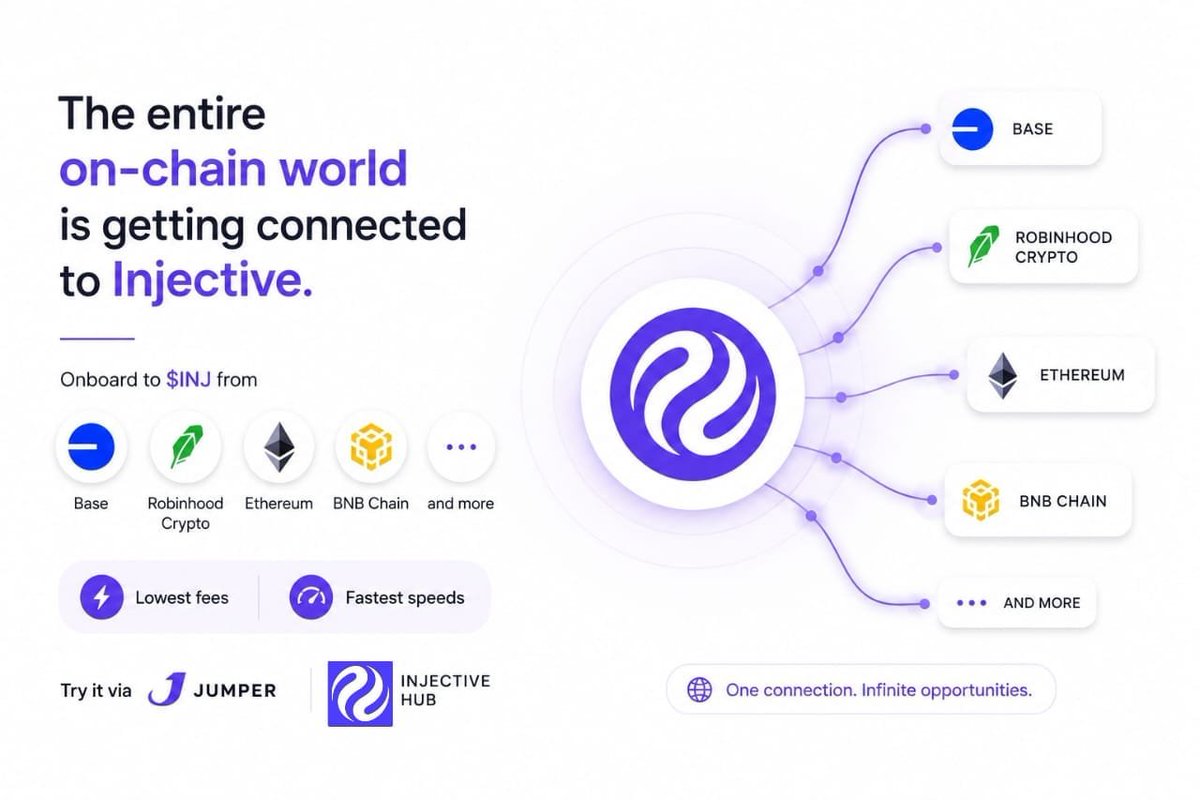
The entire on-chain world is getting connected to Injective.
As of today, you can onboard to injective-protocol:native directly from @base, @RobinhoodCrypto, @ethereum, @BNBCHAIN, and more, all with the lowest fees and fastest speeds available.
🗣️🗣️: I'm lost. What does this actually mean?
It doesn't matter which ecosystem you're coming from anymore.
Whether you're already deep in Ethereum, holding assets on BNB Chain, building on Base, or even just using Robinhood, there's now a direct, low-friction path into Injective from where you already are.
No hopping between five different tools hoping the rates and routing actually make sense.
🗣️🗣️: So why does this matter to the community?
For everyday users, it's a dramatically simpler onboarding experience, with no need to become a bridging expert just to try Injective.
For the ecosystem, it means liquidity and new users flowing in from some of the biggest platforms and chains in the industry, not a trickle, a real pipeline.
And for builders, it reinforces Injective as genuinely reachable infrastructure, not an island you have to work hard to reach.
Try it out via @jumperapp or the Injective Hub today.
Most people bet on who they think will win.
Value bettors focus on the price.
If fair odds are 2.00 and a book is still offering 2.10, that gap is the opportunity.
Those gaps appear because bookmakers don’t always react to news, lineups or sharp market moves at the same speed.
@Oddsbanditcom scans thousands of markets and surfaces those mispricings.
You won’t win every bet.
The goal is simple:
Find value.
Take the better price.
Repeat over time.
No chasing. No vibes. No pretending every bet is a lock.
And always bet within limits you can afford.
That’s how to bet responsibly.
Most people judge a chain by how many apps it has.
The better question is:
can those apps actually share the same market?
On most chains, liquidity is split.
Each app creates its own pool.
Each market starts empty.
Buyers and sellers get scattered.
@injective works the other way.
The order book lives at the protocol level.
Apps do not build their own exchange from scratch.
They plug into one shared market layer.
That means:
1. Liquidity is shared across apps
2. New products can tap into existing buyers and sellers
3. Markets get deeper instead of more fragmented
4. Traders see better prices and less slippage
Think of it like this:
Other chains give every shop its own tiny market.
Injective puts one big market in the middle, then lets many shops use it.
That is why @injective feels different.
It is not just another place to launch apps.
It is a place where those apps can plug into a live financial layer from day one.
Not more pools but one shared book.
Sunday vibes
Rest your mind, count your blessings, and prepare for a better week ahead.
No matter how this week went, you’re still here, and that’s something to be grateful for.
What’s one thing you’re grateful for today? Drop it below 👇
Everyone is talking about humanoid robots. But there's a less flashy problem that could determine how quickly they actually become useful: DATA. Here's why Physical AI needs a completely different data infrastructure. @axisrobotics 🧵
Imagine waking up tomorrow with an incredibly powerful brain but you've never experienced the physical world.
You don't know how to move a object.
What if you gave an AI a powerful brain, but it had never experienced the physical world?
It wouldn't know how a cup feels, how objects move, or what happens when it pushes something too hard.
That's the challenge Physical AI faces.
Robots don't just need bigger models.
They need experience and experience comes from data.
This is why @axisrobotics caught my attention.
By combining simulation, human interaction, trajectories, and verification, Axis is building a system that helps robots continuously learn from experience.
The goal is simple:
Experience → Data → Training → Better Robots → More Experience
Because the future of robotics might not just depend on how smart we make AI.
It may depend on how much of the real world we can teach it.
Link:https://t.co/eUDXyIlBU4
Just joined the @Barbera_1870 community! ☕🇮🇹
There’s something special about discovering a coffee tradition that has been around for 150+ years and becoming part of its community.
I am really Looking forward to following the journey and sharing the ritual along the way.
#Coffee #Barbera1870
Reducing Unnecessary Data Exposure Online.
Most digital platforms still collect more personal information than they actually need. Completing even basic actions often requires sharing full details, even when only one specific fact is relevant. Over time, this pattern increases exposure and reduces individual control over personal data.
A more precise approach is possible. Systems can be designed so that users prove only the information required for a given action, while keeping everything else private. This method supports necessary verification without creating large collections of unused personal data.
@Concordium is built with this principle in mind. Its identity framework allows people to confirm relevant attributes without revealing complete personal records. The result is a more balanced interaction between privacy and functionality.
As digital services continue to expand, designs that limit unnecessary data sharing will become increasingly important for everyday users.
$CCD
#ConcordiumAmbassador
⚠️ The important part of Proposal #42 isn’t the vote. It’s what changes for ETHB users if it passes.
#JustLendDAO is proposing to reduce the ETHB Collateral Factor from 75% to 45% while increasing the Reserve Factor from 10% to 100%.
That means:
• Collateral Factor: 75% → 45%
• Reserve Factor: 10% → 100%
For ETHB suppliers using their position as collateral, the lower collateral factor means the same amount of ETHB would support a smaller borrowing capacity.
So if you currently use ETHB as collateral, your account health deserves attention before and after the proposal takes effect.
This is what protocol governance is really about: adjusting risk parameters before they become larger problems.
🗳️ Read Proposal #42 or cast your vote:
https://t.co/awh75bMCJ0
@DeFi_JUST@justinsuntron #DeFi #TRONEcoStar
$MOTION is on $INJ
⠀⠀⠀⠀⠀⠀⠀/\_/\
⠀⠀⠀⠀____/⠀•⠀•)
⠀_____/⠀⠀⠀⠀⠀/
_/____________/
⠀⠀/⠀/⠀/⠀/
>>>>>>>>>>>>>>>>>
Rebuilding basic exchange plumbing from scratch drains developer time and capital. You spend months coding baseline market mechanics before a single user touches your product.
@injective completely bypasses that grind. Instead of just handing you an empty virtual machine, the core financial modules are hardcoded directly into the base layer.
When a team deploys here, they instantly tap into a native onchain orderbook, spot markets, and derivative structures. The network handles the heavy lifting.
Oracle feeds and cross-chain bridging sit ready to go. There is even a native Insurance Module designed specifically to underwrite derivatives markets and handle risk.
Whether you build with CosmWasm or deploy on the native EVM, the underlying architecture is unified.
Builders skip the tedious plumbing and go straight to shipping actual products. When you remove the need to reinvent basic exchange mechanics, development cycles shrink drastically.
The focus shifts entirely to what actually counts, capturing market share and drawing in liquidity.
$INJ 🔥🥷
Crypto is coming off a massive week, but the catalyst calendar isn't slowing down.
Several events this week could decide whether the current momentum continues or traders start taking profits.
Here are the catalysts I'm watching closely. 🧵
#Crypto#Altcoins
𝗛𝘂𝗺𝘆𝗻𝗹𝗮𝗯𝘀 𝗶𝘀 𝗰𝗿𝗲𝗮𝘁𝗶𝗻𝗴 𝗮 𝗱𝗮𝘁𝗮 𝗽𝗹𝗮𝘁𝗳𝗼𝗿𝗺 𝗳𝗼𝗿 𝗽𝗵𝘆𝘀𝗶𝗰𝗮𝗹 𝗔𝗜.
They collect thousands of hours of real human activities like what people see, hear, move, and feel and turn it into clean training data for robots.
Unlike language models that learn from the internet, robots need real world experience for messy everyday tasks such as ironing while a child runs past, restocking shelves in a crowded store, or assembling parts on a busy factory floor.
@humynlabs' approach uses four sensory streams captured in actual environments so robots can learn practical skills from human experience.