Statement : SBI has told the stock exchanges about its data breach, but not the customers whose data was leaked
New Delhi, 21 October 2026
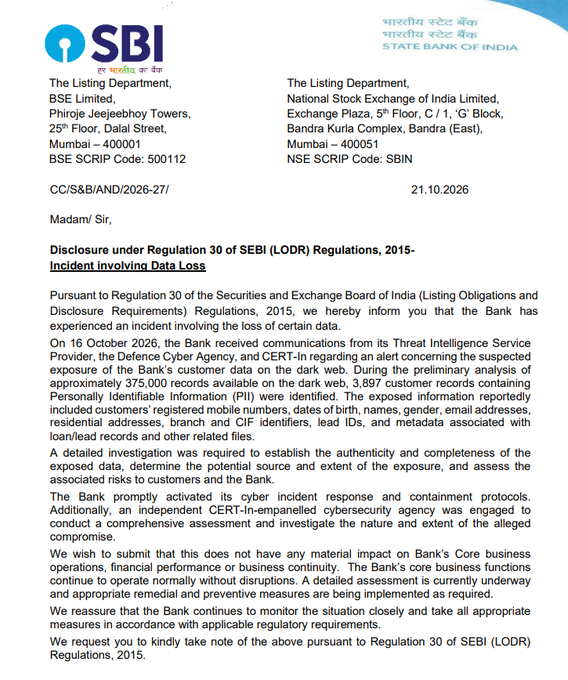
Today, the State Bank of India told the BSE and the National Stock Exchange, in a disclosure under Regulation 30 of the SEBI (Listing Obligations and Disclosure Requirements) Regulations, 2015, that it has experienced an incident involving the loss of customer data. On 16 October 2026 the bank received alerts from its threat intelligence service provider, the Defence Cyber Agency and CERT-In that its customers’ data was available on the dark web. Its preliminary analysis of about 3.75 lakh records found 3,897 customer records containing personal information. These include registered mobile numbers, dates of birth, names, gender, email addresses, residential addresses, branch and CIF identifiers, lead IDs and details linked to loan records. The bank says it does not yet know where the data came from, and it has engaged a CERT-In empanelled agency to find out.
SBI did not detect this breach itself and learnt of it from outside agencies after the data had already been published. On the same day, a threat monitoring account on X flagged a claim by a group calling itself “Siriusim” that it had released 3.75 lakh rows of SBI data and 2,722 PDF documents, including loan applications and account opening forms. The bank’s disclosure does not mention these documents. It also does not say what the remaining records, beyond the 3,897 it has identified, contain.
At the time of this statement, SBI has not said that it has informed any of the affected customers, and its disclosure is silent on the point. Five days passed between the alert and today’s filing. The filing assures investors that the incident has no material impact on the bank’s operations, financial performance or business continuity. However, it does not state anything to the 3,897 people whose phone numbers, dates of birth and home addresses are now with fraudsters. These customers are the most likely to receive calls from persons posing as SBI officials who can recite their account details back to them. A customer cannot guard against a fraud she has not been warned of.
The Internet Freedom Foundation calls on SBI to inform every affected customer directly and without further delay.
We regret to note that the law in force today does not compel the bank to do so. Section 8(6) of the Digital Personal Data Protection Act, 2023 requires a Data Fiduciary to intimate a personal data breach to the Data Protection Board and to each affected Data Principal, and Rule 7 of the DPDP Rules, 2025 prescribes how this is to be done. But the Union Government chose a staggered commencement, and these provisions will take effect only on 13 May 2027, nearly four years after Parliament enacted the law. The reporting obligations that apply today, under the CERT-In Directions of 28 April 2022 and the RBI’s cyber security framework for banks, are owed to regulators and not to customers. A listed bank is bound to keep the stock exchanges informed. No law in force clearly binds it to inform the people whose data it holds.
Our demands
1. SBI must inform each affected customer by SMS, email and letter to the registered address, in English, Hindi and the language of the customer’s branch, stating what data was exposed and what steps they should take. It should open a dedicated helpline and an online facility for customers to check whether their data is affected.
2. SBI must state what the 3.75 lakh records and the 2,722 documents contain, how many customers they relate to, and whether they include KYC documents such as Aadhaar, PAN or passport copies.
3. When the investigation concludes, SBI must disclose how the data left its systems, including whether it came through a vendor or a direct selling agent, and publish a summary of the investigating agency’s findings.
4. The Reserve Bank of India should direct all regulated entities to notify customers of personal data breaches within a fixed period, pending the commencement of the DPDP Act.
5. The Ministry of Electronics and Information Technology should bring Section 8(6) of the DPDP Act and Rule 7 of the DPDP Rules into force immediately.
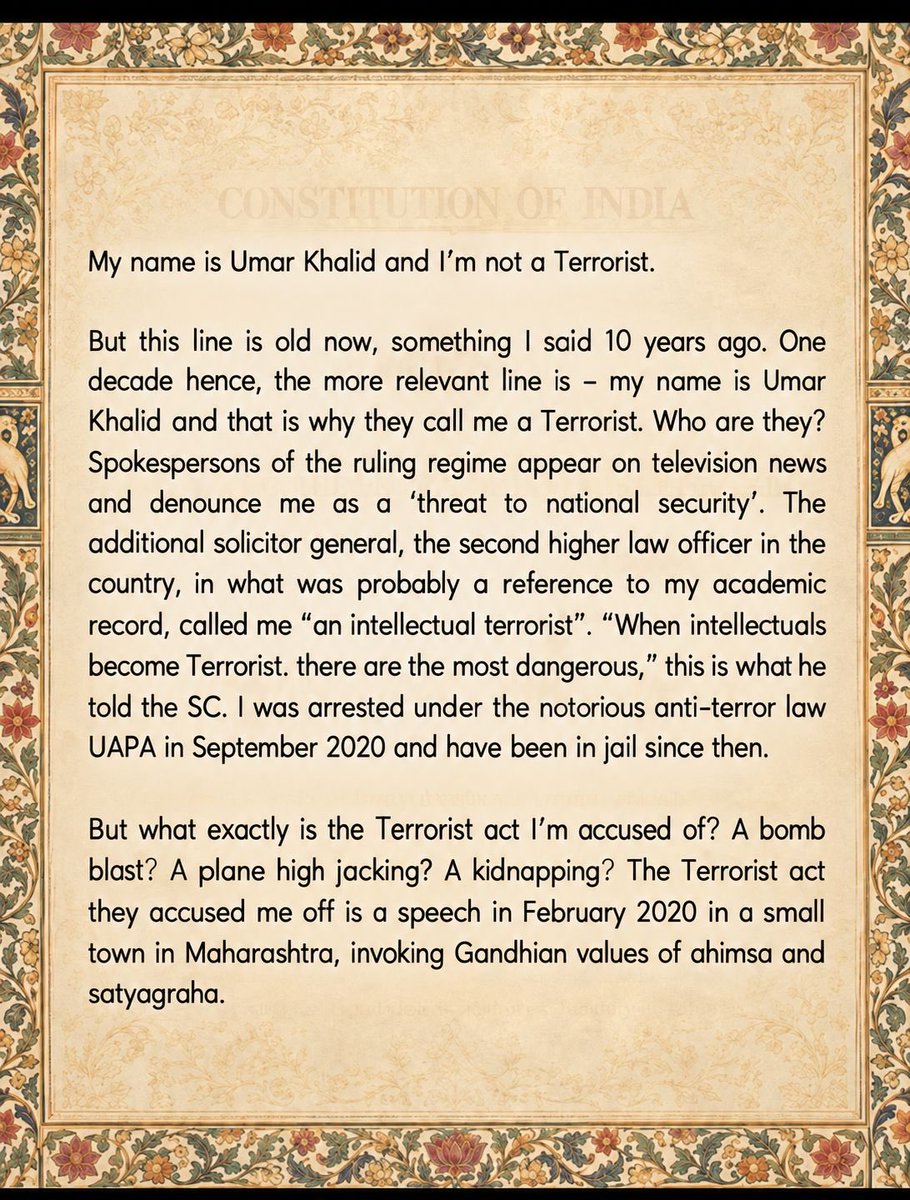
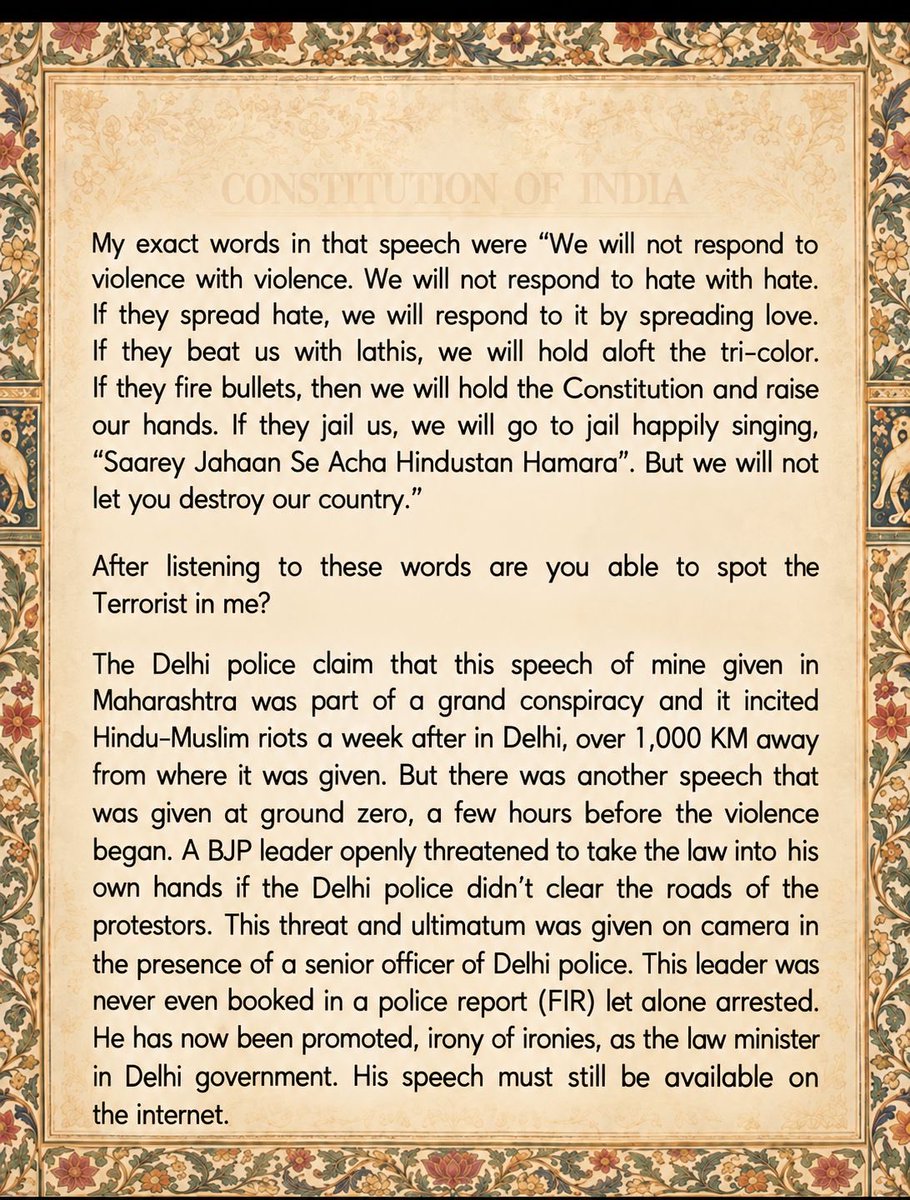
You’ve heard a lot about Umar Khalid through the media. But amid the media witch-hunt against him, there has been very little space for him to speak for himself, especially since he’s spent the last six years in jail.
So I want to tell you a little about my friend Umar, in his own words, as shared with his family and friends.
Manhandled, dragged, assaulted n misbehaved inside a police vehicle and dumped by the roadside - for the crime of speaking to the media.
This is not merely an assault on an MP. It is an assault on democratic freedoms and the rule of law. More chillingly, it happened within hours of the Supreme Court issuing directions to safeguard peaceful protest and constitutional rights.
I have written to the Hon’ble President of India @rashtrapatibhvn , the Chairman of the Rajya Sabha @VPIndia and the Chief Justice of India seeking urgent intervention and fixing accountability for the police personnel, and action on the question of parliamentary privilege.
The Government cannot intimidate democracy into silence. It cannot substitute the force of the baton for the force of debate. And it shouldn’t expect the people to surrender their constitutional freedoms merely because those in power find dissent inconvenient. The strength of a democracy lies not in its capacity to suppress dissent, but in its ability to address it.
"Tired of going to the Supreme Court again and again, I don't feel there is any use of going to the Supreme Court, I have lost trust,"- Sr Adv Kapil Sibal.
"We go to the Court, but I don't know if we will get any relief. The people of the country feel that this Government should go. If anybody can save the Constitution in these times, it is the Supreme Court of India. But I am tired of keeping on going to the Supreme Court. I am speaking for myself. I don't think there is any use of going there. I don't have much trust in the Supreme Court of India. Whatever has to happen, will happen."
"We told the Supreme Court many times that the voters' names are being wrongly deleted and wrongly included, we argued for months. The evidence is before the public. And the appellate tribunals now say 93% of the voters were wrongly removed. So the Supreme Court must have known. But no relief was given. So I am speaking for myslef, I don't have [faith]" - @KapilSibal says.
थोड़ा उमर ख़ालिद, शरजील इमाम को भी याद कीजिए। छह साल हो गए। ट्रायल भी नहीं। ज़मानत भी नहीं। आकृति चौधरी को भी याद कीजिए, जिस पर फ़र्ज़ी आधार पर NSA लगा दिया गया, सत्यम वर्मा को भी याद कीजिए। स्टेन स्वामी और साईं बाबा को भी। दस साल साईं बाबा को बिना किसी आधार के जेल में रखा गया।
सड़क पर सुरक्षा बलों की तैनाती आपातकाल की आहट बताई जा रही है। दरअसल यह तेरह साल की चुप्पियों के अपराधबोध की सांस्थानिक अभिव्यक्ति है।
So @UmarKhalidJNU in jail for six years- US mercenary Van Dyke uses Indian territory for actual terrorism & walks free in months. Bhardwaj is Swatantra in days. Need to be upper caste Hindu or white-skinned foreigner in India. Jai Hind.
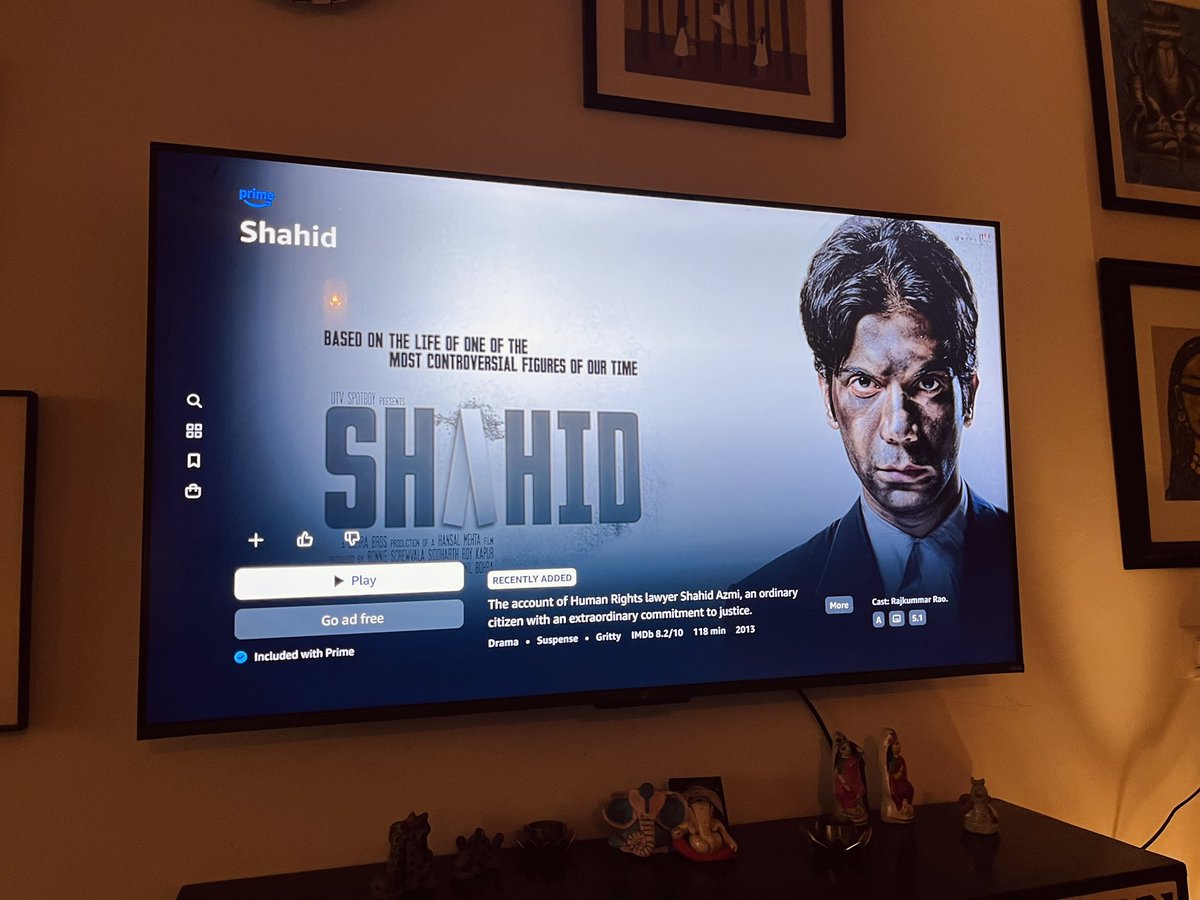
The National Award winning #Shahid is finally streaming on Prime Video. It took 13 years for our film to find a streaming home.
Shahid tells the story of Shahid Azmi, a lawyer who defended people accused under terror laws and fought for due process in a climate where Muslims were often presumed guilty before being proven innocent. He was murdered for that courage.
I’ve often wondered why Shahid remained without a streaming platform for so long. It was released a year before 2014. Then came a political climate in which dissenters, activists, journalists and those defending the rights of the accused increasingly found themselves under suspicion. In that same period, people like Umar Khalid have spent years in prison awaiting trial.
Many of us—filmmakers, actors and writers drawn to courageous stories like Shahid—either struggled to get such ideas made or were co-opted by the system into telling “kosher” stories that won national awards thanks to their political conformity and despite their mediocrity.
So why now? Why does a film like Shahid finally find a streaming platform in 2026? Has the mood changed? Is there growing resistance to the politics of fear?
Whatever the reason, I’m proud of this film. It established me as a co-writer/editor and brought me back to the kind of cinema I believe in.
Watch it if you haven’t. Watch it again if you have. This film, made by a wonderful team, is a reminder of the kind of courageous cinema we used to make and celebrate.
Thankyou @PrimeVideoIN ✊
#HansalMehta @RajkummarRao@Mdzeeshanayyub@JaiHMehta
Norway said that they are not going to play in World Cup in Qatar even if they qualified (they didn’t). Denmark left it until the last minute to confirm their participation in the World Cup 2022Germany forced their players to make political statements before the match in FIFA WC 2022 even though some players didn’t want to do it.
BBC literally disrupted the coverage of one of the best opening ceremonies of the World Cup in Qatar just for virtue signaling.
but for World Cup 2026, the whole media is silent other than a few token articles here and there and Norway and Germany aren’t protesting anything when there’s so much to protest about 🤡
Tucker Carlson interviews a British doctor who worked in Gaza.
"Four young teenage boys were brought in, all of whom who'd been shot in the testicles."
Under the sound of drones of the demonic Zionists, we still celebrate Arsenal's triumph in Beirut.
Next we'll celebrate a liberated Lebanon and a liberated Palestine from the scumbags next door.
The only reason to bomb anything 40 min apart is to kill the rescuers. Doing that to an elementary school is beyond depraved. The United States is the most evil entity on the planet
The Indian National Congress (INC) unequivocally condemns the targeted assassination of Iran's Supreme Leader, Ali Hosseini Khamenei, in a military strike carried out without a formal declaration of war. The INC extends its deepest condolences to the Supreme Leader's family, to the people of Iran, and the Shia community around the world in this moment of profound grief. We stand in solidarity with them as they navigate this grave crisis.
India's foreign policy is anchored in a commitment to the peaceful settlement of disputes through dialogue and respect for international law, as mandated in Article 51 of the Constitution of India. These principles-sovereign equality, non- intervention and the promotion of peace are foundational to India's civilisational values. Given this, the conflict in West Asia is deeply antithetical to our commitment to Vasudhaiva Kutumbaka ("the world is one family"), Mahatma Gandhi's doctrine of ahimsa (non-violence), Prime Minister Jawaharlal Nehru's policy of non-alignment.
The targeted use of force to destabilise the leadership and governing structures of a sovereign state whether in Iran or earlier in Venezuela-signals a disturbing revival of regime-change doctrines and coercive unilateralism. It also contravenes the United Nations Charter-especially Article 2(4), which expressly prohibits "the threat or use of force against the territorial integrity or political independence of any state," and Article 2(7), which forbids intervention in matters essentially within the domestic jurisdiction of any state. A targeted killing of a sitting head of state strikes at the heart of these international rules. Sovereignty is not conditional, and political legitimacy cannot be manufactured through force.
The INC reiterates that it is the inalienable right of every nation's citizens to determine their own political future. No external power has the authority to engineer regime change or dictate the leadership of another state. Such actions amount to imperialism and are fundamentally incompatible with a genuinely rules- based international order.
Tunisian director Kawthar Ben Haniya declined her Berlin Film Festival award for The Voice of Hind Rjeb in protest of honoring Israeli General Noam Tibon.
She said: “Peace isn’t a perfume to cover up violence.”
Mad RESPECT