Dear Zuha,
I know you are inquisitive about how our religious days fit into the modern world. It is a brilliant question. I will be breaking this down for you so you can clearly see that Islam is not a copycat. It is a complete system with its own deep, independent roots.
Firstly, you asked: if the Gregorian calendar is not real, why do Muslims pray on Friday, and is there a different Friday in the Islamic calendar?
To help you and others understand, we have to go back to history.
Pope Gregory was the one who introduced the Gregorian calendar, and he introduced it in 1582. However, when you look at Islamic history, you will see that Muslims had been observing Jumu'ah for nearly a thousand years before that Pope was even born. If you open classical books of Islamic history such as the Seerah of Ibn Hisham or The Sealed Nectar, the physical proof is right there.
These books documented the very first Jumu'ah prayer held by the Prophet Muhammad (peace be upon him) in 622 CE. It took place in the valley of Ranuna during his migration from Mecca to Medina. In that same era, Allah revealed an entire chapter in the Quran called Surah Al-Jumu'ah, where He commanded the believers to leave their worldly trades and gather. This proves Yawm al-Jumu'ah was a lived reality in the 7th century, over 900 years before the Gregorian calendar existed in Rome.
Now, you might wonder how this connects to the Friday we know today. Frankly, the seven day weekly loop is an entirely different system from how we count solar or lunar months. It is an ancient, unbroken mathematical cycle. You do not even have to take my word for it. Non Muslim historians and sociologists agree on this.
For instance, Eviatar Zerubavel in his book The Seven Day Circle confirmed that this weekly cycle has remained completely unbroken for thousands of years across different empires. The day the Western world decided to call Friday aligns seamlessly with the sixth day of that ancient cycle.
In Arabic, the days are just numbered. Sunday is Day One. Monday is Day Two. The sixth day is Yawm al-Jumu'ah, the Day of Gathering. This means we do not pray on this day to honor a Roman calendar. That is, it was just a coincidental relationship. We pray on it because Allah established it on a divine timeline.
Secondly, you asked: why is Friday night considered so blessed, and what are you missing here?
To understand this, we have to look at the foundations of human existence. Friday goes more than just the end of the work week. The Prophet Muhammad (peace be upon him) taught us that Friday is the day Prophet Adam (peace be upon him) was created, the day he entered Paradise, the day he was sent to earth, and the day the world will end.
This is why the Prophet had a very profound routine. Every Friday during the early morning Fajr prayer, he would recite Surah As-Sajdah and Surah Al-Insan. He did this deliberately. These two chapters detail the creation of the universe, the biological creation of man, and the intense realities of the Day of Judgment. Praying these chapters every Friday morning is a divine reset. It reminds you of your origin and your final destination, both of which are tied to this specific day.
Because Friday carries the heavy weight of the end of times, reciting Surah Al-Kahf is your spiritual shield. The Surah contains stories about the ultimate trials of wealth, power, and faith. Reading it provides a divine light that protects your heart from the materialistic noise of the world and the deception of the Dajjal until the next Jumu'ah.
So by this fact, you are not missing anything. You just need to see that we are not following a Gregorian Friday. We are following a divine timeline. Don’t fret.
Allah knows best.
“For the future and man's practical activity, Islam calls to create a society whose laws and socio-political institutions will maintain and not violate this harmony. A permanent searching through history. This is the aim of Islam and its specific historical duty in the future”
i've never met Dr. Eyad Qunaibi. Never emailed him, never DM'd him. But I spent months building him a website, a content pipeline, and a multi-language knowledge base. 3,800+ pieces of content.
why?
i've been following his work for years... he does something you don't see much in religious content: structured, scientific arguments grounded in shariah.
no overly-emotional messaging, no vague appeals. you can follow his reasoning step by step until you either agree or know exactly where you disagree. alot of Islamic content I come across tries to get you to feel something first and think later. he... goes the other way.
and as a founder, my instinct is to create something new.
original idea, original brand, build from zero.
but sometimes the most useful thing you can do is find someone whose ideas deserve a bigger audience and build the infrastructure to get them there.
his reach was basically YouTube and a mobile app.
no website.
i checked the domains and they were just sitting there, so I grabbed them.
i reverse-engineered the app's API, extracted years of content, and built a pipeline that automatically transcribes every new YouTube video, formats it, translates it to English and French, and interlinks it with his entire body of work. All searchable, all connected.
it's also fully *self-updating*
the ideas don't need to be invented, they just need to go where people will actually find them. Web, SEO, and increasingly AI channels like ChatGPT where this kind of content was completely invisible before.
i keep wondering how many people with genuinely important ideas are stuck behind a distribution problem they don't even know they have.
link below
Imam al-Ghazālī رحمه الله says:
“If a person had a beloved and was told, ‘If you abstain from seeing her tonight, she will be yours for a thousand nights without toil or hardship. But if you visit her now, you shall never see her again,’
The passing of Syed Muhammad Naquib al-Attas is a tremendous loss. A towering scholar has returned to his Lord in this blessed month. May Allah be pleased with him and accept his efforts.
إنا لله وإنا إليه راجعون
Chinese scientists have developed,
The best shortest-path algorithm in 41 years!
A team from Tsinghua University has broken Dijkstra's "sorting barrier" - the first improvement since 1984.
Just use for a world-map 🤯
Paper - https://t.co/0AhR5O7vl4
https://t.co/a9KMVRuYGx
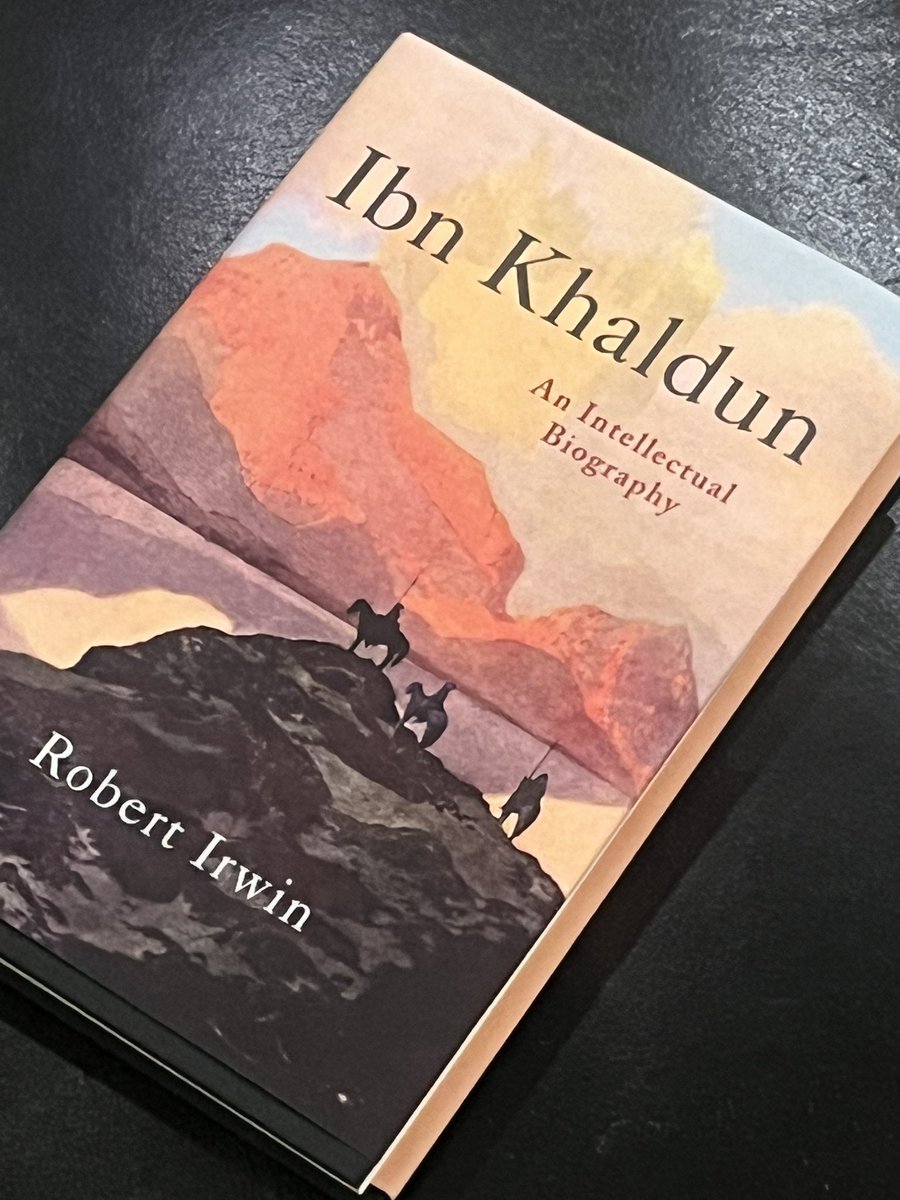
My last read of 2025 - a book about my favourite philosopher, Ibn Khaldun. This 14th century thinker explains the world and its affairs through two sets of causes - objective (derived from Nature) and subjective (derived from culture).
The interplay of these two types of causes creates the right royal mess that is human history. But, through reason and reflection, it is possible to discern patterns in how empires rise and fall, in how economies move from growth to decay, in how new vitalising ideologies turn into brain dead official orthodoxies, and into how different types of societies emerge, interface, and collapse.
Collapse for Ibn Khaldun is inevitable- empires rarely endure beyond a few hundred years, civilisations maybe a few thousand, but this is all part of the gigantic recycling machine of history - a machine that defies control since its momentum arises from fundamental defects in human nature.
Ibn Khaldun is arguably the first ‘modern’ philosopher of history, sociologist, economist, psychologist, and political philosopher. It is a shame that many writers freely borrow from him without acknowledgment or are genuinely ignorant of his contributions.
This bodes ill. Readers used to outnumber non-readers 2 to 1. Now non-readers outnumber readers 3 to 1.
It's hard to imagine a change of that magnitude not having significant effects.