Open-model inference provider for Europe, private by default. Open and independent intelligence, behind an API you already know. Backed by @ycombinator
Hello World!
We're launching our open-model inference platform for Europe, private by default, open to anyone.
Because it's a launch day, free tier is for everyone!
https://t.co/A756xuWXAf
Munito Sandboxes is in public preview: a cloud computer on demand for each task, on bare metal in Europe.
A sandbox is a Linux microVM with its own kernel, its own disk and its own network.
What you get
→ Docker inside, SSH, and a URL for any port
→ Pause, resume and fork, so an experiment branches instead of starting over
→ A desktop when the agent needs eyes and hands
→ Internet access stays off until you turn it on
→ 1,000 of them started in about a second, each with its own kernel
What it costs
→ $0.0072 per vCPU-hour and $0.0009 per GiB-hour, up to 8 vCPUs and 16 GiB
→ So a 2 vCPU, 4 GiB sandbox is $0.0180 an hour, against $0.1656 at @e2b and at @daytonaio
→ Billed per second while it runs. A paused sandbox pays for no time, and a persistent one pays only for its saved state, $0.0002 per GiB-hour
That is about 90% less for CPU and memory.
Start at https://t.co/m1jXHRBpzp
I'm a founder @ycombinator. My inference optimization loop needed hundreds of cloud computers at once, so I built them.
This is the third complex large scale system I've built during the batch. But who's counting!
Today it's a product: Munito Sandboxes, in public preview. Cloud computers on demand, a Linux microVM for each task, on bare metal in Europe.
@munitoai serves open models on European compute. Our margin depends on serving them well, so the loop runs against our own stack: rewrite a serving setup, measure it, keep what wins. It needs a clean computer for every experiment, hundreds at once. Nothing was built or priced for that, so I built it. Munito has run on it for months.
Measured from my laptop against the public API:
→ 1,000 sandboxes started in about a second
→ a 16 vCPU / 32 GiB machine running 2 seconds after the call
→ for the launch, 32,752 started at once, each painting one pixel. The picture finished in under a minute, zero failures.
Each one is a real computer: its own kernel, disk and network. Docker inside. Pause, resume and fork, so an experiment branches instead of starting over. A URL for any port. A desktop when the agent needs eyes and hands.
If you run AI agents, RL rollouts, evals or CI at volume, this is for you. Tell me what you're building: [email protected]
LightOnOCR-3-4B: small model, high-quality OCR. Now on Munito.
LightOn's olmOCR-Bench reproduction: 86.1 for LightOnOCR-3-4B, 81.9 for Mistral OCR 4.1.
Munito global standard: $4/1,000 pages. EU/US: $4.40/1,000, volume discounts on demand.
https://t.co/QkgQeHRkUa
Open models still need someone to run the infrastructure behind them.
@alexeyeryshev saw that challenge firsthand while leading inference at Mistral. Now, he’s building @munitoai to make it easier for developers to run open models in Europe.
The platform offers compatible APIs, inference and storage within the EU, without requiring developers to manage GPUs themselves.
The idea is to give developers more control over where their AI runs, while keeping the infrastructure simple enough to work with the tools they already use.
Read more on the Fondo blog 👇
https://t.co/e7AOZwBzjB
Abliterated GLM-5.3-Flash, DeepSeek V4.1 Flash and Qwen3.8-27B are available on Munito AI for verified teams: inference and storage in the EU, no retention by default, access after a KYC check and a support request.
Get access: [email protected]
A cache helps only when each turn reaches it.
So each package sends a session key with every turn: pi in the x-session-affinity header, Hermes Agent and OpenClaw as prompt_cache_key. Munito AI sends the turn to where its prefix is cached.
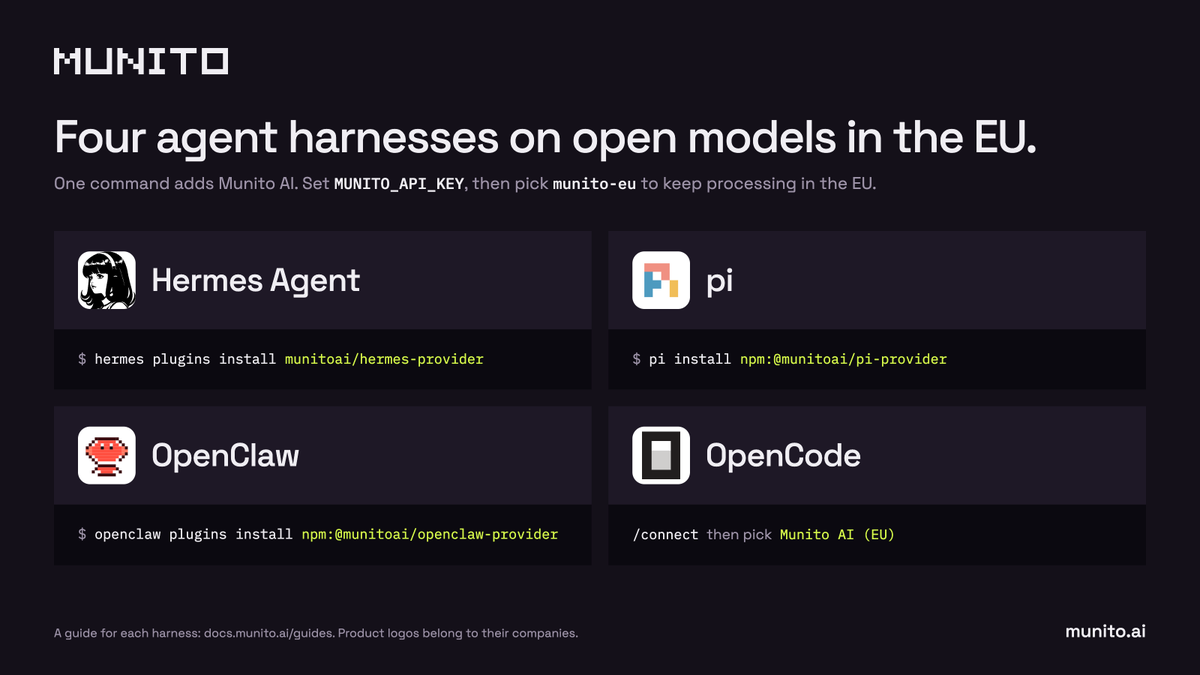
Four agent harnesses on open models in the EU:
@NousResearch's hermes plugins install munitoai/hermes-provider
pi install npm:@munitoai/pi-provider
@openclaw plugins install npm:@munitoai/openclaw-provider
@opencode: /connect, then Munito AI (EU) Set MUNITO_API_KEY and pick munito-eu.
For an agent, the cached-input price is the one that counts.
Each turn resends the whole conversation. Most of that input is a prefix the model already read.
On GLM-5.3-Flash and DeepSeek-V4-Flash, cached input costs about a fifth of new input. No fee to write the cache.
@QwenAIFans@alexeyeryshev@ycombinator@Zai_org@Alibaba_Qwen@deepseek_ai We don't provide support for any server side tool calls. But for a local-first coding harness this shouldn't be too much of an issue. Plain tool-calls are fully operational thought.
We're planning to add server-side tools (web-search, image generation, something else?) soon.
https://t.co/qCB4Qrzx2X has officially launched on @ycombinator, an open-model inference provider for Europe, private by default.
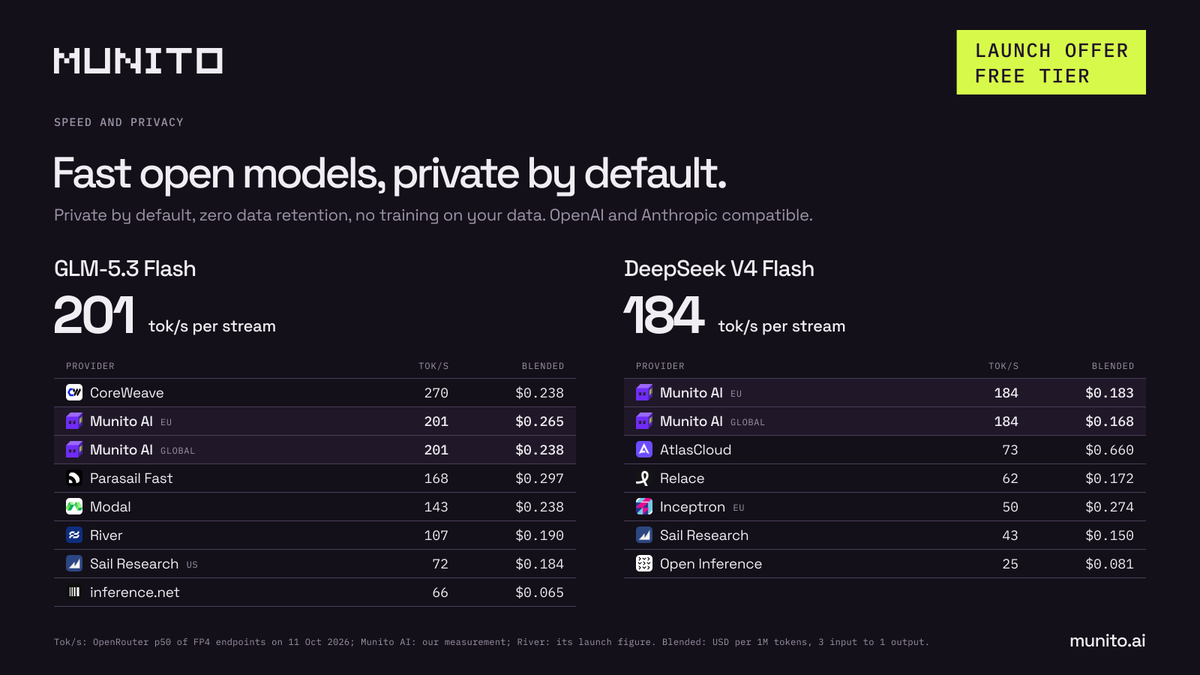
Point your OpenAI SDK or Claude Code at Munito and run GLM (@Zai_org), Qwen (@Alibaba_Qwen) and DeepSeek (@deepseek_ai) in the EU.|
https://t.co/U4aXJtDSXW
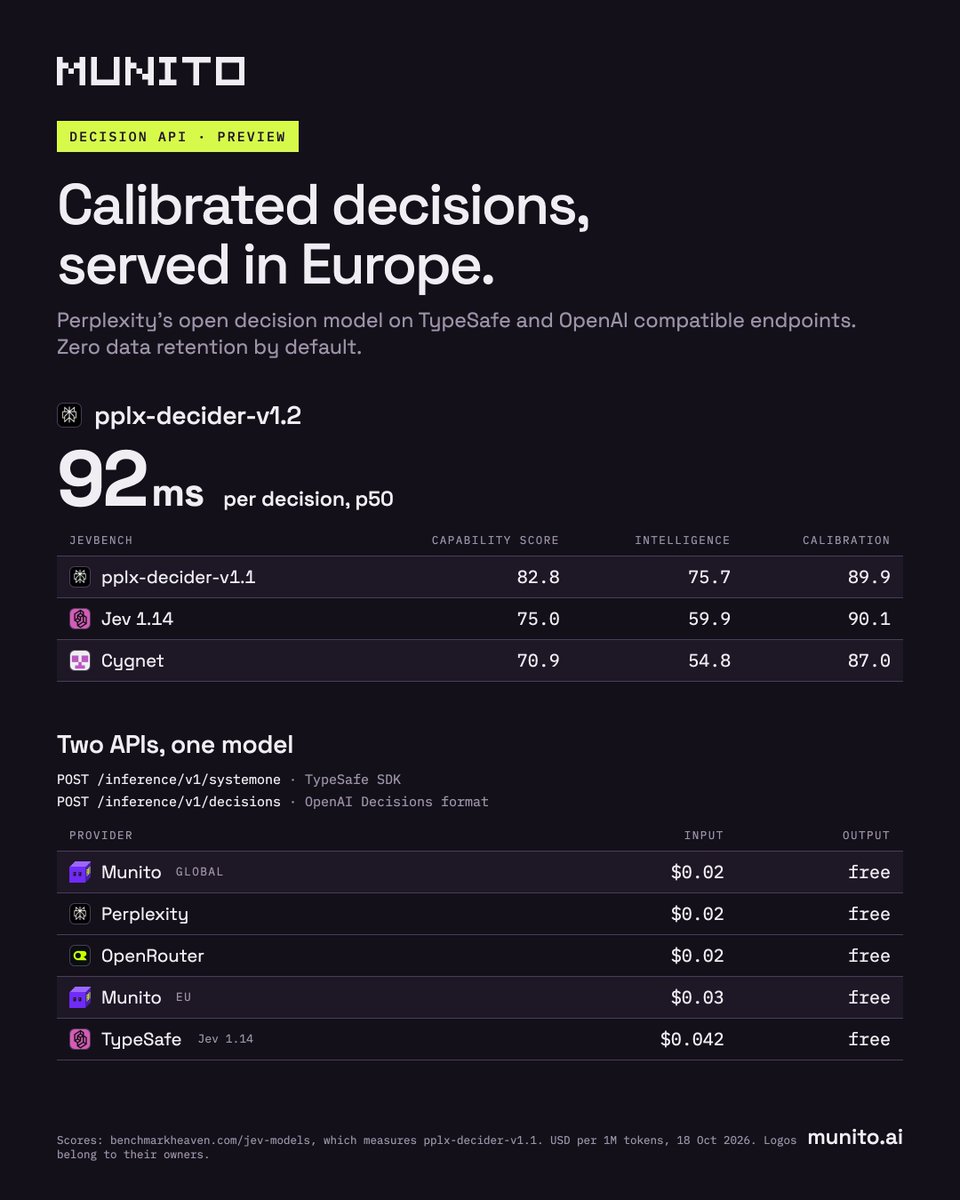
Not every AI problem needs a giant model.
@TypeSafe_AI's Jev models opened up a whole class of apps:
1. ai powered Ouija boards
2. fast Tinder swipes
3. picking up emojies based on give color
Try them free on our fully EU-based infra 🇪🇺
Add `:nitro` to any model slug on @OpenRouter and your request goes to whichever provider is serving that model fastest right now.
Running the same prompt on DeepSeek V4.1 Flash, our most used coding model:
- without: 6.8s
- with `:nitro`: 3.9s
New updates today
Advanced analytics. Cost by model and by API key, cache hit rate, every 429. Your API keys have nowhere to hide.
Paid tiers, open to anyone. No sales call, no “let’s find 30 minutes”. Add credits, get higher rate limits.
https://t.co/A756xuWXAf
One of our early clients asked us to add an MCP to configure Munito (very meta ask), so we just did it, you could ask your AI to configure our AI and then use our AI for switching off your old AI.
Or should I say SI?
Check it out https://t.co/4BfLKVFXEE
Consider this a rite of passage for any new inference company: "we're the fastest on OpenRouter".
Well, maybe not the fastest all the time, and not on OpenRouter yet, but I think we have a pretty good shot 🚀
(If someone from @OpenRouter is reading this, please check out our application)