@SKYAirline_CL
Son unos estafadores. Dejaron fuera de un vuelo a mi madre dos veces, incluso habiendo pagado nuevamente por el pasaje. Hace tres horas que estoy llamando y no responden. Los empleados en el aeropuerto se lavan las manos.
SALT 36 will be held at my alma mater, the University of Buenos Aires, on July 29-31 2026. This will be the first time the conference takes place in South America.
Abstract deadline: Dec 15, 2025
Link: https://t.co/SSyJEzcUKt
Just out: 𝗣𝗿𝗼𝗯𝗹𝗲𝗺𝗮𝘀 𝗱𝗲 𝗴𝗿𝗮𝗺𝗮́𝘁𝗶𝗰𝗮 𝗱𝗲𝗹 𝗲𝘀𝗽𝗮𝗻̃𝗼𝗹, edited by José María Oliver, Rosana Pascual, and Daniel Romero. I contributed a chapter on sentence-final connective discourse markers.
The book is free to download here: https://t.co/eFxxgzCA7R
@langofmind It was an introductory class. I reviewed the main syntactic contexts triggering island effects, the distinction between weak and strong islands, and some island repair phenomena (e.g., ellipsis, resumption).
In the next two classes, we'll discuss different theories of islands.
Today I started my lecture on syntactic islands explaining that Luís Islas (eng. "Louis Islands") was an Argentinian goalkeeper that won the 1986 World Cup and the Copa América in 1993.
The Argentinian stereotype is not going to survive by itself, you know...
@ElliotMurphy91 I don't think it is so clear. The SMT can be understood as a functional motivation for the content of UG. So if, say, islands are part of UG, they should be seen as solutions to legibility conditions imposed by the interfaces. It doesn't mean UG is empty, it means UG is elegant.
The book "Darwin y la evolución del lenguaje humano" is now available for download! I contributed a chapter about how syntactic islands aren't entirely arbitrary but correlate with interface requirements.
Big thanks to the editors for an amazing work!
https://t.co/bq9da7zVel
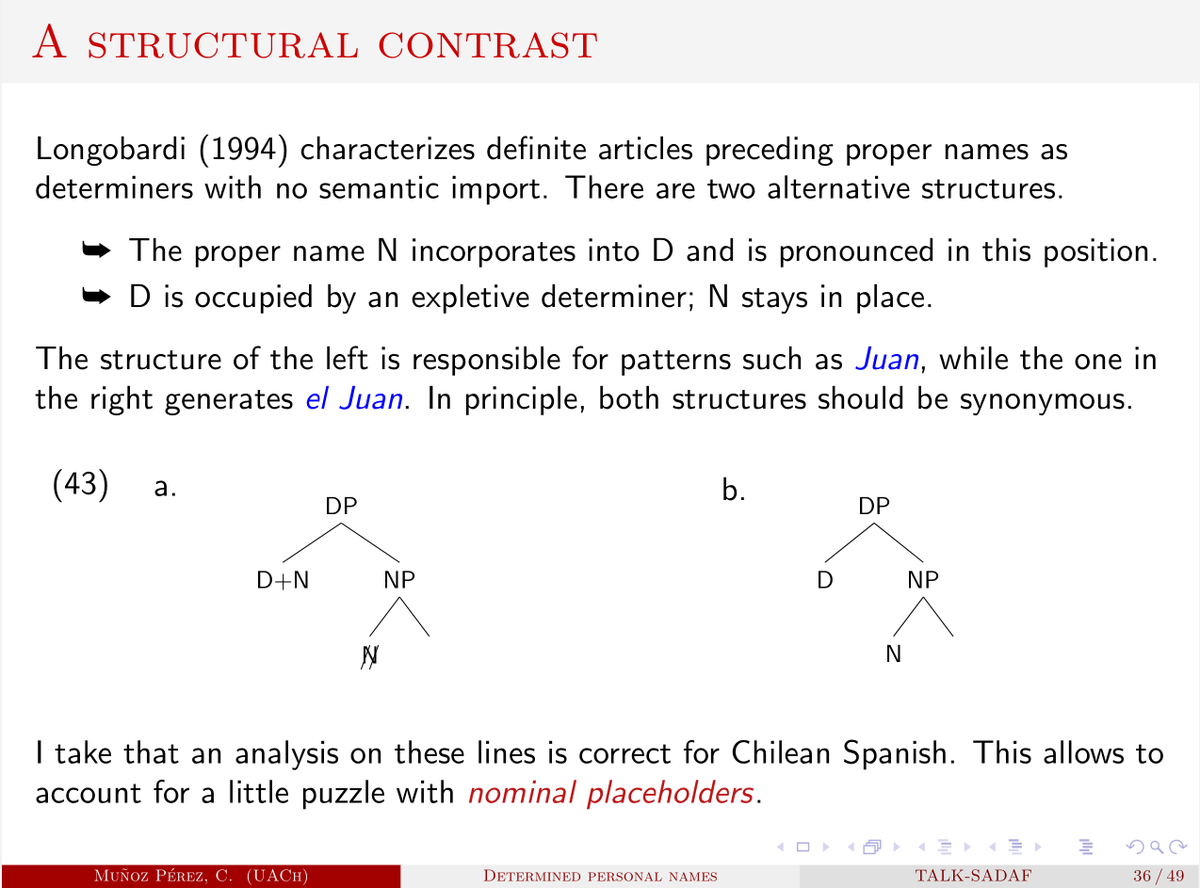
@ChrisTCollins While Longobardi refers to these determiners as "expletive", this might be somewhat of a misnomer. They are just the realization of a definite D when N does not undergo N to D movement. When N does move to D, the latter is pronounced as a bare proper name.
Had a great time talking about definite articles with proper names in Chilean Spanish for the TALK group (UBA)! Unlike other dialects, where the article carries discourse/expressive meaning, in Chilean Spanish it appears to be a pure expletive —just as Longobardi (1994) predicts.
@ChrisTCollins the determiner is a "pure expletive" in the sense that it has no semantic import in Chilean Spanish. It does in most Spanish varieties though: it typically has an expressive interpretation.
@ChrisTCollins right. in Longobardi's analysis, D is always there. but you have two options: either you incorporate N to D and get "Juan", or you don't do that and D receives an "expletive" pronunciation as "el", so you get "el Juan".
Last week, we had the pleasure of hosting Samara Almeida and Andrés Saab at Universidad Austral de Chile. They delivered brilliant talks on multilingualism and grammatical gender, which sparked great interest and discussion among our students.
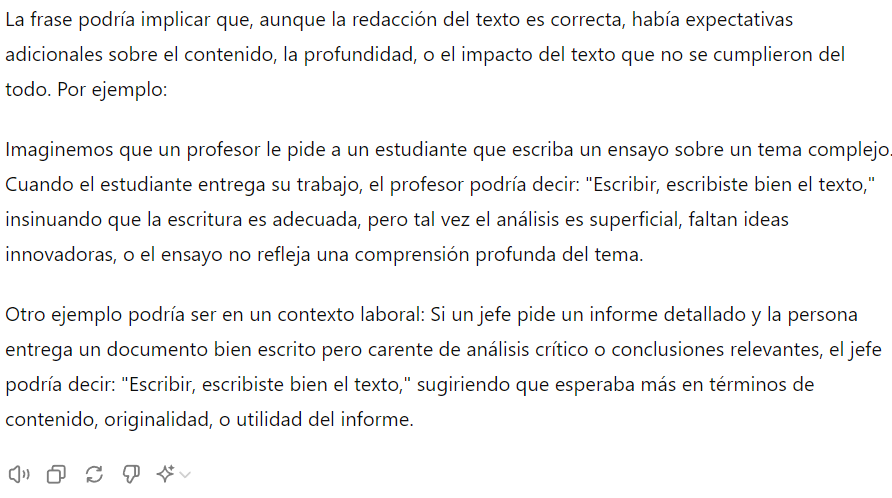
I asked ChatGPT to explain the meaning of the predicate doubling sentence "Escribir, escribiste bien el texto". In work with Matías Verdecchia, we have argued that the infinitive is a contrastive topic. ChatGPT reports exactly this type of interpretation.
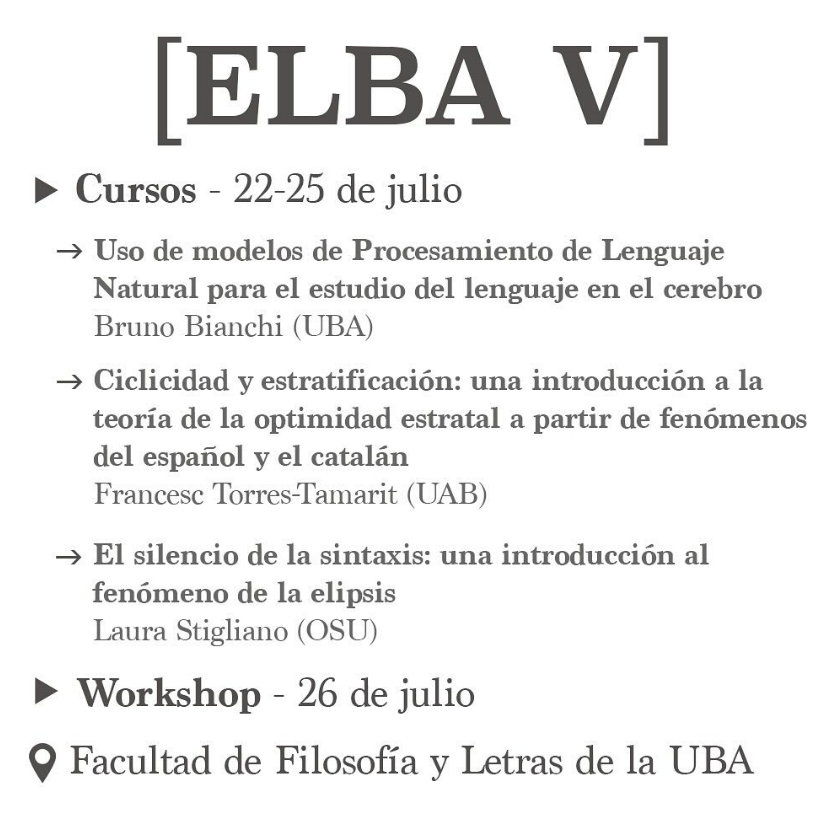
Sad not to be in Buenos Aires next week for the 5th ELBA Summer School. This event has become very important for linguistics in the Southern Cone, offering amazing courses by notable experts in the field.