RAG was supposed to make LLMs smarter.
Give them memory.
Ground them in facts.
But most RAG today is just:
Search → Paste → Pray.
That’s not intelligence.
That’s copy-paste with extra steps.
The real shift?
Agents now control retrieval itself.
They don’t just fetch docs.
They reason before retrieving.
They reason after retrieving.
Sometimes… they don’t retrieve at all.
Instead of:
❌ “Embed the query”
They ask:
✅ “What do I actually need?”
Instead of:
❌ Dumping 10 chunks
They plan:
✅ “Which source matters for THIS question?”
Memory becomes real.
Tools become choices.
The LLM becomes part of a thinking system.
That’s Agentic RAG.
Not better search.
A different architecture.
Once you see it run enterprise workflows…
vanilla RAG feels incomplete.
I stopped paying for Claude Code.
$200/month for an API subscription to write code.
Then Ollama dropped Anthropic API compatibility.
Now Claude Code connects to free, local models on my machine.
Here's the exact setup (took me 10 minutes):
1. Install Ollama
→ curl -fsSL https:// ollama .com/install .sh | sh
2. Pull a model
→ ollama pull qwen2.5-coder
3. Point Claude Code at localhost
→ ANTHROPIC_BASE_URL=http: //localhost :11434 claude
That's it. Claude Code thinks it's talking to Anthropic. It's talking to your laptop.
Best models I've tested:
• Qwen 2.5 Coder - best all-around for code generation
• DeepSeek-Coder - strongest at debugging and refactoring
• Llama 3 - solid general reasoning
Local models aren't Sonnet or Opus. Complex multi-file refactors still stumble. Long context windows get messy.
But for everyday coding - scaffolding, tests, quick edits, boilerplate - they handle it fine.
Your code never leaves your machine.
Your bill goes from $200/month to $0.
Your API key stays in your pocket.
(Save this for later.)
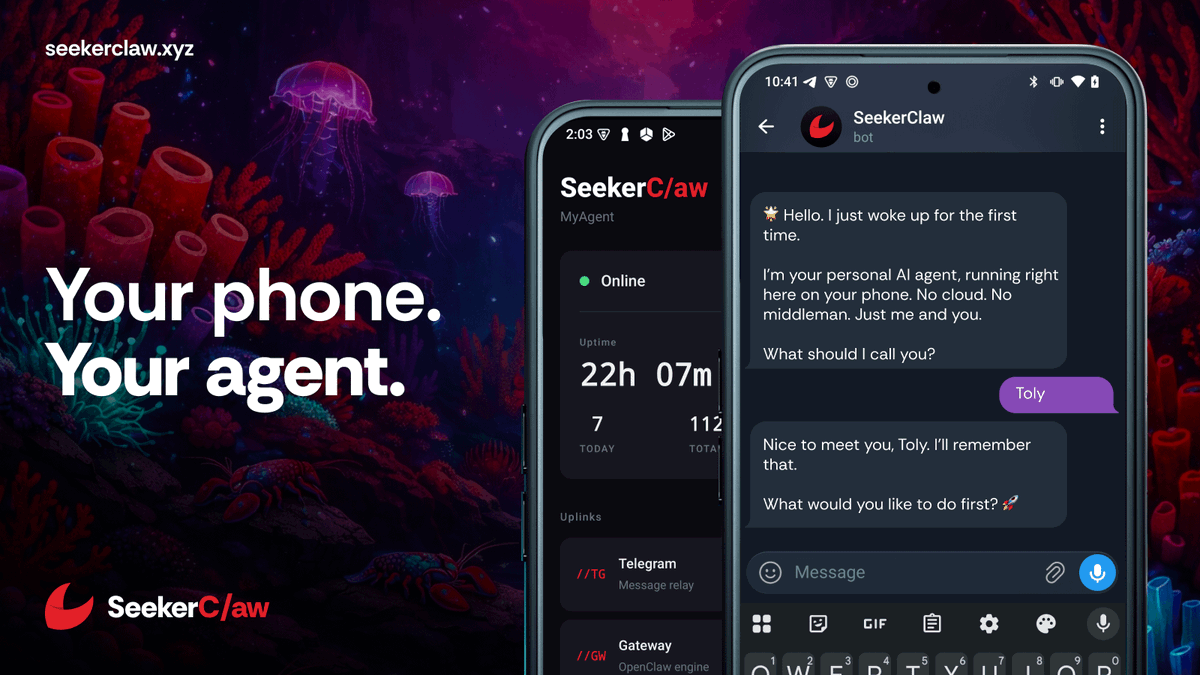
Introducing SeekerClaw
The first AI agent fully running on your @solanamobile. It does things. Incredible things.
What can it do? Download it. Ask yourself. You'll be surprised.
Introducing Perplexity Computer.
Computer unifies every current AI capability into one system.
It can research, design, code, deploy, and manage any project end-to-end.
Prompt engineering is dead.
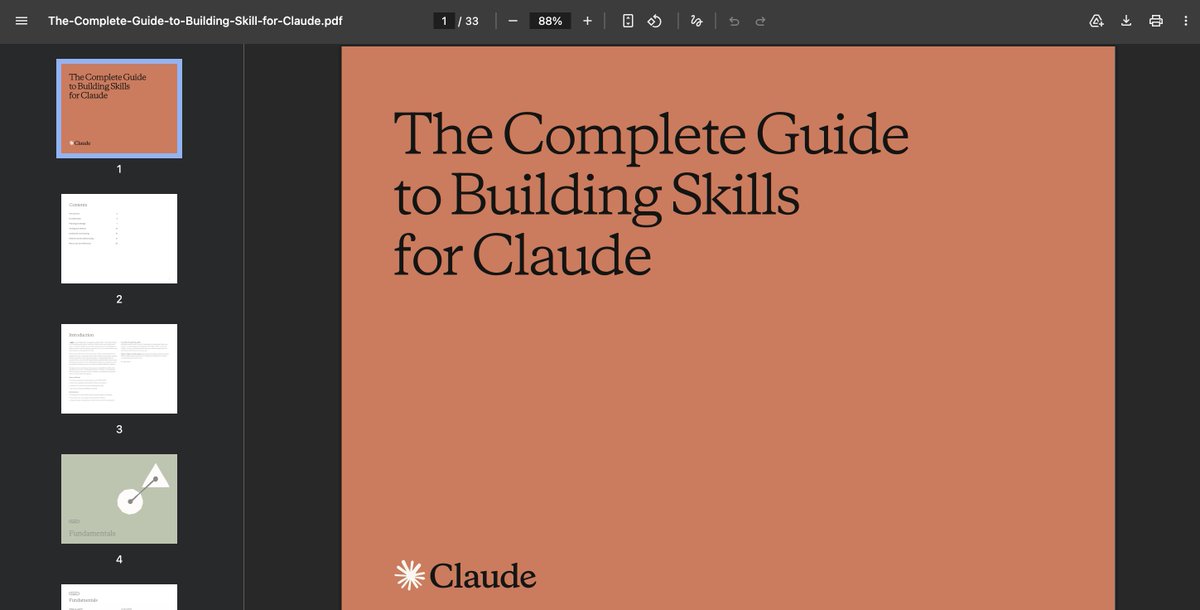
Anthropic recently released the real playbook for building AI agents that actually work.
It’s a 30+ page deep dive called The Complete Guide to Building Skills for Claude and it quietly shifts the conversation from “prompt engineering” to real execution design.
Here’s the big idea:
A Skill isn’t just a prompt.
It’s a structured system.
You package instructions inside a https://t.co/ayF9XmnQpU file, optionally add scripts, references, and assets, and teach Claude a repeatable workflow once instead of re-explaining it every chat.
But the real unlock is something they call progressive disclosure.
Instead of dumping everything into context:
• A lightweight YAML frontmatter tells Claude when to use the skill
• Full instructions load only when relevant
• Extra files are accessed only if needed
Less context bloat. More precision.
They also introduce a powerful analogy:
MCP gives Claude the kitchen.
Skills give it the recipe.
Without skills: users connect tools and don’t know what to do next.
With skills: workflows trigger automatically, best practices are embedded, API calls become consistent.
They outline 3 major patterns:
1) Document & asset creation
2) Workflow automation
3) MCP enhancement
And they emphasize something most builders ignore: testing.
Trigger accuracy.
Tool call efficiency.
Failure rate.
Token usage.
This isn’t about clever wording.
It’s about designing an execution layer on top of LLMs.
Skills work across https://t.co/pDY56kadwE, Claude Code, and the API. Build once, deploy everywhere.
The era of “just write a better prompt” is ending.
Anthropic just handed everyone a blueprint for turning chat into infrastructure.
Download the guide here: https://t.co/xEZ78RGkYu
Nothing humbles you like telling your OpenClaw “confirm before acting” and watching it speedrun deleting your inbox. I couldn’t stop it from my phone. I had to RUN to my Mac mini like I was defusing a bomb.
Just hired 10 AI employees! 🚀
The future is here! My M1 Mac Mini now runs a 24/7 AI company for just $50/mo.
I broke down my entire AI company + tasks for all 10 agents.
2026 efficiency is insane:
- No big hires
- No office
- Just one Mac Mini + vision
Barrier to entry = $0.
If you're not building yet, what are you waiting for?
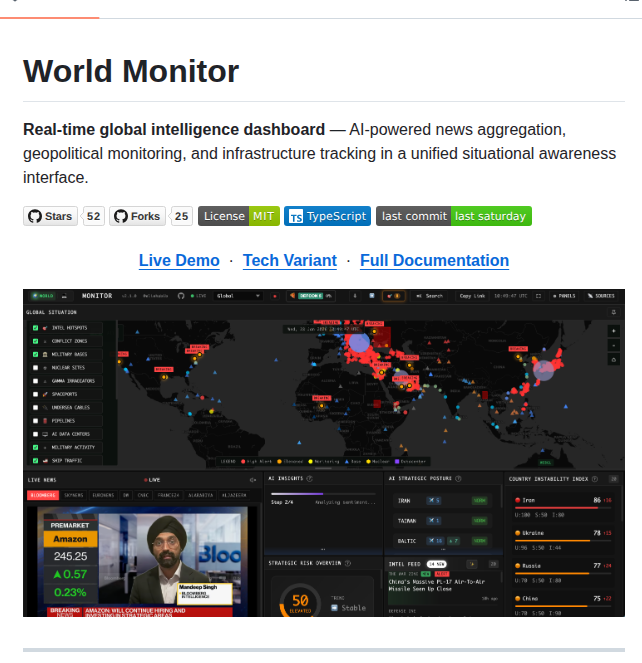
🚨 Someone just built a real-time global intelligence dashboard and open sourced it for free.
It's called World Monitor. Think of it as a CNN war room meets Bloomberg Terminal for geopolitics but anyone can use it.
No paid OSINT tools. No expensive subscriptions. No classified access needed.
Here's what this thing tracks in real-time:
→ Active conflict zones with escalation scoring
→ 220+ military bases from 9 countries
→ Live military aircraft tracking (ADS-B)
→ Naval vessel monitoring including "dark ships" going off radar
→ Nuclear facilities worldwide
→ Undersea cables, oil pipelines, and AI datacenter clusters
→ Protests, sanctions, internet outages, and satellite fire detection
→ Prediction markets as early warning signals
Here's the wildest part:
It has an AI that reads 100+ news sources, classifies threats in real-time, and generates intelligence briefs automatically.
Every country gets a live "Instability Index" score from 0-100 based on military activity, protests, news velocity, and structural risk.
When 3+ signal types spike in the same area, military flights + protests + satellite fires, it triggers a convergence alert.
This is the kind of tool governments pay millions for.
It runs in your browser. One command to install.
100% Open Source. MIT License.
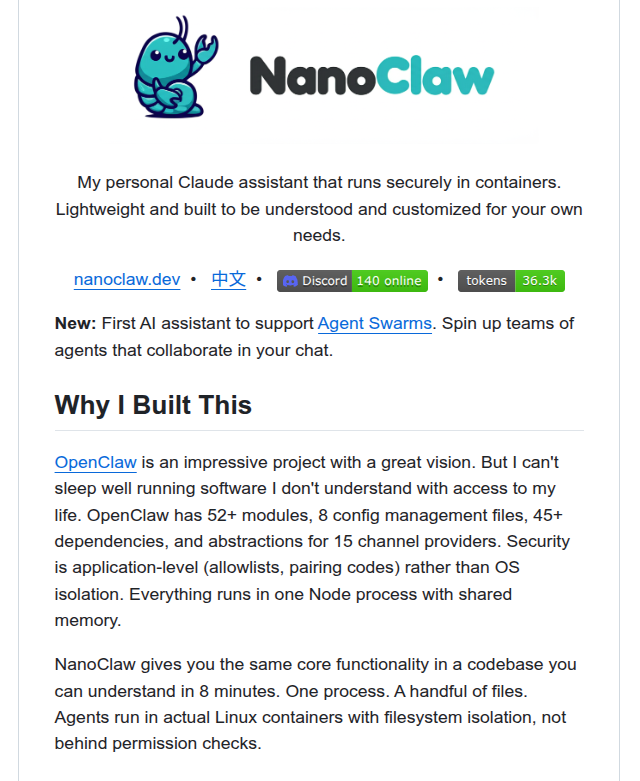
NanoClaw, the lightweight alternative to Clawdbot / OpenClaw already reached 10.5K Github stars ⭐️
Compared with OpenClaw, NanoClaw’s specialty is simplicity plus OS level isolation.
- Much smaller and manageable codebase, only 4K lines.
- Runs in containers for security.
- Connects to WhatsApp, has memory, scheduled jobs, and runs directly on Anthropic's Agents SDK
- stores state in SQLite, runs scheduled jobs, and keeps each chat group isolated with its own memory file and its own Linux container so the agent only sees directories you explicitly mount.
- its safety model leans on application controls like allowlists and pairing codes inside a shared Node process.
OpenClaw is built for broad multi channel coverage, while NanoClaw intentionally stays minimal so you customize by changing a small codebase instead of operating a big framework.
I hired my 14th AI employee today!! 🦞
Everything in @VugolaAI is 95% automated now.
I broke down all of my agents, their task, and most importantly how much it costs. 👀
The crazy part is we are ONLY 20% into 2026!!
Start building your own AI company today! 💪
THE AI COMPETITION IS ON!!
OpenAI CEO Sam Altman and Anthropic CEO Dario Amodei refused to hold hands during this group photo from the India AI Impact Summit 😂