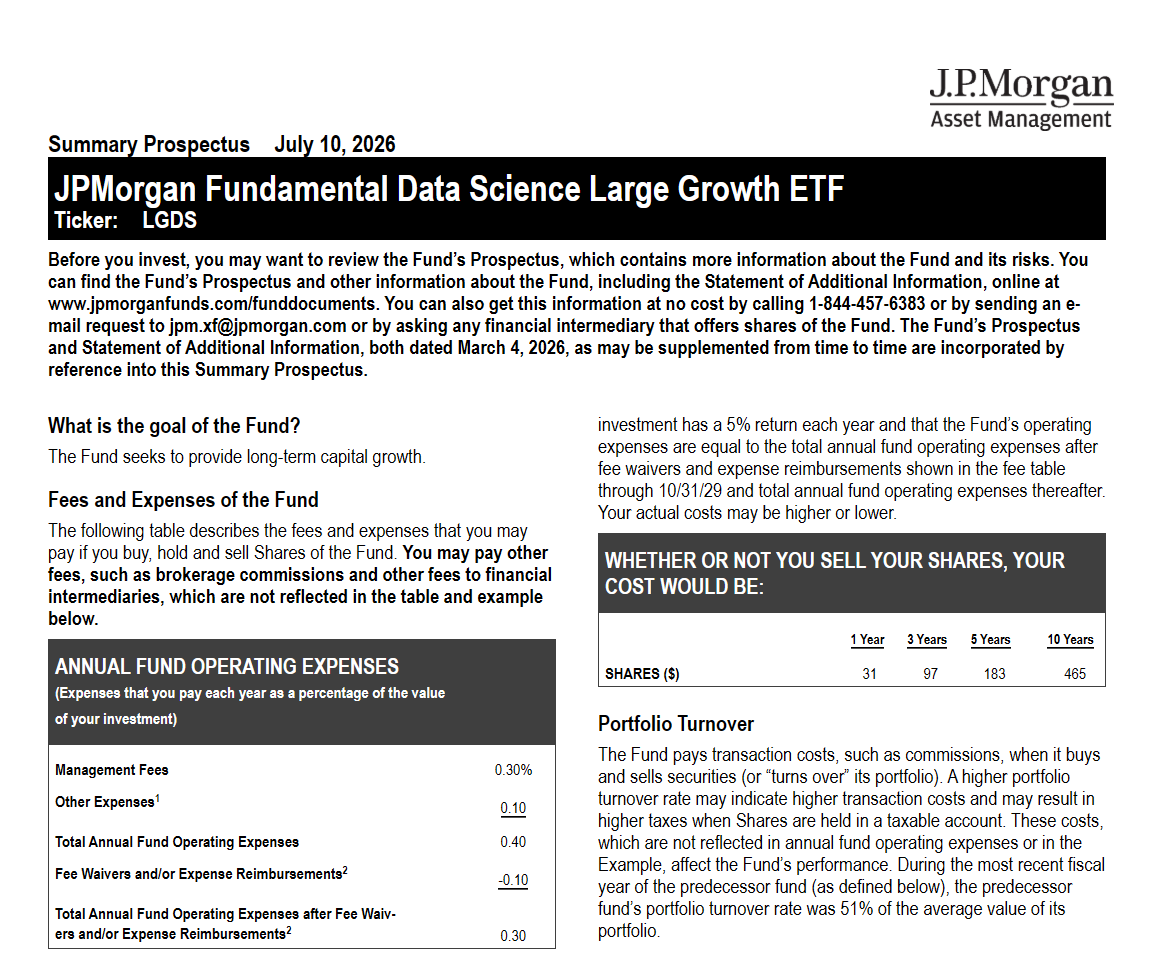
JPMorgan listing ETF tomorrow July 13
JPMorgan Fundamental Data Science Large Growth ETF
Ticker: $LGDS
Fees: 0.30% after 0.10% waiver
Lead Market Maker: RBC Capital Markets, LLC
Exchange: The Nasdaq Stock Market
Prospectus:
https://t.co/p0Lh12Wn6R
@Nasdaq@JPMorganAM
Claude Code on desktop now has an in-app browser.
Claude can pull up docs, designs, or any other site. It can read, click through, and interact the same way it does with your local dev servers.
It's sandboxed and configurable: you choose whether sessions persist.
check this out! you can get some amazing things done.
codex is the core of our new work product and what makes it so good. codex is not going anywhere.
Finally, it is a good moment to talk about the hardcore math details of the work that GPT 5.6 helped me with.
The whole journey started in 2023 when my colleague @PiotrPePo emailed me with a question about algebraic K3 surface. The idea was that he was looking for configurations of lines on such surfaces which have remarkable property, namely that they have unusually high logarithmic Chern slope. In laymen terms, such objects are extremely rare and highlight a very special type of geometry on the surface.
It was known for many years that due to Bogomolov-Miayoka-Yau inequality such a slope cannot be larger than 3 and for very symmetric quartic and some other classes of algebraic surfaces it was known to be at most 8/3.
In our preliminary work together, we proved that the famous Fermat quartic x^4+y^4+z^4+w^4=0 (projective coordinates) contains a subconfiguration of lines with slope 8/3. This was a discovery which I quickly made after our initial exchange of emails with Piotr. Since 2023 we started thinking about a possible way to prove this conjecture that perhaphs, since Fermat's quartic is so symmetric, it might be the actual maximum.
We have published a very nice survey paper with new results in EMS Surveys in 2026
https://t.co/zLSl7sBbMQ
Initially, in 2024 and 2025 I've been asking various AI models to find some kind of hint for us, whether there is a way to make and organize our computations in a better way. An initial hint came from GPT Pro to use systematically all the inequalities that we've been using and turn this whole venture into some kind of linear programming computation.
This initial hint was partially interesting but we could not get past 8/3 with the techniques that we had.
But in the paper we had a lot of nice examples of surfaces which contained billions of different subconfigurations of lines. So a brute force search was basically impossible.
And here comes GPT 5.6 Sol which I used to reiterate on this problem. The model, prompted with many pages of my technical documentation, in Codex, managed to find a critical paper about fractiona linear programming, an idea from a paper
W. Dinkelbach, On nonlinear fractional programming, Management Sci. 13 (1967)
The model immediatelly implemented the whole setup and tested it against the many families of K3 surfaces that we collected.
It was a big shock to me when after basically about 30 minutes of work, around 4 am in the morning I finally saw a counterexample to the slope conjecture. There exists a configuration of 24 lines on Schur quartic which provides the slope 14/5. Initially, I could not believe that this was true but I quickly prototyped a suitable prompt and code which verified everything perfectly. From this insight we understood that we were completely wrong about the conjecture because we have assumed that the maximum should come from the most symmetric K3 surface, but instead the right idea was to look for the most symmetric configuration!
After all, I think this whole experience made me realize how important it has become in my scientific life to use high quality models. We could have spent another hundreds of hours trying to prove a wrong conjecture. Now we finally understand what is possible for K3 quartics. The answer is a major advancement in our understanding of algberaic geometry of surfaces and shows that a fruitful collaboration between humans and AI is possible and can empower humans to get better insights into mathematics.
The new paper will appear tonight on arXiv.
Claude Cowork is coming to mobile and web.
Hand Claude a task at your desk and pick up the finished work from your phone. Close the laptop and Claude keeps going.
Beta is rolling out over the next several weeks starting with the Max plan, with more plans to follow.
Non mais les babinet et autres sont justes hors sol. Il se prend pour le gourou de la tech. Il n’apporte rien. Bien sûr que les tokens vont être la prochaine charge financière d’exploitation des entreprises. Nous allons les utiliser et en consommer de plus en plus.
Il faut simplement acter que la place de l’Europe dans cette nouvelle économie est assez restreinte, pour autant nous avons des atouts a commencer par la France avec mistral etc. Ces mecs faut juste leur couper le micro 🎤
Chouchou des petits porteurs, Air Liquide peut prendre de vitesse la Bourse grâce à l'IA, juge Bank of America, qui recommande désormais d'acheter l'action
https://t.co/rCgkYUV2fO
Claude in Microsoft Foundry is now generally available, hosted on Azure.
Azure customers get Claude Opus 4.8 and Claude Haiku 4.5, with Azure authentication, billing, and commitment retirement.
More than $600B has been invested in AI over the past two years.
As AI scales, the race is no longer just about GPUs. Memory, power, and infrastructure are becoming key competitive advantages.
🔗https://t.co/tOZ5PosHvn
#SKhynix#AI#Semiconductor#HBM#AIMemory
Arthur Mensch confirmed on CNBC this week that OpenAI and Anthropic are calling Mistral asking for compute. The two companies racing to build the most powerful AI in the world are dependent on a European competitor they have been trying to outrun.
Let that land for a second.
The narrative you have been sold is that the US is running away with AI. That OpenAI and Anthropic have such a commanding lead that the rest of the world is playing catch-up.
That narrative is missing something physical.
The International Energy Agency projected this year that US data center electricity demand will double by 2030. The US grid is already at capacity. Europe has the power. Europe has the land. And right now the company fielding calls from the most funded AI labs on earth is a four-year-old French startup.
Mensch said Mistral is prioritizing its own customers first. The surge in agentic usage is generating far more tokens than anyone planned for and existing capacity is spoken for. The US labs are in the queue.
But they are in the queue.
Most people following AI are watching benchmark scores and funding rounds.
The actual constraint right now is electricity and physical space. And on that dimension, the scoreboard looks nothing like the one most people are reading.
Watch the full podcast on YouTube at @CNBCi