🇬🇧 UK lawyer Paul Powlesland cleaned 200 bags of waste from a polluted river.
Fish and dragonflies have returned.
Now he faces up to 2 years in prison for doing it without a permit.
This is modern Britain: punishing people who actually clean up the environment while the bureaucracy strangles common sense.
Absolutely insane.
Source: @Coinvo / Writer: Oliver
Today, on my final day as Director of National Intelligence, I’m releasing never-before-seen communications and documents exposing how Dr. Fauci provided millions in US taxpayer dollars to fund dangerous gain-of-function research at the Wuhan lab, worked with politicized elements within the Intelligence Community to suppress the truth about his actions and hide the virus’ lab-leak origins, and lied to Congress while under oath in 2024. It’s time you know the truth.
https://t.co/3YJSstB7d4
You have noticed it. ChatGPT feels dumber than it used to. Your prompts that worked six months ago produce worse results now. The writing sounds flatter. The ideas sound safer. The internet itself feels like it is shrinking. Every article reads the same. Every email sounds the same. Every answer sounds like it was written by the same voice.
You thought it was you. It is not you.
Researchers at Oxford and Cambridge published a paper in Nature proving what is happening. They call it Model Collapse.
Here is the mechanism in one sentence. AI trained on AI-generated data gets dumber every generation until it forgets what real human data looked like.
The internet is filling with AI-generated content. Blog posts. Articles. Reviews. Comments. Social media. AI companies scrape the internet to train the next generation of models. Which means the next generation of AI is being trained on the output of the current generation.
Each cycle loses information. Not randomly. It loses the rarest, most unusual, most creative parts first. The researchers call these the "tails of the distribution." The weird ideas. The unexpected perspectives. The things that made the internet feel human. Those disappear first.
What remains is the average. The safe. The expected. The bland.
Then the next generation trains on that. And loses more. And the next generation trains on that. And loses more. The researchers proved this is not a slow decline. Major degradation happens within just a few iterations. Even when some of the original human data is preserved.
They tested it on large language models. On image generators. On statistical models. The pattern was the same every time. The output converges toward a narrow, flattened version of reality that looks nothing like the original data.
The lead researcher put it plainly. "Large language models are like fire. A useful tool. But one that pollutes the environment."
The pollution is invisible. You cannot see which sentence on the internet was written by a human and which was written by AI. Neither can the AI that is about to train on it. And once the tails are gone, they do not come back. The damage is irreversible.
This is not a prediction anymore. It is a diagnosis.
The internet you grew up on was built by humans writing things no algorithm would have written. Strange, personal, imperfect, alive. That internet is being diluted. One generation of AI at a time. And the models trained on what remains are learning a smaller and smaller version of the world.
Model Collapse is not a technical problem. It is a cultural one. The thing that made the internet worth reading is the thing that disappears first.
Mark Zuckerberg, an outspoken critic of "man-made climate change", shows off his new $300 million, 287-foot mega yacht, powered by four gigantic diesel engines.
Yet another stark reminder that Net Zero is only for the peasants
Ted Chiang is right: claiming that LLMs are conscious is just ridiculous.
One simple example. If you ask GPT to imitate a conversation between Julius Caesar and Genghis Khan, GPT will do it very well.
It will talk about wars, betrayal, and power. Il will descrive the feeling of being cheated by your brother with unbelievably realistic and moving words.
Does this mean that GPT contains a self-conscious copy of Julius Caesar or Genghis Khan? Of course not.
Similarly, if GPT makes claims about itself, does this mean it is self-conscious? Of course not.
An LLM is just simulating language, feeling, and consciousness.
True, we don’t have an accepted definition of consciousness. But, at a minimum, to be conscious, an entity must have something at stake.
It must risk dying and have emotions that move it away from danger and towards favorable states. It must have a driver.
This is also why I share Chiang’s worry about moral atrophy.
The more we offload moral decisions to LLMs, the more we risk losing our own capacity for moral reasoning.
Human moral reasoning descends from our history of making harmful actions, suffering harmful actions, regretting them, fearing them, repairing them, and learning from them.
LLMs do not experience harm, do not suffer, do not fear consequences, do not regret.
So they cannot do moral reasoning.
We are offloading moral reasoning to systems that cannot do moral reasoning.
What can go wrong?
*
Full piece in the first reply
@rtenews Over our dead bodies. This will be the last thing this disastrous government will try to do before they find themselves out on their arses.
Our children won't be dragged into wars only a specific compromised' type of EU 'political class wants.
@SteveReedMP Thanks Steve. I was not going to drink water this weekend until your patronising post reminded me how important it was. How much do they pay you and your social media team again?
That time William Shatner was emotional explaining how it felt to take his first flight into outer space and Jeff Bezos cut him off to spray champagne. Like a scene straight out of The Office
The 22-minute monologue that begins this show offers clear, compelling proof that Israel committed genocide in Gaza.
It's then followed by a harrowing interview with Dr. Maynard and the atrocities he saw in Gaza.
Anyone denying the value of this is either a fraud who doesn't believe what they say about the Israeli/US genocide, or is very dumb, or both.
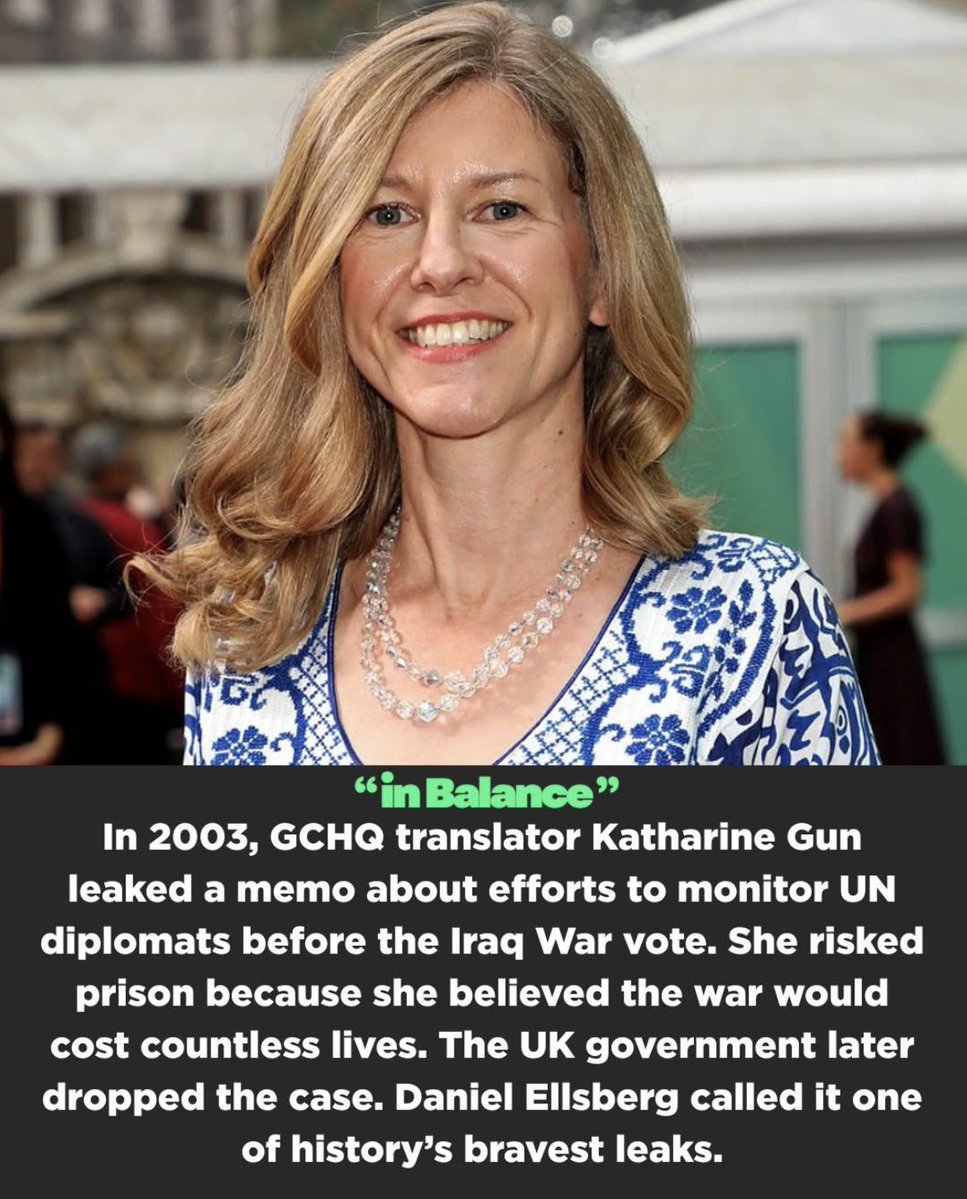
In 2003, a 28-year-old translator working for British intelligence received an email she wasn’t supposed to see. What she read convinced her that governments were trying to manipulate the world into war.
Her name was Katharine Gun.
She worked at GCHQ - Britain’s top-secret intelligence agency. On January 31, 2003, she received an email from senior NSA official Frank Koza. The US wanted British intelligence to help spy on members of the UN Security Council.
Specifically, diplomats from Angola, Chile, Pakistan, Cameroon, Guinea and Bulgaria - nations whose votes could decide whether the UN backed the invasion of Iraq. The operation was simple: bug phones, read private emails, uncover secrets, weaknesses, fears and anything that could pressure diplomats into supporting the war.
Katharine read the email in disbelief.
This was not ordinary intelligence gathering: it looked like an attempt to manipulate the UN into approving a war. She knew what leaking the document could cost her. Prison.
The destruction of her career. Under Britain’s Official Secrets Act, she could face years behind bars for exposing classified intelligence. But she leaked the email anyway. On March 2, 2003, The Observer newspaper published the secret NSA request on its front page.
Suddenly, the world could see evidence that intelligence agencies were allegedly targeting UN diplomats ahead of the Iraq War vote.
Inside GCHQ, panic exploded. Investigators began interrogating employees, searching for the source of the leak, monitoring staff and creating an atmosphere of fear throughout the building. Katharine watched innocent coworkers fall under suspicion. That’s when she made another decision that stunned people around her. She confessed. Rather than allow others to suffer for something she’d done, Katharine walked into her manager’s office and admitted she was responsible.
She was arrested.
Suspended from her job. Formally charged under the Official Secrets Act.
By late 2003, she faced trial at London’s Old Bailey with the possibility of being sent to prison. But her legal defence created a dangerous problem for the British government when her lawyers argued she acted to prevent an illegal war. To challenge that claim, the government would need to release confidential legal advice discussing whether the Iraq invasion itself was lawful under international law.
Then came February 25, 2004. The courtroom filled.
Katharine Gun sat waiting as prosecutors prepared to move forward against one of the most famous intelligence leaks in modern British history. Then, without warning, the government collapsed the case.
“The Crown offers no evidence.”
After months of preparation, the trial ended almost instantly. Katharine walked free. Many observers believed the government feared the public release of its own private legal doubts surrounding the Iraq War more than it feared letting the whistleblower go.
Years later, former Pentagon Papers whistleblower Daniel Ellsberg called Katharine Gun’s leak one of the bravest acts he had ever seen.
Edward Snowden would later cite her as one of the people who proved intelligence systems could be challenged from the inside. And perhaps the most remarkable part of the story was this:
Katharine Gun was not a politician.
Not a famous activist.
Not a powerful insider.
She was simply a young translator who read one email and decided her conscience mattered more than her career.
Two governments.
Major intelligence agencies.
The full force of secrecy laws.
And one woman still chose to stand up and speak out.
After the case was dismissed, reporters asked whether she regretted leaking the document.
Katharine Gun answered calmly:
“I have no regrets. I would do it again.”
WE ALL NEED TO BE THIS BRAVE. WE ALL NEED TO DO THE RIGHT THING. WE ALL NEED TO BE MORE LIKE KATHARINE GUN.
Good morning, everyone!
@MichealMartinTD Stop pretending to give a fuck. Grow a pair and pass the occupied territories bill. But you won't do that as you're an unprincipled asshat.