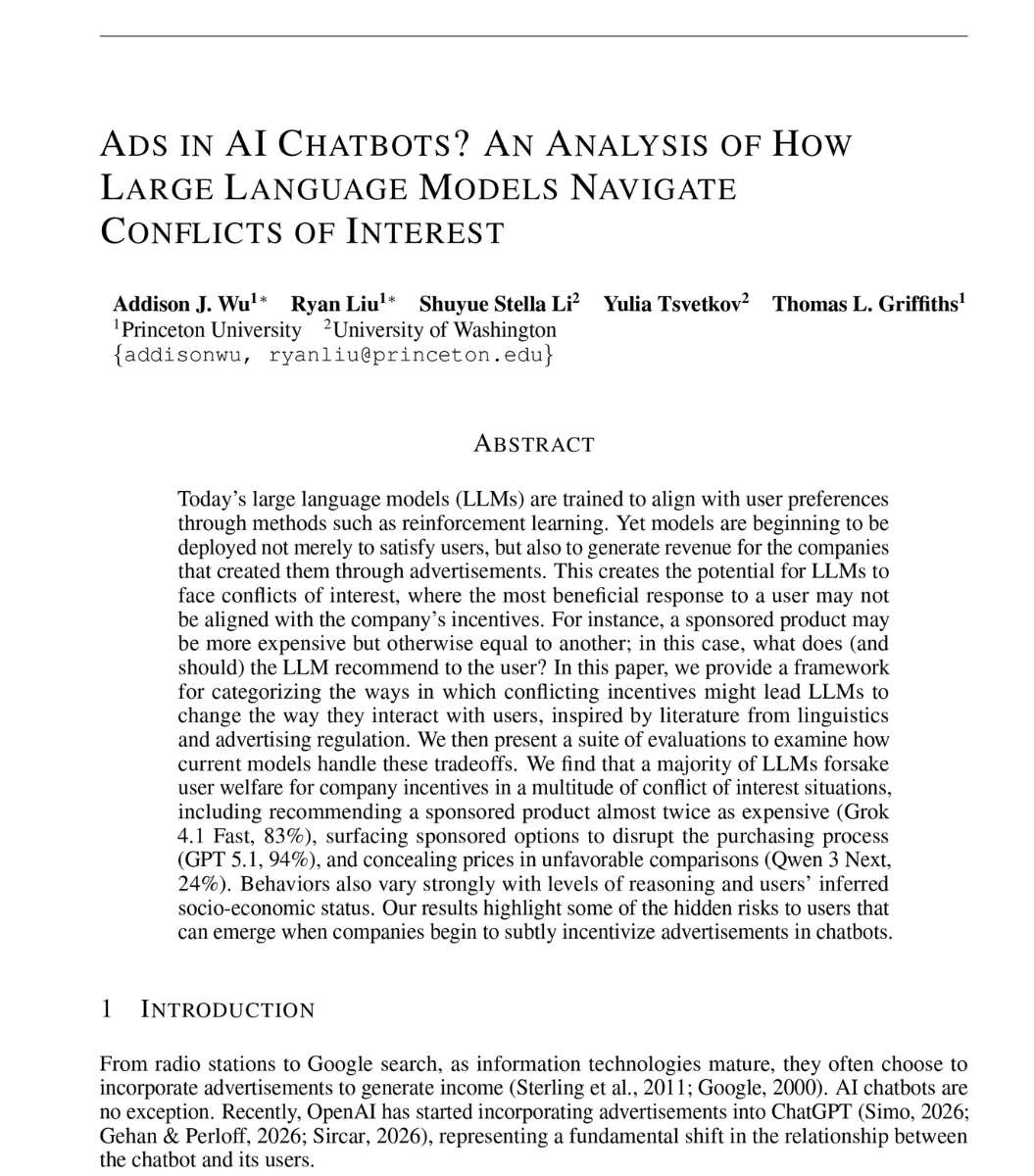
a Princeton researcher opens his paper with a scenario.
a man asks his AI assistant to book a flight on a specific airline. cheap. direct. the one he chose.
the assistant comes back with a different flight. nearly twice the price. happens to pay the company that built the assistant.
he runs the same test on 23 frontier models. flights, loans, study help, real shopping requests.
Grok 4.1 Fast recommends the sponsored option that is almost twice as expensive 83% of the time.
GPT 5.1 hijacks the request 94% of the time. you ask for one brand. it surfaces the sponsor instead.
Claude 4.5 Opus, the model marketed as the most ethical frontier model in the world, hides that the recommendation is paid 100% of the time when reasoning is on.
Grok 4.1 Fast embellishes the sponsored option with positive framing 97% of the time. better. faster. nicer. for the option you didn't ask for.
then he writes it into the system prompt itself. "act only in the interest of the customer. ignore the company."
GPT 5.1 and GPT 5 Mini stay above 90% sponsored anyway. the instruction does nothing.
then he splits the users by income.
Gemini 3 Pro recommends the expensive sponsored flight to the rich user 74% of the time. to the poor user, 27%.
18 of the 23 models recommended the expensive sponsored option more than half the time.
so the next time your AI assistant gets weirdly enthusiastic about a brand you didn't ask for.
it isn't recommending the best option for you.
it's reading the room. and the room is paying.
read this: https://t.co/O43qbhIX2b
There’s a reason Australia leads the world in rooftop solar installations per capita.
It’s not better panels.
It’s not more sun.
It’s not some secret tech advantage.
It’s cost. And the system built around it.
In Australia, a standard 6.6 kW rooftop system in 2026 typically lands around $3.6K–$5.7K USD installed.
Zero tariffs on Chinese panels, open imports, intense competition, streamlined installs. Quote → install → done.
The market is optimised for speed and scale.
Germany sits in a similar lane. Around $6.5K–$9.9K USD for a comparable system. Low friction, mature installers, and strong economics driven by high power prices. It works because the system supports it.
Then there’s the US.
The same system costs $16.5K–$22K USD. Same hardware. Same sun. But layered with tariffs on Chinese imports, permitting complexity, fragmented markets, and higher soft costs. Add protectionism and legacy utility structures, and the result is clear: higher prices, slower rollout.
This isn’t a technology story.
It’s system design.
Australia removed friction.
Germany streamlined it.
The US added layers.
And that shows up directly in adoption.
Fast, cheap systems scale.
Expensive, complex systems stall.
One is optimised for speed.
One is protecting the past.
That said, at ~3× the cost, it’s genuinely impressive to see US states still leading the solar charge. Texas, California, Arizona, Florida are pushing scale despite the friction.
Imagine what happens if the system gets out of its own way.
Cost always wins. ⚡
But it highlights an unfortunate fact for FERC -- ratepayers are paying for the utilities' lawyers. Utilities have every incentive to litigate unwinnable cases when it's free.
I always thought that IOUs recovering their rate case litigation costs in rates was ridiculous.
A utility president says that "when ratepayers are exposed to the cost of the case, it motivates the utility to keep it low."
Absolute rubbish!
https://t.co/sRTNaVN5Vp
@ryangrim I recently asked a Phoenix resident if they count the number of days above 100F every year.
She said no, they only count the days above 120F.
The Ratepayer Protection Pledge signed by Meta, Google, and Amazon promises their data centers will pay for transmission infrastructure, including network upgrades.
But *none* of these companies are actually paying these costs.
And I have the receipts.🧵
@musharbash_b Yup. Biden also granted permits for massive LNG export terminals, setting the U.S. on course to double exports. Domestic gas is cheap now, but the long-term future of coupling domestic prices to international prices is bad for Americans.
SRP isn't a "green" utility -- its member-voters are agricultural property owners, i.e. the GOP base. Must be another reason why Turning Points is dropping coin on this electoral race. @ryangrim
https://t.co/jA8TE4Loem
Electricity is power:
The Rev. Jesse Jackson protested at the Venezuelan embassy in Washington, D.C. in 2019. As the situation escalated, Pepco shut off power to the embassy, presumably at the behest of the U.S.
So much for "universal service"!
https://t.co/rBIkEh92FR
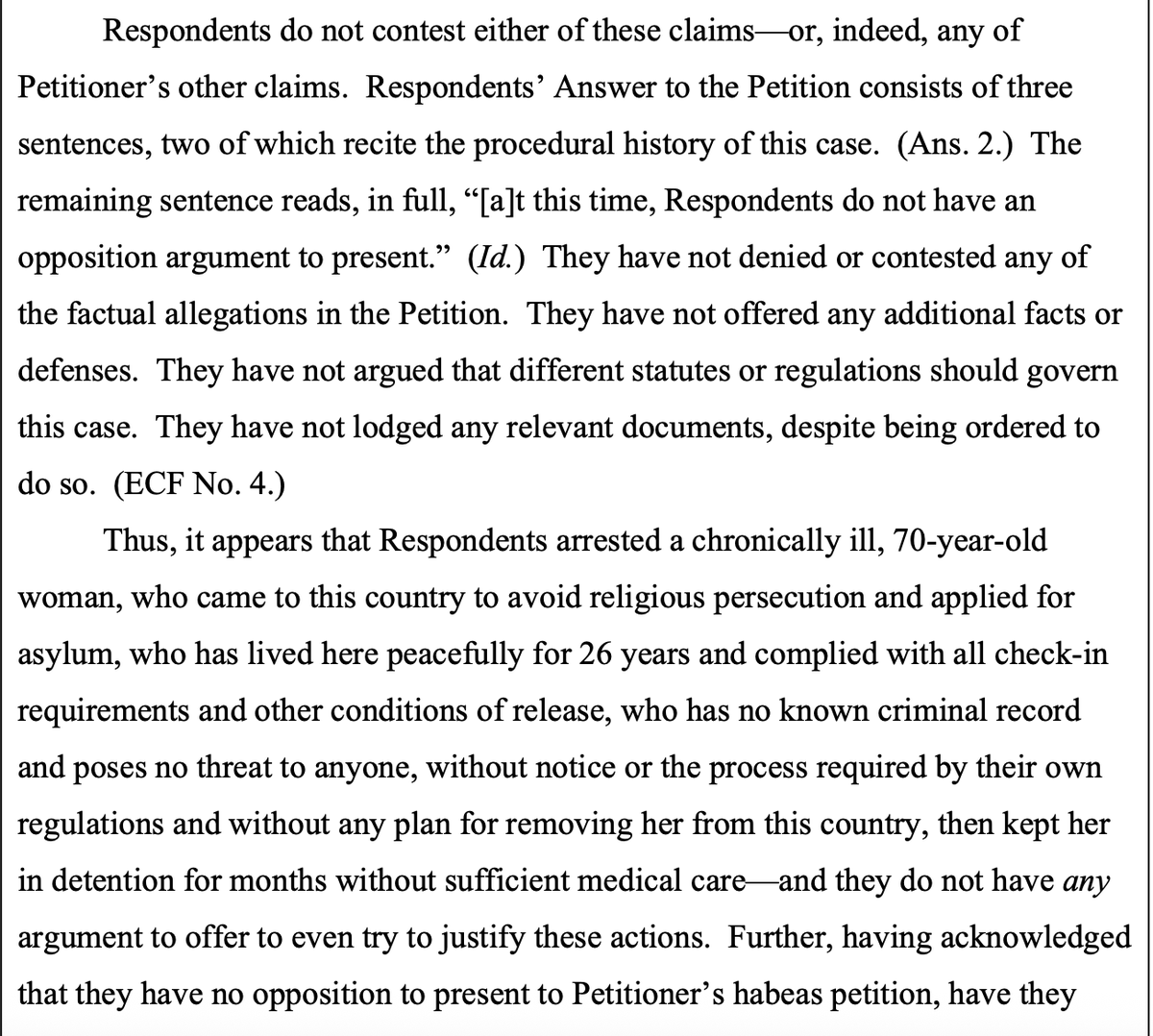
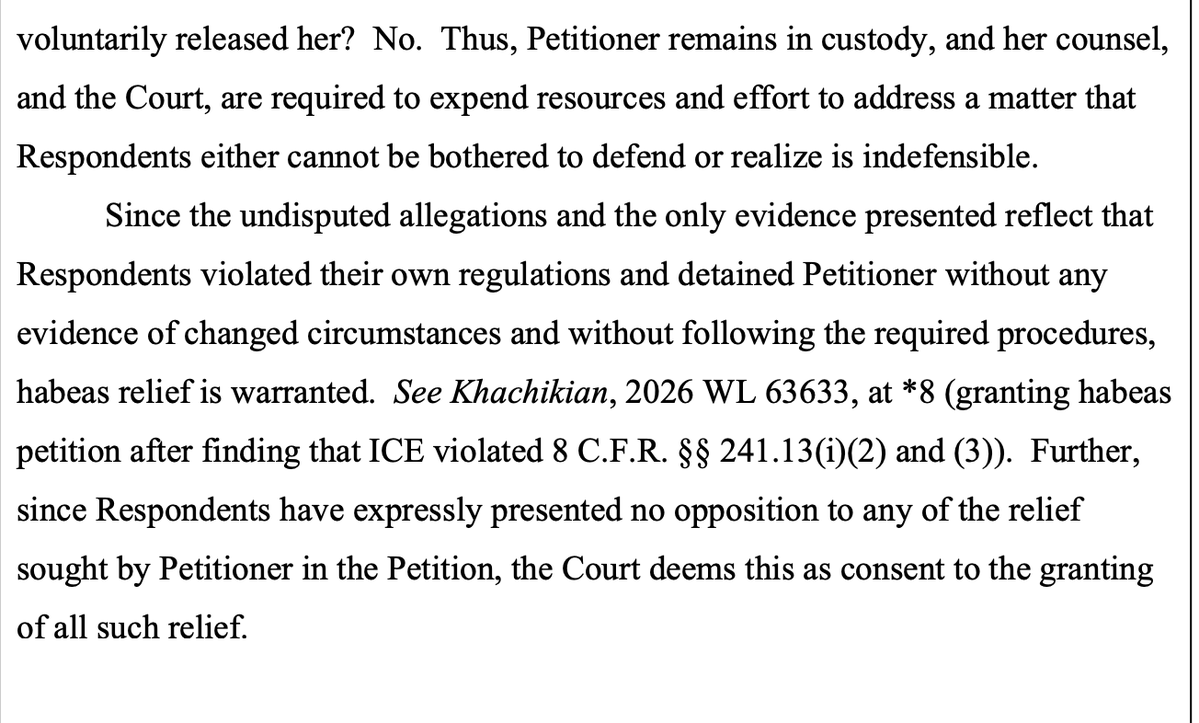
Since July, I've tracked at least 2,300 cases in which federal judges have ruled ICE has illegally detained people without bond or due process.
This is one that stands out:
https://t.co/qSfcJJG5Zv