If you're expecting Kumari kaṇṭam, Yāḷi lords of Kumari, Tamiḻaṉ king Irāvaṇaṉ's war in Moon and Mars, Cōḻas and Pāṇṭiyas conquering and ruling over the world, Great Tamils making contacts with the Andromedans. Then this post is not for you! https://t.co/1HEEpz5N8e
I can't speak for civilizations that may have arisen parallel to the Indus Valley Civilization in the deep South. But sites like Ādichanallūr, Keeladi, Porunthal, and several sites in Sri Lanka challenges the narrative that the Second Urbanization began only in the North first!
Critiquing Hindutva narratives is perfectly valid. But that should not lead us to dismiss the possible Indus roots of Hindu traditions. Even major works like Asko Parpola’s The Roots of Hinduism explore precisely this complex & layered historical process. IVC is Proto-hindu TBH!
Hi @DrDavidMiano, I think this point needs more nuance. Virtually every serious Indus scholar—whether Indian or foreign—has identified numerous affinities between Indus cultural remains and later Hindu traditions. Debate exists over interpretation, but not over the affinities.
@VinayakKishore I hate to break it to you, but your 2026 modern India culture is not the same as the 4,500-year old Harappan culture. The Harappans would find more similarity with ancient Mesopotamia than with you.
The decline of the Indus Civilization did not mean the disappearance of its people. Its populations dispersed across the subcontinent, carrying cultural practices with them. Modern Hinduism is best understood as a synthesis of many traditions, including an Indus legacy.
With Korra breaking the old Avatar Cycle and restarting it anew, I would've introduced a non-bender Avatar in Avatar: Seven Havens—one who eventually masters all four elements. It would've brilliantly dismantled the old hierarchy that places benders above non-benders. #TLOK#ATLA
Well, I’d say the opposition is divided. One group sees it as the usual claim that Indians never produced anything on their own. The other isn’t bothered by the Elamite connection itself, but by how it is framed—as a one-way influence from Elam rather than mutual development!
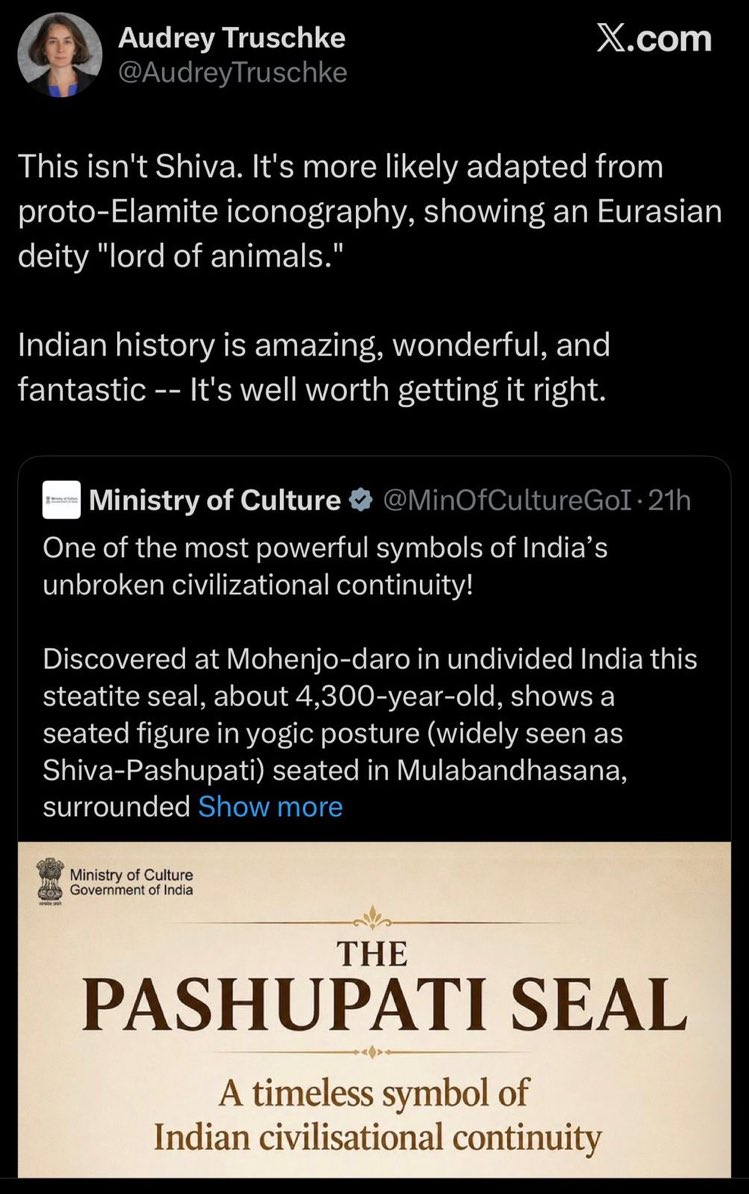
Entire RW is outraging over Audrey Truschke's proto-elamite identification of Pasupati Seal.
But didn't see a single correct refutation of her comment. RW really lack academic vigour.
P.S Ancient Indian civilization & Ancient Iran have a lot of striking similarities.
The irony is that many foreign Indologists often produce more rigorous work than our deeply divided academic camps. We have brilliant Indian historians and linguists too—but many unauthentic Indians prefer narratives over scholarship and ignore them.
It is very clear that no one in the comments is understanding what I am saying. I am addressing the weak position of Indology within India itself, not giving my support to Dr. Audrey’s interpretations. We have poor Indologists at both the local and international levels too!
Here we go again with the “foreigner” argument. When Indians themselves neglect Indology and Oriental studies, foreign scholars stepping in is inevitable. And honestly, many foreign-born Indologists have done more serious & objective work than many ideologically driven Indians.
The real issue is that you rarely see a Bengali or Hindi-belt Indologist deeply studying Old Tamil language and culture, or a Tamil scholar dedicating years to Kalinga/Odisha history or the Kashmiri language. Serious pan-Indian scholarship across regions is still painfully rare!
Here we go again with the “foreigner” argument. When Indians themselves neglect Indology and Oriental studies, foreign scholars stepping in is inevitable. And honestly, many foreign-born Indologists have done more serious & objective work than many ideologically driven Indians.
Even before the case, we must challenge the sheer audacity of a White woman in the US telling the Indian Ministry of Culture that she knows what Indian culture better than them is staggering. Can any Indian ever get away directing something like this towards America? This happens
How many of you have come across this gem work on Indian kingship by Noboru Karashima? Unlike many local scholars who sideline South India, Karashima gives balanced attention to both North and South India. This is what a serious Indology text should look like.
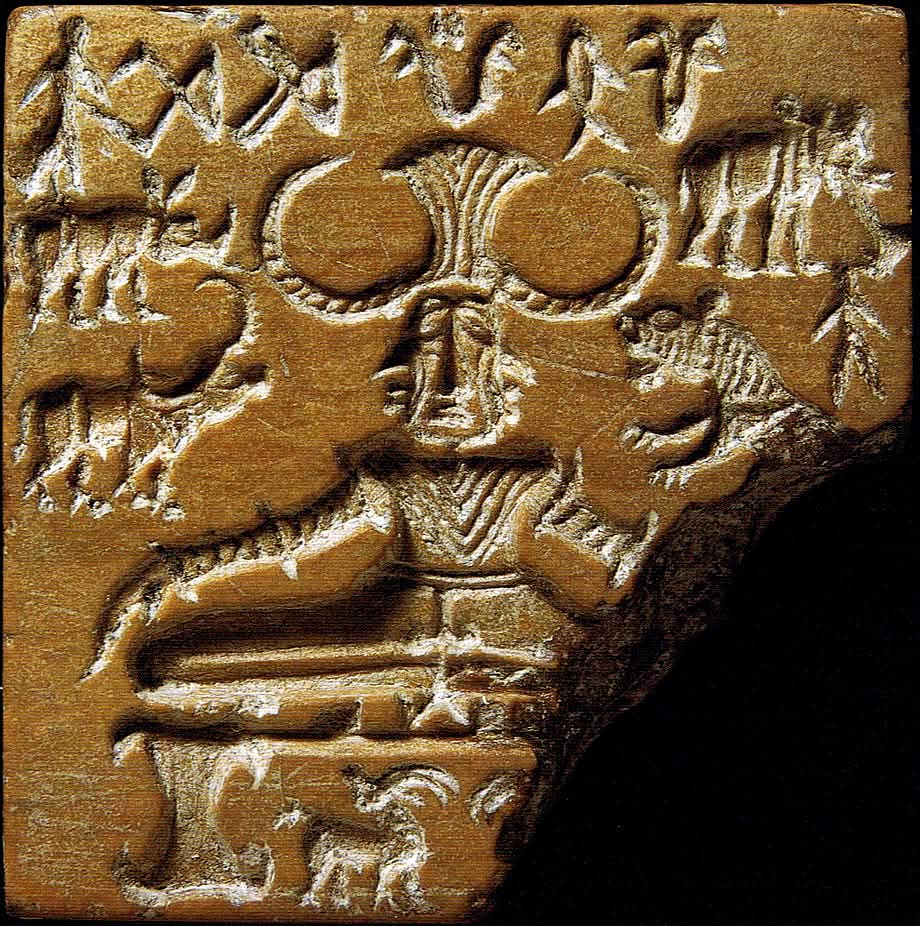
There are plenty of reasons to associate the so-called “Pashupati seal” with a proto-Śiva figure. Even if it isn’t literally Śiva, the iconography still clearly depicts a yogic male proto-hindu deity and a precursor to later Hindu symbolism.
And is open to diverse interpretation!
This isn't Shiva. It's more likely adapted from proto-Elamite iconography, showing an Eurasian deity "lord of animals."
Indian history is amazing, wonderful, and fantastic -- It's well worth getting it right.
Even external and imperial-scale powers entering Tamilakam—the Pallavas, Hoysalas, Western Gangas, Kakatiyas, and the Nayaks of Tamil Nadu and Sri Lanka—still administered in Tamil and left records in it.
That’s not imposition—that’s integration into a strong linguistic fold!
That’s not hypocrisy—that’s context.
In Tamil Nadu, asking migrants to learn Tamil is about basic integration and that too if they're staying long. Abroad, Tamil gained status in places like Singapore and Sri Lanka through history, numbers, and contribution—not random demands.
@Nagarjun_K18@NarutoUzmaki201@lankaunited99 In India, Tamils insist that migrants should learn the local language. But when Tamils are migrants in other countries, they don't follow the same principle & even demand for official status in foreign land
They never answer for their hypocrisy
If I’m right, a large part of Telugu-origin families in Tamil Nadu—many tracing back to the Vijayanagara era—have long since Tamilized & identify as Tamil today. That’s how history works: communities evolve and integrate. This is also one reason why Telugu is not a official lang.
Man, what nonsense is this? Tamils aren’t the ones holding power in Delhi—the dominance lies with the Hindi belt, and delimitation will only tilt the balance further by giving them more seats. We Tamils alone can’t push back against this imbalance—others need to step up too.
My Telugu and Kannada brethren.. let's support delimitation.
Finally, KL and TN influence will reduce and we both will get to seat appropriately.
TN+ KL -60
KA + Telugu stated - 70.
We got cheated back then..
@marthandavelan Phenotypic expression is not limited to skin colours alone. And people like PR, Danush, etc., has features that cannot be from AASI. I am not saying they're less AASI, but almost all of the people in this subcontinent are heavily mixed and their genetics is very diverse and deep!
How many of you know that in the deep South India, Christianity absorbed local traditions—associating Mother Mary with deities like Kanyā Kumāri (Skandamata) as Aṉṉai vēḷāṅkaṇṇi, especially in coastal TN and Kerala?
Is this cultural appropriation—or preservation at work?
If we follow this “preserve local culture” logic, then the same people shouldn’t complain about evangelism or mock South Indians as “rice-bag converts.” By that very argument, evangelism too has engaged with and preserved elements of local culture. Sanskritization ≈ Evangelism
Sanskritisation preserves local culture. That's why heavily Sanskritised regional cultures like Tulu Nadu, or even Kerala to an extent, are preserved to a large extent.
Sanskritisation might appropriate but never destroys. That's why cultures are safe inside it. On the other hand, Abrahamic religions will destroy local culture. Islam has already replaced the traditional costumes of a lot of countries with Burqa.