A think tank dedicated to expanding the understanding of the cross disciplines of architectural & environmental psychology and implementing it in various areas.
What if #Mumbai’s rooftops stopped being dead concrete and became engines of income, fresh food, green cover and cleaner air — all at once?
Mu.S.Ex. has submitted a practical proposal to the @NMMCCommr for a rooftop nursery + rainwater harvesting model.
Professional nurseries rent society rooftops. Societies install and maintain rainwater harvesting systems to supply irrigation water (plus basic power support where needed). Nurseries bring expertise, operations and market access. Societies earn steady rental income.
This creates the economic incentive that past mandates lacked.
The model delivers clear benefits to every stakeholder:
Housing societies — New revenue from underutilised rooftops. Greener buildings. Potential access to fresh local produce. Long-term asset value.
Nursery operators & urban farmers — Affordable access to high-demand urban space. Reliable water and power partnership. Premium pricing for hyper-local produce.
Navi Mumbai (NMMC) — Scaled green cover and RWH compliance at minimal public cost. Measurable gains in stormwater management (green roofs retain 50-80%+ of rainfall), urban cooling, air quality, biodiversity and carbon sequestration.
Residents & the city — Stronger local food systems, green jobs, and daily access to nature in dense urban environments — supporting mental well-being and neighbourhood resilience.
A genuine win-win-win framework.
This approach is already proven in other major cities.
#NewYorkCity — Brooklyn Grange has operated commercial soil-based rooftop farms since 2010, producing over 100,000 lbs of organic vegetables annually. Their intensive green roofs deliver stormwater benefits, biodiversity and community value in one of the world’s densest cities.
#Singapore — Rooftop and vertical farming systems form a core part of the national strategy to reach 30% local food production by 2030 (from over 90% imports). These systems reduce food miles, build climate resilience and cool buildings in a high-density tropical city.
Professional operation + aligned incentives = scalable, long-term results.
Vashi Sectors 28 & 29 offer an ideal setting for a proof-of-concept pilot.
Suitable residential rooftops, active societies and strong local networks. Mu.S.Ex. has discussed the model with local Corporator Shri Shashikant Raut, who supports taking it forward as a pilot.
Start with a small number of buildings. Measure yields, water use, rental economics, temperature and air quality impacts. Refine the framework. Then scale across the city with supportive policy.
This is how #NaviMumbai can lead in turning underused urban infrastructure into productive, resilient green assets.
The full proposal has been submitted to the Commissioner’s office @NMMConline@NMMCCommr.
Mu.S.Ex. is happy to share details and explore collaborative pilots with housing societies, nursery groups, urban planners and design professionals.
What are your thoughts? Could this model work for societies in your area? Let’s build more productive, liveable and self-reliant neighbourhoods — one rooftop at a time.
Mu.S.Ex. | Musing Spatial Experiences
@NaviMumbaiNet #UrbanAgriculture #UrbanFarming #SustainableCities #ClimateAction #SmartCities #UrbanPlanning
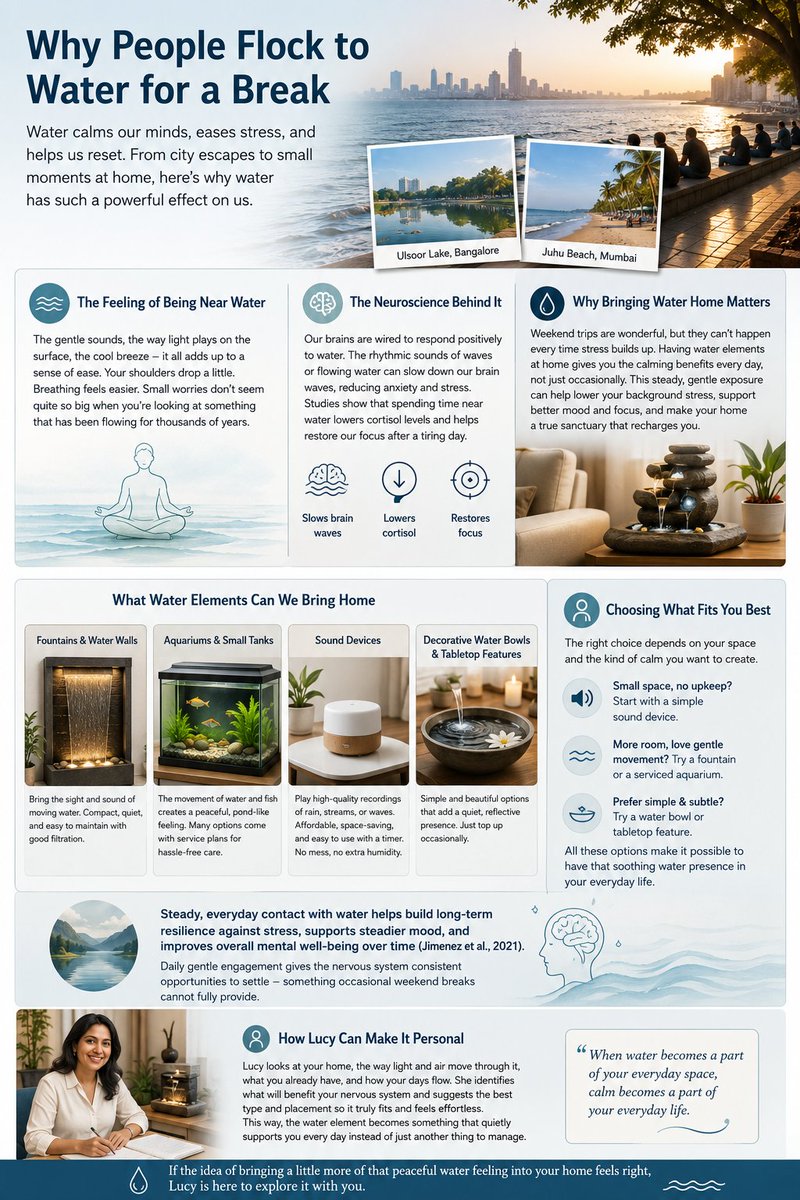
Why do we instinctively move towards the sea, a lake or a waterfall when life becomes too loud?
Perhaps it is because water gives the mind something gentle to follow. The rhythm of waves, shifting reflections and continuous movement can soften attention without demanding it. For a moment, traffic, deadlines and unfinished thoughts seem to loosen their grip.
But calm should not have to wait for the next weekend at Marine Drive or a trip outside the city. This article explores how fountains, aquariums, water sounds and even small reflective elements can bring some of that restorative feeling into everyday life. The right choice is not the most dramatic feature - it is the one that fits your home, your routines and the kind of calm your nervous system needs.
Why can a conversation feel effortless on a park bench, a seafront or a quiet walk - then strangely heavy inside a room?
Outdoors, there is movement to soften silence, distance to reduce pressure, changing light to hold our attention and a shared world to look at when eye contact becomes intense. Indoors, poor air, rigid seating, harsh lighting and an over-staged atmosphere can make two people feel as though they are performing closeness instead of experiencing it.
The good news is that a home can borrow some of the emotional ease of the outdoors. This article reveals the small spatial choices that help people relax, talk more naturally and feel genuinely present with one another.
You finish a day of sitting at work, travel home sitting, eat dinner sitting and finally “rest” by sitting again. The body has barely changed position, yet the day feels exhausting.
We often treat movement as something that happens only during a workout. But the more powerful question may be: does your home give your body small reasons to stand, stretch, reach, walk and change posture throughout ordinary life?
A glass of water placed differently, a work surface that supports standing, a route that encourages a few extra steps or a seat that does not trap you for hours can quietly interrupt a sedentary routine. Explore how interiors can make healthy movement feel natural rather than another task on your list.
Plastic did not storm into our homes. It arrived politely - as the unbreakable lunch box, the colourful bucket, the easy-to-clean chair and the affordable surface that promised to make life simpler.
Then it moved into places we stopped noticing: flooring, laminates, mattresses, wiring, window frames and the dust we breathe every day. The most unsettling part of our relationship with plastic may not be what we throw away, but what quietly stays with us indoors.
This article traces how convenience became dependence, what hidden plastic can mean for a healthy home, and how to make more thoughtful material choices without pretending we can change everything overnight.
Have you noticed how some places make you hurry even when you are not late?
Long corridors, hard edges, impatient lighting and routes designed only to get us from A to B can train the body to move as if every moment is an emergency. Yet an old garden path, a shaded courtyard or a floor that changes gently beneath your feet can do the opposite: it can make you pause, look around and return to yourself.
Slow walking is not laziness. It is a form of attention - and design can either protect it or erase it. This article explores how the ground beneath us shapes our pace, why constant speed exhausts us, and how a home can invite a more present rhythm.
What if #Mumbai’s rooftops stopped being dead concrete and became engines of income, fresh food, green cover and cleaner air — all at once?
Mu.S.Ex. has submitted a practical proposal to the @NMMCCommr for a rooftop nursery + rainwater harvesting model.
Professional nurseries rent society rooftops. Societies install and maintain rainwater harvesting systems to supply irrigation water (plus basic power support where needed). Nurseries bring expertise, operations and market access. Societies earn steady rental income.
This creates the economic incentive that past mandates lacked.
The model delivers clear benefits to every stakeholder:
Housing societies — New revenue from underutilised rooftops. Greener buildings. Potential access to fresh local produce. Long-term asset value.
Nursery operators & urban farmers — Affordable access to high-demand urban space. Reliable water and power partnership. Premium pricing for hyper-local produce.
Navi Mumbai (NMMC) — Scaled green cover and RWH compliance at minimal public cost. Measurable gains in stormwater management (green roofs retain 50-80%+ of rainfall), urban cooling, air quality, biodiversity and carbon sequestration.
Residents & the city — Stronger local food systems, green jobs, and daily access to nature in dense urban environments — supporting mental well-being and neighbourhood resilience.
A genuine win-win-win framework.
This approach is already proven in other major cities.
#NewYorkCity — Brooklyn Grange has operated commercial soil-based rooftop farms since 2010, producing over 100,000 lbs of organic vegetables annually. Their intensive green roofs deliver stormwater benefits, biodiversity and community value in one of the world’s densest cities.
#Singapore — Rooftop and vertical farming systems form a core part of the national strategy to reach 30% local food production by 2030 (from over 90% imports). These systems reduce food miles, build climate resilience and cool buildings in a high-density tropical city.
Professional operation + aligned incentives = scalable, long-term results.
Vashi Sectors 28 & 29 offer an ideal setting for a proof-of-concept pilot.
Suitable residential rooftops, active societies and strong local networks. Mu.S.Ex. has discussed the model with local Corporator Shri Shashikant Raut, who supports taking it forward as a pilot.
Start with a small number of buildings. Measure yields, water use, rental economics, temperature and air quality impacts. Refine the framework. Then scale across the city with supportive policy.
This is how #NaviMumbai can lead in turning underused urban infrastructure into productive, resilient green assets.
The full proposal has been submitted to the Commissioner’s office @NMMConline@NMMCCommr.
Mu.S.Ex. is happy to share details and explore collaborative pilots with housing societies, nursery groups, urban planners and design professionals.
What are your thoughts? Could this model work for societies in your area? Let’s build more productive, liveable and self-reliant neighbourhoods — one rooftop at a time.
Mu.S.Ex. | Musing Spatial Experiences
@NaviMumbaiNet #UrbanAgriculture #UrbanFarming #SustainableCities #ClimateAction #SmartCities #UrbanPlanning
Water scarcity in Hyderabad is getting worse every year. It’s high time @GHMCOnline makes rainwater harvesting pits mandatory for all apartment complexes to recharge our depleting groundwater. Let’s save water before it's too late! 🙏💧
#SaveWaterHyderabad#RainwaterHarvesting
media has been static for 150 years
world models change that with interactive media
we're hosting Inception: India's first world model hackathon with @interact_studio powered by @reactorworld
june 20. bangalore. $1500 prize pool
access to models almost nobody has built on before
applications open
We spend most of our waking hours inside buildings, yet most spaces are still designed without any real understanding of how they shape our nervous systems, emotional states, cognitive performance, and overall psychological wellbeing.
At Musing Spatial Experiences (Mu.S.Ex.), we have defined 12 core areas within architectural and environmental psychology. We actively collate knowledge from these areas and apply it directly in our design work. This evidence-informed approach allows us to move beyond aesthetics and create spaces that respond to the actual physiological and psychological needs of users.
Here’s how this approach translates across different scales of work:
• We develop #sensory installations and products informed by research on perception, acoustics, and material psychology.
• Tables are crafted from discarded site wood, designed so the spinning element generates visual illusions through motion and ceiling light reflections.
• Insulated Illusion Walls are built primarily from refurbished wasted wood, functioning as both visual engagement pieces and sound-absorptive elements that minimise noise transfer to neighbouring spaces.
• Starry Sky Ceilings use optical fibres to recreate constellations, giving users the calming sensation of sleeping under an open night sky.
• Upcycling strategies are applied in practice, such as transforming cracked and unusable ceramic pots into durable, aesthetically resolved mosaics for high-use kitchen areas.
• At the medium scale, we undertake adaptive interventions guided by principles of #SensoryDesign and emotional response in constrained spaces.
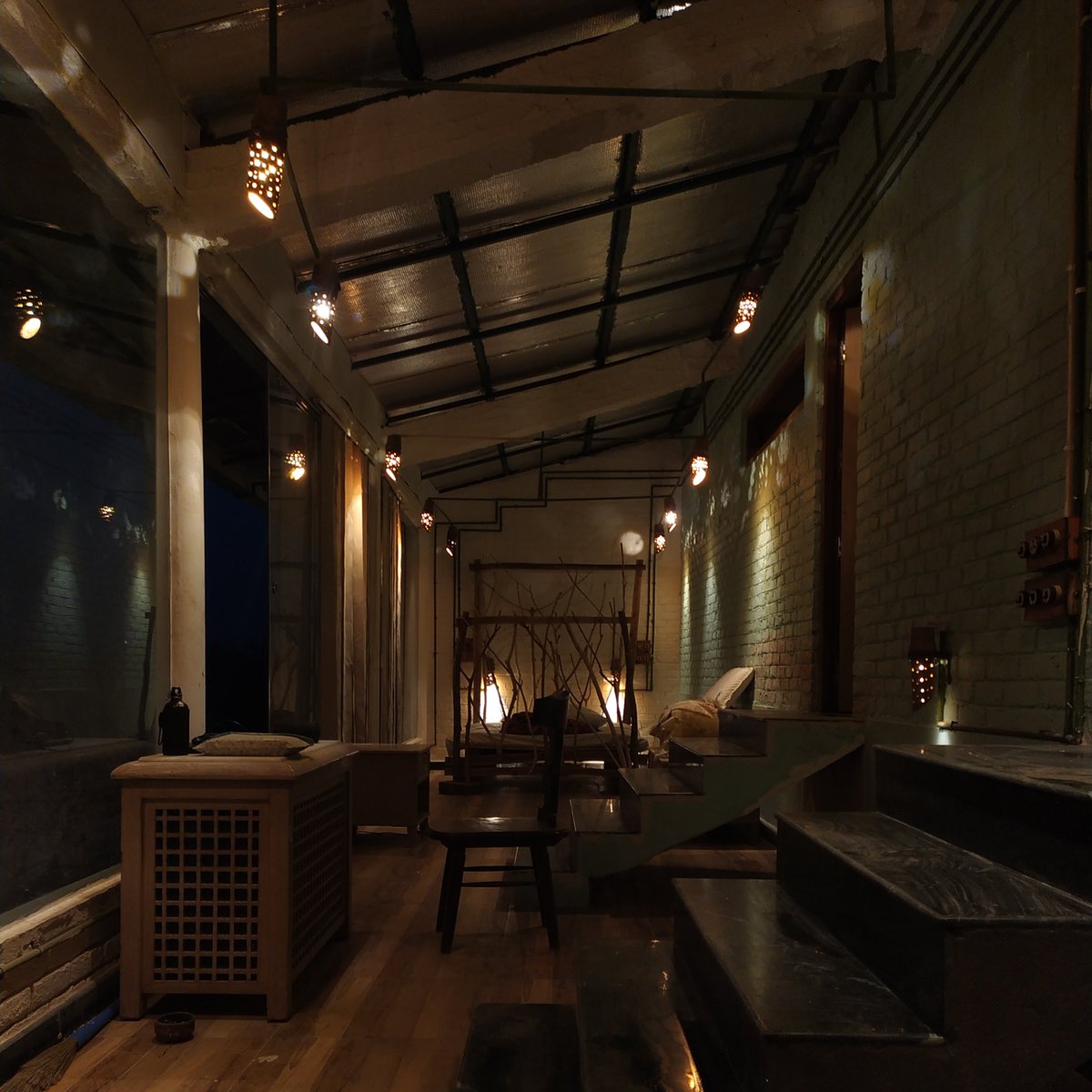
• Garage rooms are converted into Airbnb bedrooms by embracing existing architectural constraints, such as exposed conduits, and turning them into warm, characterful design features.
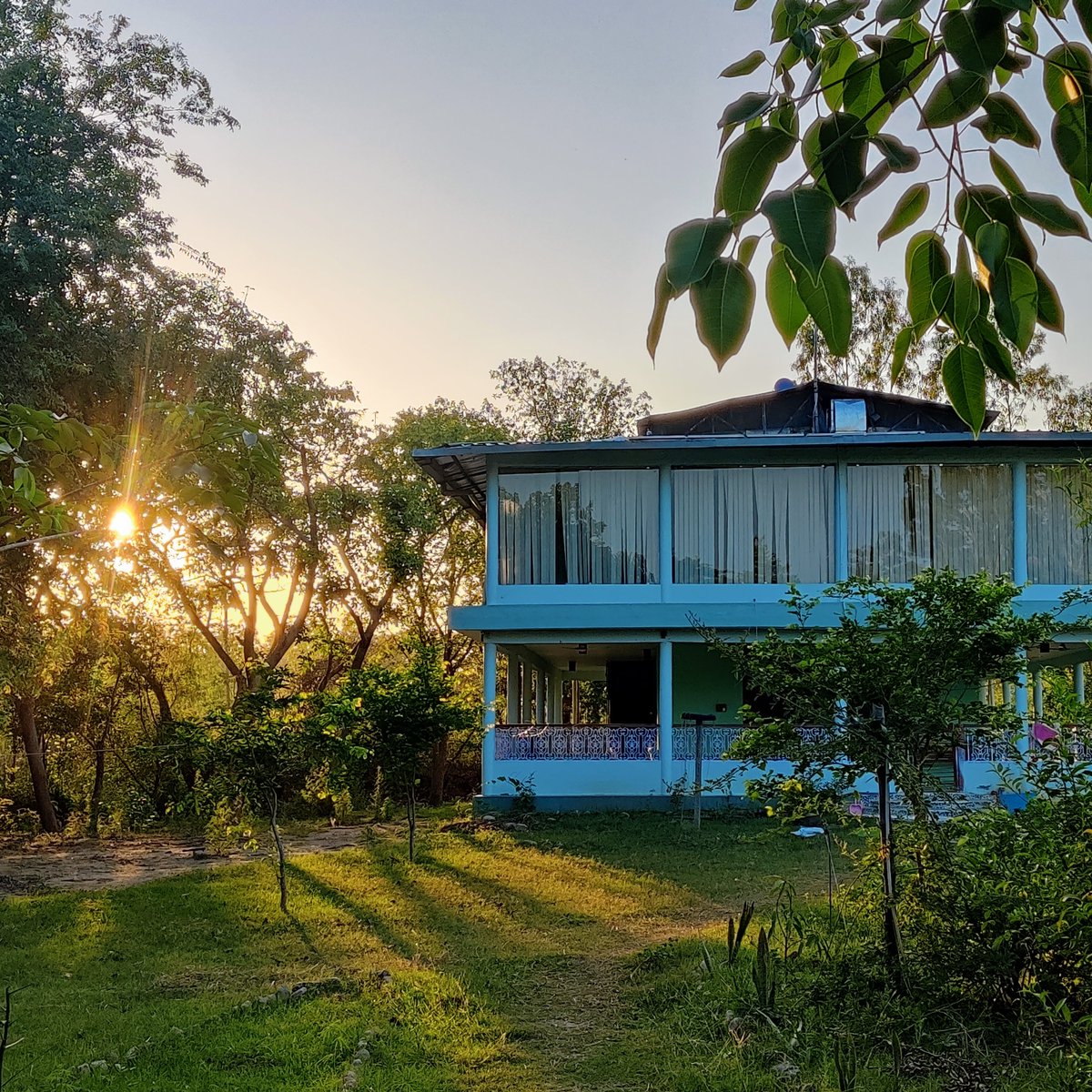
• Lighting, colour palettes, and overall spatial mood are designed for forest farmhouse resorts to create genuinely therapeutic and restorative environments rather than overstimulated or harsh ones.
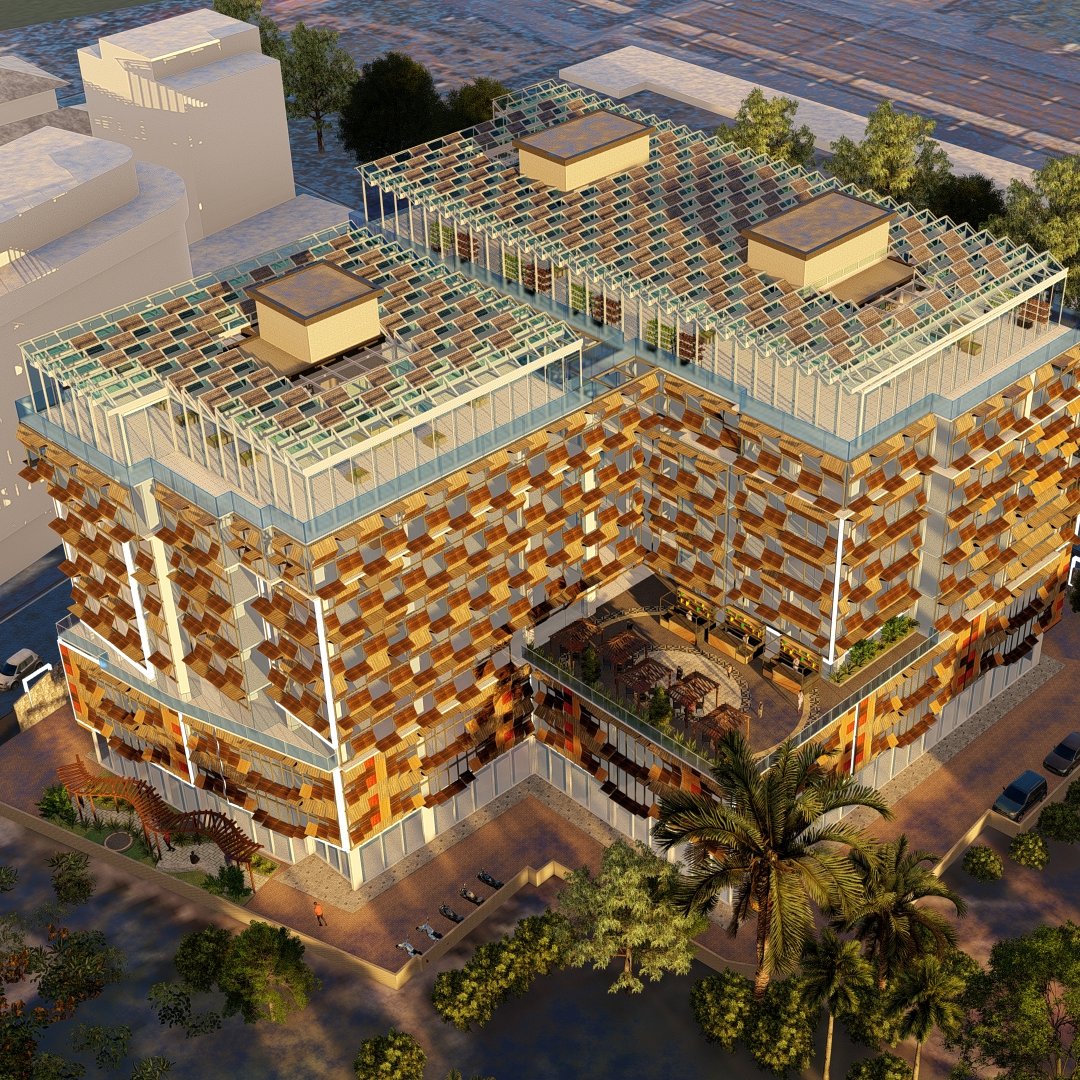
• At the larger scale, we apply collated knowledge on biophilia, thermal comfort, user wellbeing, and sustainable behaviour in projects such as the Mather Square retrofitting in Kochi.
• Kinetic wooden double-skin facades respond dynamically to solar angles, while layered #BiophilicDesign elements and sensory transitions guide movement through the building.
• A central atrium functions as a natural thermal chimney, drawing fresh oxygenated air from rooftop gardens downward while expelling warm air, thereby improving occupant comfort and reducing urban stress.
• These strategies also deliver measurable outcomes in operational efficiency, green credentials, and long-term asset value through flexible and future-proof floor plates.
• Across all scales, we design with both neurodivergent and neurotypical users in mind, prioritising sensory safety, acoustic performance, and environments that support regulation. This reflects core principles of #Neurodiversity and #DesignForWellbeing.
• We create spaces that actively support #MentalHealth by reducing sensory overload and promoting calm, focus, and emotional regulation through intentional design choices.
• #SustainableDesign is treated as integral rather than additive — we actively work with on-site waste streams and upcycled materials as a core part of the design process.
• Our approach to #SpatialDesign focuses on how people experience, move through, and feel within a space, rather than treating design as purely visual.
• We believe good design should function as #WellnessDesign — creating environments that actively support mental and emotional wellbeing rather than just visual appeal.
• Projects like Mather Square demonstrate how #ModernInteriors and thoughtful #SpatialDesign can be combined with sustainable strategies to create meaningful environments.
• We approach both #HomeDesign and adaptive residential projects with the same rigour we apply to larger architectural work, focusing on real user experience.
If you are interested in design practice that is grounded in architectural psychology and environmental psychology, and that treats sustainability, sensory experience, and human wellbeing as inseparable, I encourage you to explore the full deck and share your reflections.
https://t.co/9KqANhCjkG
You can't knock down walls in a rental. But you can still make small changes that help how you feel every day.
We’re offering free 5-minute one-on-one chats with an architect where you can bring any specific thing in your space that’s bothering you and get practical, rental-friendly ideas to improve it right away.
A lot of people who rent tell us the same kind of things keep coming up. The workspace slowly takes over the bedroom corner. The lighting feels off and leaves them with headaches by evening. Sleep is restless because the room never quite feels calm. Or there’s no quiet spot for their pet to settle without barking at every sound. Over time these small frictions add up and the space starts to feel like it’s working against them instead of supporting them.
Most renters can’t paint, drill, or make permanent changes without risking their deposit. So the usual advice about big renovations or buying new furniture doesn’t really apply. That’s exactly why we created these short chats.
In five minutes you describe what’s not working. We look at the space together (you can share photos or just talk through it) and suggest simple rearrangements or tiny adjustments using only what you already own. Things like moving a bed a few feet, changing how a desk faces the window, creating a small visual separation between work and rest, or finding a better spot for a plant or lamp that softens the feel of the room. Nothing dramatic. Just practical moves that often make a surprising difference in how rested or focused people feel.
These are not lectures or sales calls. There’s no pressure to buy anything and no long list of recommendations you have to follow. You get one or two clear ideas you can try the same day if you want. The whole thing is free and the only goal is to leave you with something useful.
You can choose video or text chat depending on what feels easier. Some people prefer showing the space quickly on video. Others like describing it in text and getting ideas back the same way. Both work fine.
We’re keeping the groups small so everyone gets proper attention. Only the first 25 people per time slot get a confirmed spot. If your preferred slot fills up we’ll put you at the front of the list for the next round.
This comes from the work we do at Musing Spatial Experiences — looking at how the way our surroundings are arranged quietly shapes daily life. These short chats are a practical way to bring that thinking to people who are renting and want small, realistic improvements without waiting for a new place or a big budget.
If any of this sounds like it could help, you can grab a spot here :
https://t.co/SrD52GMhqa
#BiophilicDesign #WellnessDesign #RentalLiving #Wellness #MentalHealth
The story of architects from their amateur years in academia to their years in a well established industry provides us with a variety of experiences to learn from. Our students have their own take on architectural career paths in India.
https://t.co/PHkgDEa4ef