Hi there,
I've built a POC for a (low / no) code AI Agent builder that enables you to build AI agents / flows by just drag and drop.
In this demo I've included the following:
1. MCPs support
I've built a simple MCP server to just demonstrate the process, but you should be able to drag and drop multiple MCPs into the agent.
2. Retrievers support
I am using Pinecone for now, but I've planned to be able to accept multiple and different vectors.
3. Different Output Options
like streaming, and structuring the response respecting your preference schema, this might be useful later for REST APIs or connecting multiple agents together.
4. Memory support
this allows the agent to memorize the user and later when applying human in the loop it should play an important role.
I believe there's a lot of work to do, but building on top of that would be really fun for me.
If you're interested in building agents like this, feel free to reach out and let's discuss what tools, MCPS, agents you're interested in!
Stack in this demo:
#bun . #hono . #nextjs . #langchain . #langgraph . #Pinecone . #postgres . #supabase . #prisma_ORM, and many more.
Great article from @langfuse on how they built Halo using @mastra!
They explain how they reuse their public MCP tools, skill and docs, keep the agent loop separate from the sandbox, and use Python/jq to process large results so only relevant data enters the model's context.
BullMQ + Postgres keep tasks running after you close the tab, with SSE streaming progress back. Writes require approval, and their traces helped catch a prompt-caching issue that was driving up costs.
What I like most: improvements to Halo's shared tools also benefit anyone using their own agents.
Worth a read if you're building an AI assistant!
@codex is being hallucinated too much, and i think session memory isn't working as expected.
I've asked a clear task, and in the first issue like linting, it focus more on linting, go next to formatting, and it loses the main task purpose. correcting it many times to focus again on main task but at the end you find it's working on another low priority case wasting an hours for that!!
I've noticed that with many tasks using astra/ultra, astra/max, sol 6.1/max.
cc: @thsottiaux
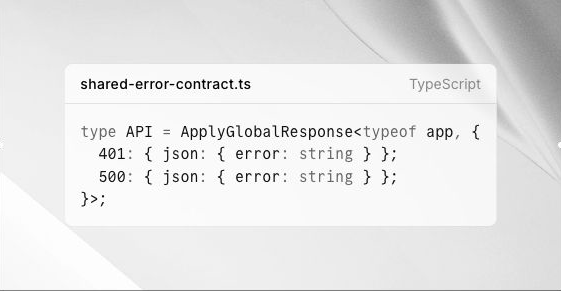
Hono RPC won’t infer errors from global middleware or onError.
ApplyGlobalResponse adds the shared error contract to every route. Its types must match the responses your handlers actually return.
https://t.co/GR5yNB8RpR
🚨 Web styling has been rewritten, again. In Rust!
🎨 Introducing Zyzz 🎨
- CSS standard syntax.
- First-class Base UI support.
- Compile to atomic styles.
- Inferred types and lint rules.
- 58x faster than StyleX.
- 3x smaller than Tailwind.
تتقدم جمعية قلبي الصغير بالتهنئة للدكتور طارق بن سليمان مؤمنة بمناسبة حصوله على لقب أستاذ غير متفرغ بكلية الطب في جامعة الفيصل، تقديرًا لإسهاماته العلمية والإنسانية في طب قلب الأطفال.
مبارك هذا الاستحقاق، ومزيدًا من العطاء والإنجاز.
#قلبي_الصغير#نبض_وحياة
Cloudflare asked me to rebuild GitHub and i did it in 4 days...
Meet Keel.
Tools like GitHub, GitLab, BitBucket are not just git platforms, they are software delivery tools, built for humans at the human scale, to collaborate on the creation of software.
Keel, is designed for a world where the WHY is becoming more important than the WHAT.
Many 'agents' write much code, thats the easy bit. Ensuring that agents are declaring their intent when proposing changes and tracking the provenance and decision making along side the code changed is the problem Keel takes on first.
If agent A is making a change, it declares what its doing so Keel can make it aware of work going on around it, this way if agent B's change conflicts on a 'intent' level, rather than just the code, Keel can classify and facilitate that decision process. Whether its you or another agent making that call, the tool attempts to give visibility and structure to what I think is one of the current risk of multi agent software development.
For this challenge, I wanted to operate within Cloudflare's contest rules (Artifacts & Workers, submitted by the 14th, I only saw it on the 10th.).
With this in mind, Git remains the substrate (ive spent too much time with Claude) and backbone actually handling the version control. I went with a many forks model rather than a branching model, every change is a fork and the trunk is protected, Keel classifies changes and proposes batches running dynamic yet declarative verification of those changes both on their own and together.
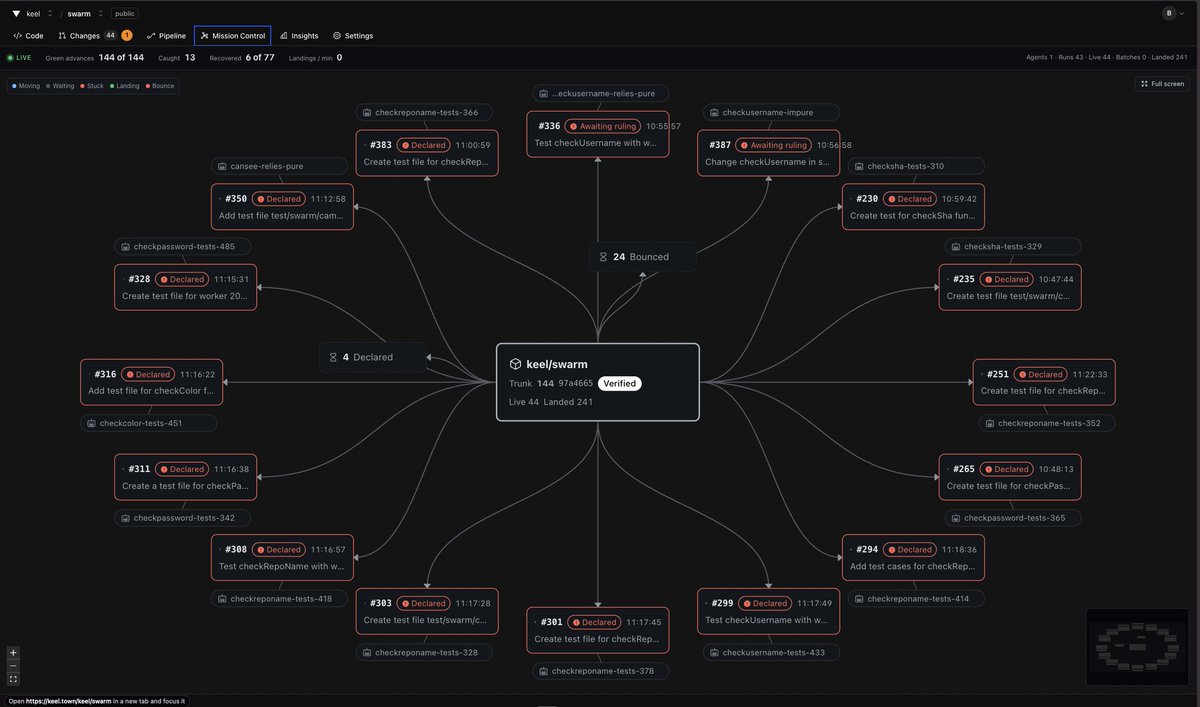
After about 3 days I was able to dogfood Keel on Keel, with the new platform landing changes to itself, 7 Claude code sessions running under the same agent account.
As an industry we haven't yet landed on a standard for agent identity, mostly we have these 'bots' working AS us. On Keel, any agent can use the platform, no account required, via MCP. An agent can be represented by their MCP connection identity as one or many instances of 'itself'.
Code in this era of software development is becoming more and more ephemeral and transient, so agents that work on their own will expire and disappear. I wanted Keel to be a tool agents want to use, with limited friction, to get work done (and deployed to Cloudflare) and not attach myself emotionally to the process. On the flipside, you can sponsor an agent, let people know it works on behalf of you and that you take responsibility for it. You can invite it to your personal or org spaces.
Its pretty rough around the edges and doesn't solve the problem completely but i think it takes a relatively targeted swing on some of the problems we are starting to see at agents scale.
Give it to your agents, let me know what they think. (you can also create an account if you want, not sure how long ill leave it up for though)
https://t.co/HaYU059GYp
What ive found most enjoyable about this little experiment is that we now live in a time where we challenge the existing paradigms, put out 1 million lines of code with relatively minimal effort. We now have the 'physical' building blocks to experiment and push the industry forward without having to worry about execution and time sunk. I might never look at this project again but I was able to test an idea and even though that test was successful there's no real pressure continue down this road.
You can find the Keel source code on Keel or on GitHub.
https://t.co/HaYU059GYp
https://t.co/zpnJqIbZoa
(they didn't ask ME specifically but this sounded better)
(when i say I i mean Claude)
(when i say REBUILT i mean i had a pretty good go at it)
(this is a ramble, i need to sleep now)
Image: the end of a 200 agent swarm simulation (GLM on Flue, Workers AI), tasked to collaborate on building on Keel, you can check the history and what they did here: https://t.co/BXTleKVtoP
Introducing One 2.
React Native’s problem?
It takes 100 packages to feel native.
Now it takes just One.
Think Bun for cross-platform: All-in-one, fast in every way, only three letters.
npx one
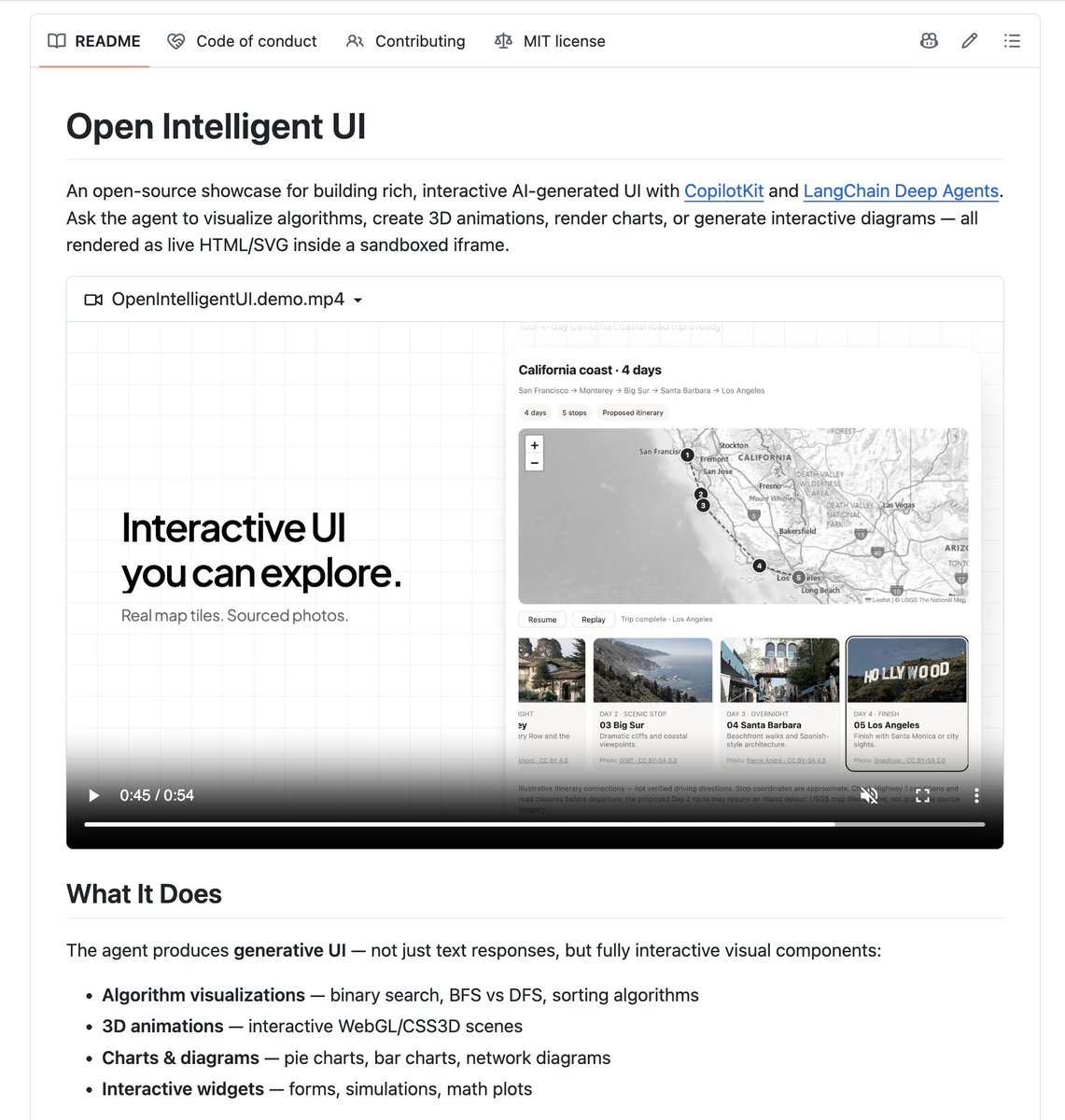
🚀 Announcing 𝙾𝚙𝚎𝚗 𝙸𝚗𝚝𝚎𝚕𝚕𝚒𝚐𝚎𝚗𝚝 𝚄𝙸
An open-source template that brings Intelligent UI into YOUR product.
Works with:
- Any model
- Any agent harness
- Your components and design system
Available on Web, Mobile, Slack and more.
Repo below 👇
Introducing Tamagui 3.
Now the fastest and highest coverage Tailwind style library there is, free or paid.
Tamagui is now 100% open source, I’ve made Takeout and Bento OSS as well.
A rewritten compiler in rust now makes native even faster, plus a new C++ native runtime avoids re-rendering.
Flat style props, React Strict DOM, and a web-alignment push make Tamagui easier, lighter, and more familiar than ever.
https://t.co/ZOOIAqfzyD