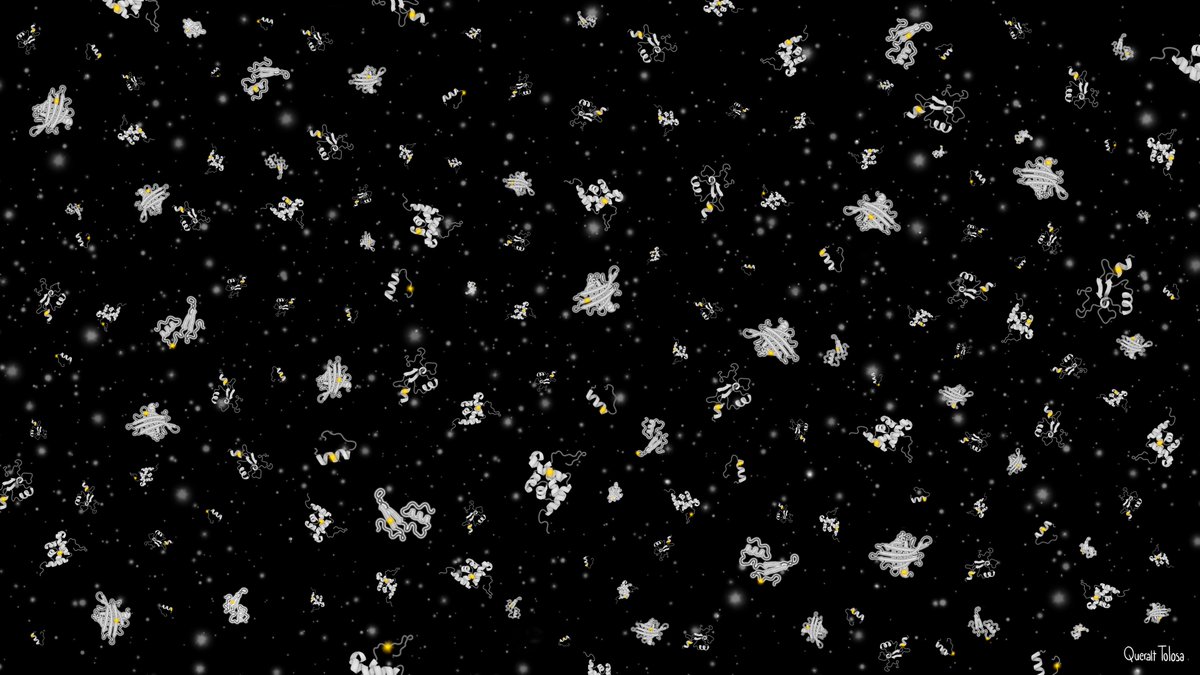
Introducing Human Domainome v1, the largest and most comprehensive library of human protein variants to date, which maps the effects of +500K mutations across 522 domains. The study by @BenLehner and Toni Beltran @mutatoni is out in @Nature.
✍️ Illustration by @QueraltTolosa
Excited to share @AlbertIltirda's randomisation of protein cores at scale: Genetics, energetics and allostery during a billion years of hydrophobic protein core evolution
with @aj4re@CRGenomica@sangerinstitute https://t.co/X0C7coty8j
How do chromatin modifications quantitatively impact gene expression?
How do sequence variants or combinatorial marks influence relationships?
We developed a modular #EpigenomeEditing toolkit to systematically test these Q, published today 🧵…
https://t.co/2p4W0J50Oc
The gut microbiome influences metabolites, hormones and immune function
Perturbing gut microbiota therefore impacts homeostasis across somatic tissues
Could it also affect the reproductive system - and even offspring?
See our results👇& tweetorial🧵
https://t.co/lb6w6BjoW7
@ToniBeltran13 @CRGenomica@sangerinstitute That's the Src kinase domain alone. Here's the allosteric map of the kinase domain in the context of the full-length protein (+ SH2, SH3, SH4 etc).
I'm super grateful to have had the support of all the Lehner lab members, and of course of @aj4re and @BenLehner. We are super excited to expand this approach to other kinases and enzymes next! 🧬🧑🔬💻
I’m super happy to finally share what I have been up to the last few years at the @BenLehner lab in Barcelona! We made lots of double mutants on the kinase domain of Src to study allosteric communication.
This complete allosteric map also allows us to take an unbiased look at the surface of the kinase. Many surface pockets are enriched in inactivating allosteric mutations, and we think these might be interesting sites to target with drugs in the future! 💊
Excited to share a new, MUCH IMPROVED version of our deep indel mutagenesis (DIM) manuscript:
https://t.co/ukxVOsYSzs
See the thread below for details.
Very happy to share what I've been working on in Barcelona with @BenLehner ! We made many (>400k) mutations in a disordered peptide and the globular domain it interacts with to gain a comprehensive map of how specificity is encoded in a partially fuzzy protein interaction (1/n)