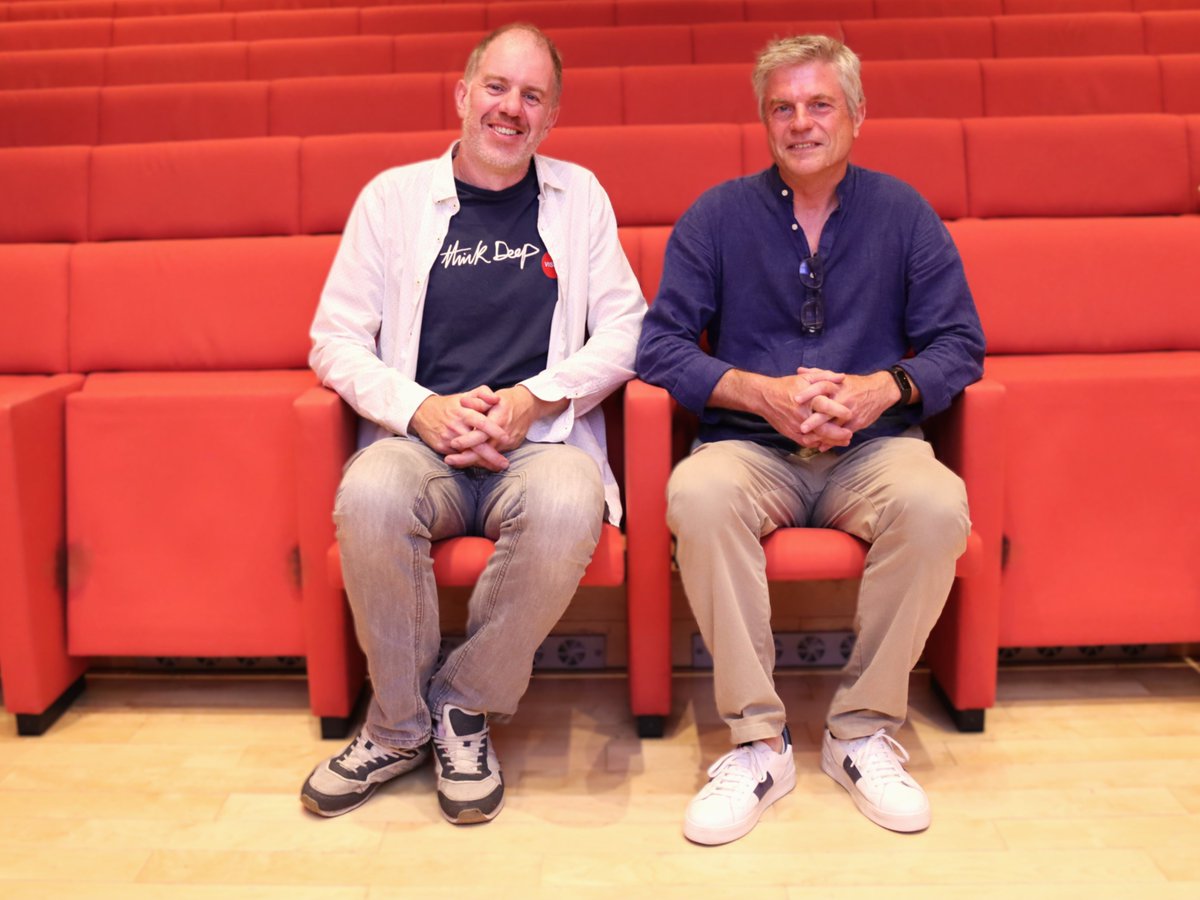
Read our latest #research, "TF-MAPS: fast high-resolution functional and allosteric mapping of DNA-binding Proteins", with @BenLehner in @SpringerNature@NatureSMB. Read here: https://t.co/KHrAFAkS35
this is such a beautifully humbling experiment. phage ϕx174 has just 5,386 bases encoding 11 proteins—about as small and well-studied a biological system as you could ask for. mutate every nucleotide and ask what happens. even here, ~25% of damaging mutations have no mechanistic explanation. and ai predictors didn’t do particularly well. we can read biology. we can increasingly perturb biology. but we are still a long way from understanding biology.
https://t.co/gmdhGR5YHY
Going from a creative idea [..you ask..] what does that predict that other ideas don't predict? And what's the fastest way we could find out that it's just completely wrong? I think that's critical and I think that doesn't come naturally to a lot of people because they become very attached to their ideas, and they want them to be correct. And that's the worst possible thing. Ideas are cheap. You have to be able to have many ideas, and most of them could be wrong.
–@BenLehner, on the Night Science Podcast, episode 9
#InterviewsCNIC 🎙️ @BenLehner
🗣️ ‘Good governance is just as important as good science’. Ben Lehner is Head of Generative Genomics at the @sangerinstitute and Senior Group Leader at the @CRGenomica.
His research combines high-throughput #genomics, protein biology, and #ArtificialIntelligence to understand how genetic variation affects protein function and drives human disease.
📰 Find out more in this #interview for #CNICPulse: https://t.co/X2kUs1x85f
#Science #CardiovascularResearch #CVD
1/6 🧬 Big news in genomics & synthetic biology!
We @huijin6418@BenLehner present the complete mutagenesis of both the genome and proteome of the bacteriophage ΦX174!
📖 Read the full preprint on @bioRxiv here: https://t.co/r61JNKJMW3
Excited to co-host #AIxBio 2026 (8–11 June) at @wellcomegenome / @sangerinstitute in Cambridge, UK!
Join an amazing speaker lineup alongside co-hosts , @ferruz_noelia, Jun Cheng, Jussi Taipale @BenLehner, @deboramarks,
The conference will explore five themes:
🔬 Solving the gene regulatory code
🧪 Solving proteins — data, structure and design
💊 Solving chemistry and therapeutics
🫀 Solving cells, tissues and organs
⚙️ AI methods development
Abstract submissions are open — deadline 27 April 2026.
Selected abstracts will be featured in the main programme alongside invited talks.
Register and submit your abstract here:
https://t.co/jNn3fgODPh
#AIxBio #AI #Biology #MachineLearning #Genomics
Meet evedesign: a new open-source ML framework that makes protein design accessible and interoperable.
📢 See our post: https://t.co/lK3Szb3ff8
Protein design models are powerful, but combining them shouldn’t require custom glue code.
✅Combine models for multi-objective optimization
✅Integrate lab-in-the-loop experimental of data
✅100% secure: run on your own infra, no data sharing
Get started building therapeutics & industrial enzymes today 👇
📄Paper: https://t.co/eTOTY6kfZ0
💻Code: https://t.co/Hn3zatn5nc
🌐Webserver: https://t.co/cAM8NVMbL4
Reach out to collaborate: [email protected]
Come join us at the @sangerinstitute to start your lab in generative biology / AI. Sanger is core-funded so you can generate data at scale to train the next generation of models and understanding. Design/Engineering/Chemistry/Proteins/Pathways!
pls RT
https://t.co/CnmpBqw0Ih