The evolution of allostery in a protein family. New preprint from the brilliant @ainamartiaranda. Seven complete allosteric maps. https://t.co/ElvnNLPGh1
Alzheimer’s disease 🧠starts with a molecular domino effect - but what triggers the first piece to fall?
In our new study we cracked open the black box of early protein aggregation, and the findings could reshape how we fight neurodegeneration. 🧵👇
https://t.co/PQZcE4bGwN
The first 27 pages, the age is listed as 0.
The first 27 pages, the age is listed as 0.
The first 27 pages, the age is listed as 0.
The first 27 pages, the age is listed as 0.
The first 27 pages, the age is listed as 0.
The first 27 pages, the age is listed as 0.
MoCHI: neural networks to fit interpretable models and quantify energies, energetic couplings, epistasis, and allostery from deep mutational scanning data
• This study introduces MoCHI, a tool designed to analyze deep mutational scanning (DMS) data by fitting interpretable genotype–phenotype models. It uniquely combines neural networks with biophysical modeling, providing insights into free energy changes, energetic couplings, and higher-order epistatic interactions.
• A standout feature of MoCHI is its flexibility to simultaneously infer both global (non-specific) and specific (pairwise or higher-order) epistasis, enabling the deconvolution of genetic interactions and nonlinearities in DMS datasets.
• The tool leverages mechanistic models to connect genotype changes to molecular phenotypes and observed experimental measurements. For example, it successfully quantified binding and folding free energies in protein mutagenesis experiments, achieving high predictive accuracy (R² = 0.94 in some cases).
• MoCHI also supports multidimensional phenotypic modeling, demonstrated through analyses of proteins like PSD95-PDZ3 and KRAS, revealing allosteric effects and identifying genetic architectures that prioritize targets for drug development.
• The framework supports sparse modeling, enabling researchers to capture significant higher-order interactions without overwhelming complexity, and provides interpretable results grounded in physical and biochemical principles.
• Limitations include its reliance on substantial data for accurate parameter inference and challenges with non-identifiable models in sparse datasets. Future improvements may enhance efficiency and address these gaps.
• MoCHI is freely available, encouraging widespread use in quantitative biology and precision protein engineering.
@ALLOXbio@aj4re@BenLehner
💻Code: https://t.co/zO8gDbBzF9
📜Paper: https://t.co/U5CA21jZiH
#DeepMutationalScanning #Epistasis #Allostery #NeuralNetworks #ProteinEngineering
ÚLTIMA HORA | 1.900 desaparecidos provisionales y riesgo de colapso en hospitales de València, según el acta de la reunión de crisis de Mazón y Marlaska
Hay 70 cadáveres localizados pendientes de su levantamiento oficial
https://t.co/ZIqzmKRw5u
Massive experimental quantification of amyloid nucleation allows interpretable deep learning of protein aggregation
1. This study presents a revolutionary dataset of amyloid nucleation for over 100,000 protein sequences, addressing the limitations of previous aggregation prediction methods trained on smaller datasets.
2. The key innovation is the development of CANYA, a convolution-attention hybrid neural network that dramatically outperforms existing models in predicting amyloid nucleation from sequence data.
3. Unlike previous methods, CANYA provides accurate, interpretable predictions by leveraging deep learning and massive experimental data, allowing the study of complex aggregation behavior across a diverse sequence space.
4. The study highlights the poor generalization of current amyloid prediction tools and demonstrates the importance of high-throughput experimental data for improving predictions.
5. A groundbreaking feature of CANYA is its ability to provide interpretable insights into the determinants of amyloid nucleation, revealing patterns that drive protein aggregation, such as hydrophobicity and β-strand propensity.
6. This research opens new possibilities for understanding amyloid-related diseases and advancing biotechnology applications by offering a robust model to predict protein aggregation behavior.
7. CANYA’s predictions are validated across an additional 7,000 random sequences, with results showing superior accuracy compared to widely used prediction models like CamSol, TANGO, and Aggrescan.
8. The dataset and model provide a valuable resource for the scientific community, enabling the development of more reliable tools to predict and understand protein aggregation.
@BenLehner@Bennibolo@IBECBarcelona
💻Code: https://t.co/lGr8twoimH
📜Paper: https://t.co/WjGToX2B10
The Genetic Architecture of Protein Stability @Nature
1/ 🧬 Simplified protein stability landscape: This paper reveals that the genetic architecture governing protein stability can be surprisingly simple. It demonstrates that additive energy models can predict phenotypic outcomes from complex mutations, debunking the idea that highly complex models are necessary.
2/ 🔍 Large-scale mutation experiments: The study explored vast sequence spaces with over 10 billion genotypes and found that most phenotypic changes could be predicted using additive energy models, where interactions between mutations are minimal and sparse.
3/ 💡 Energetic couplings: While most genetic interactions are additive, the paper highlights that some pairwise energetic couplings (interactions between mutations) are structurally related and important for more accurate predictions in some proteins.
4/ 🧠 Simple and interpretable: Instead of relying on deep learning models with millions of parameters, the authors used simple thermodynamic models that are interpretable and mechanistically insightful, showing that complexity isn't always necessary for understanding protein function.
5/ 🔬 Practical applications: These models could have broad applications in fields such as clinical variant effect prediction, protein engineering, and drug design, providing a robust tool for predicting the stability of protein structures with numerous mutations.
6/ 🌐 General principle: The study suggests that this simplicity in the genotype–phenotype relationship might be a general principle across macromolecules, offering insights into the evolutionary and functional constraints of proteins.
@BenLehner@JoernSchmiedel@ainamartiaranda@aj4re
💻 Code: https://t.co/zO8gDbBzF9
📜 Paper: https://t.co/LdCdB83d0v
Más de mil músicos hacen vibrar la localidad valenciana de Ontinyent al son de ‘Chimo’ la marcha mora más internacional en su 60 aniversario
Se trata del pistoletazo de salida a las fiestas de Moros y Cristianos que reúne cada año a miles de personas
I’m super happy to finally share what I have been up to the last few years at the @BenLehner lab in Barcelona! We made lots of double mutants on the kinase domain of Src to study allosteric communication.
Introducing the Domainome... Site saturation mutagenesis of 500 human protein domains reveals the contribution of protein destabilization to genetic disease by @ToniBeltran13 @CRGenomica@sangerinstitute @BGI_Genomics https://t.co/ZJkk0q1wdD
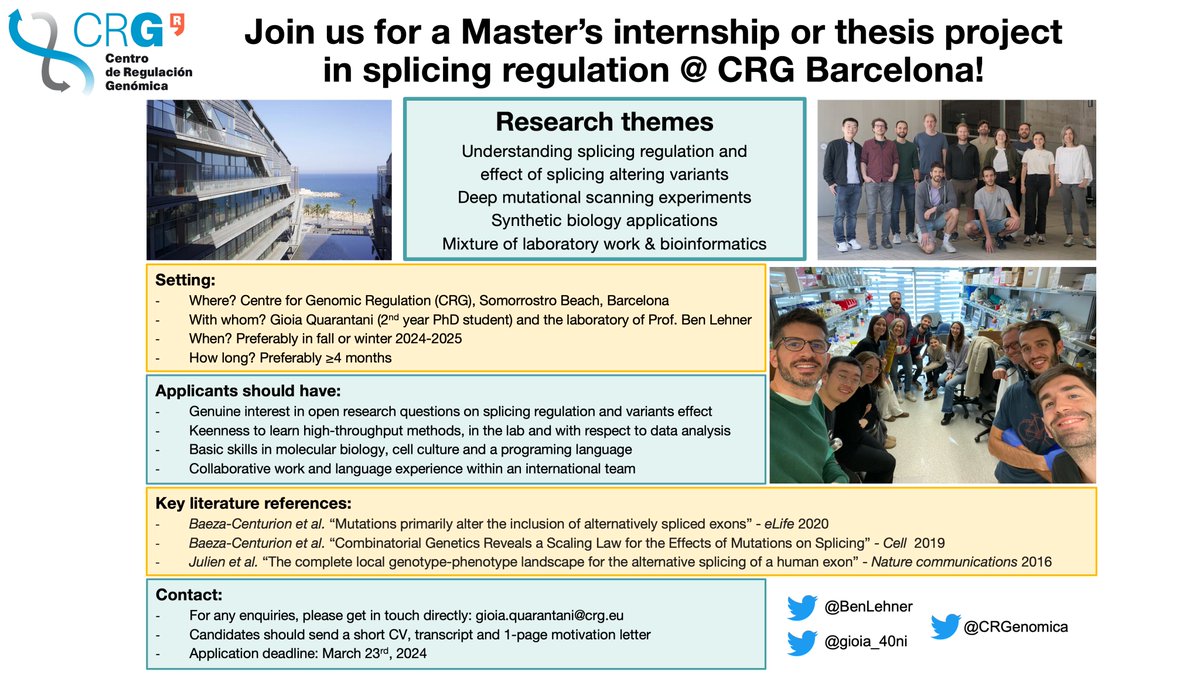
Join us at the @BenLehner lab @CRGenomica in Barcelona!🌅
We're seeking motivated ≥4-month Master's students for thesis/intern positions.
Explore splicing regulation & effects of splicing-altering variants through deep mutational scanning 🧬🥼
Very happy to share our latest work studying cell cycle dynamics during tissue growth! Have a look to find out how mechanical constraints shape cell proliferation patterns in growing epithelia!
w/ @ruth_baker@DJCohenEtAl
https://t.co/JxwAea4eyu