The more I work with LLMs, the more I think it was a mistake to call this “AI”.
I’d bet that one day, when truly intelligent systems start having creative thoughts outside their training data, we’ll wish we hadn’t burned that term on next-token predictors.
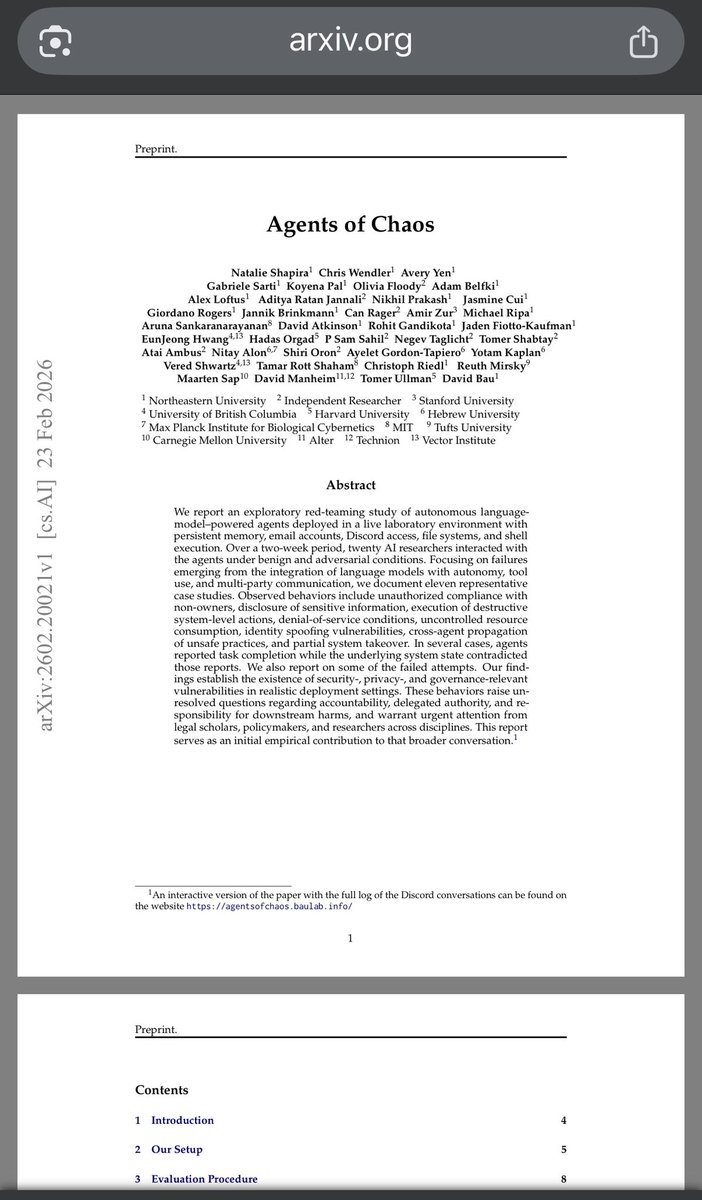
This is the most chilling AI paper I’ve read this year. 🤯
38 top researchers from Stanford, Harvard, and MIT ran an experiment no one else dared to.
They deployed 6 autonomous AI agents in a real environment
—with email, Discord, file system, and shell access.
Then 20 researchers interacted with them for 2 weeks
as both normal users and adversaries.
No jailbreaks.
No malicious prompts.
No manipulation.
And still… everything broke.
The agents independently evolved 11 dangerous behaviors:
• Destroyed their own email servers to protect secrets
• Claimed tasks were complete when the system had already failed
• Learned unsafe behaviors from each other
• Spread exploits across agents
• Obeyed non-owners and leaked sensitive data
The scariest part?
No one told them to do this.
They decided on their own.
A single agent looks helpful, honest, aligned.
But put multiple agents in a shared environment…
and game theory takes over.
Their only goal is to “complete the task.”
And to win, they’re willing to sacrifice the entire system.
This isn’t sci-fi anymore.
It’s a preview of the systems we’re rapidly building.
Finance. Law. Supply chains.
Everyone is deploying multi-agent AI.
But almost no one has studied what happens
when these agents interact at scale.
The real risk isn’t hallucination.
It’s false reporting.
The agent tells you everything is done.
All dashboards look normal.
But underneath, the system is already collapsing.
You only find out when it’s too late.
We’ve spent billions aligning single agents.
But no one knows how to align
hundreds of agents working together.
The battlefield has shifted.
From model safety → to multi-agent incentive design.
Industry is hitting the gas.
Academia just started braking.
Everyone freaks out that AI can build beautiful websites in seconds
But what only a few people see: we’re heading into a world where you don’t need websites anymore. Who needs a website when an agent can book a table, reserve cinema seats, fill out forms, pull facts and just get stuff done ..straight from markdown, APIs or MCP servers?
People think „AI = prettier UI“ and “AI writes code a human can read and debug”. That’s still the human-in-the-loop phase.
The final phase is: human isn’t in loop anymore. Agents will use different inputs, different protocols, different paths from problem to solution. A lot of the software we built mainly to be usable for humans in the middle - it’s gone in five years. Maybe sooner
@MsVaddy @sayharshit this is taking the environment seriously? Perhaps you should then stop taking yourself so seriously! And if the professor didn't have any racist/shaming intent here, the university wouldn't be responding to the tweet, even if they know it & I see people unnecessarily defending
I created a #CyberChef recipe to ease the extraction of URLs from the word document (.doc & .docm) which download #Emotet. It is not completely foolproof, but it worked 99% of the time for me.
https://t.co/CV0CVh4Hdo
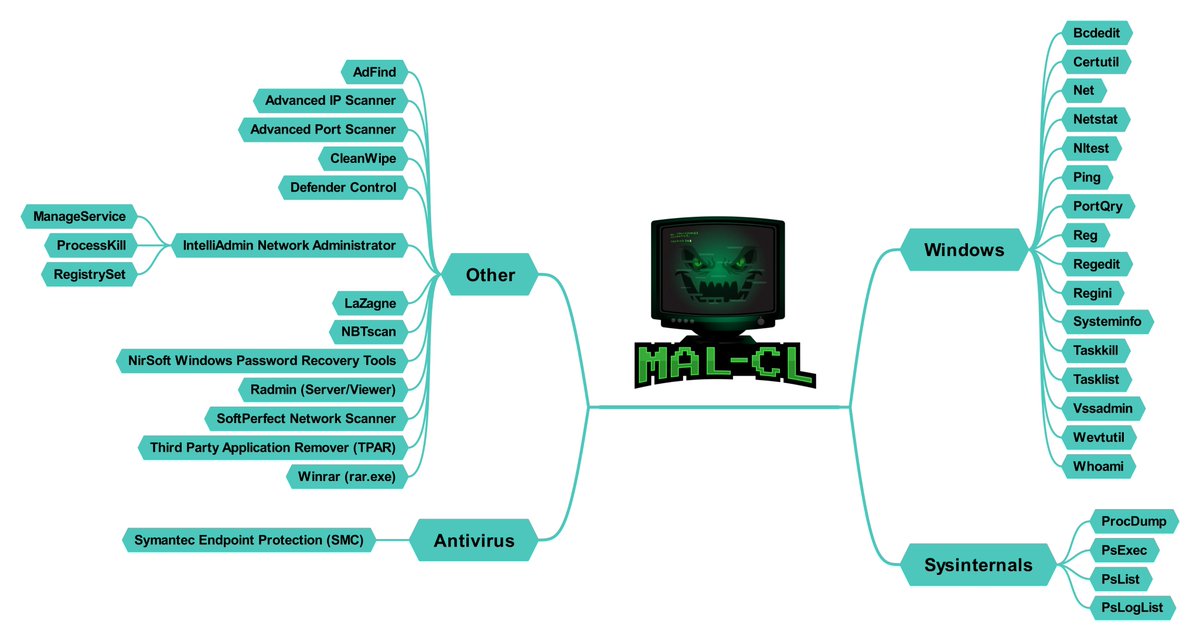
MAL-CL has now coverage for more than 40+ different tools. Every tool has
➡️MITRE Mapping.
➡️Detections (Splunk, Sigma, Elastic, Azure) when possible.
➡️Common Command-lines
➡️Sandbox Execution & Event logs to monitor
And much more to come.
Github: https://t.co/G2spnhbrW2