I found myself looking for more YouTube lectures like the Sarah Paine on Dwarkesh ones.
And realized why I don’t listen to interview podcasts anymore.
Little organization of thought and, at best, just hot takes poorly argued with 15 minutes of good info said in 2 hours.
An ask: anything like the Paine lectures you’ve watched lately?
“It’s very clear Epic owns the market. Its prices are extraordinary. It has killed innovators left and right — it’s time for a change.” A must-read story from Casey Ross and @brittanytrang, who are investigating the electronic health records giant Epic. https://t.co/EQTlBdtrCH
Springfield made it official today. Nearly 2,000 jobs, $850M invested, and a hybrid-electric aircraft built right here. Grateful to @ElectraAero and Marc Allen for betting on Ohio — and to @GovMikeDeWine, @naamce, @Hoag8 and @DaytonRegion for helping get us here.
10 projects. 1,127 new jobs. 4 regions of Ohio. One vote today.
That’s not a hot streak — that’s the system working. Companies keep choosing Ohio. @jobsohio
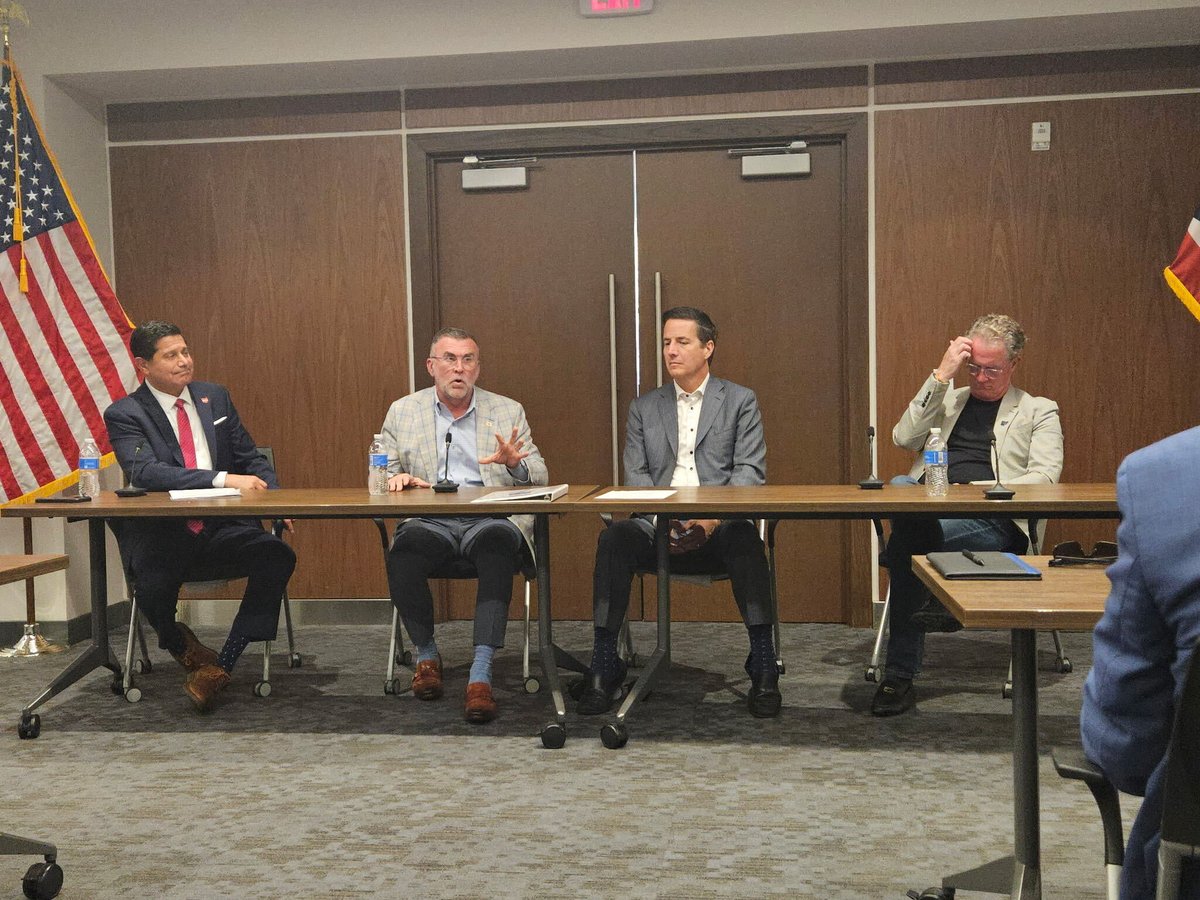
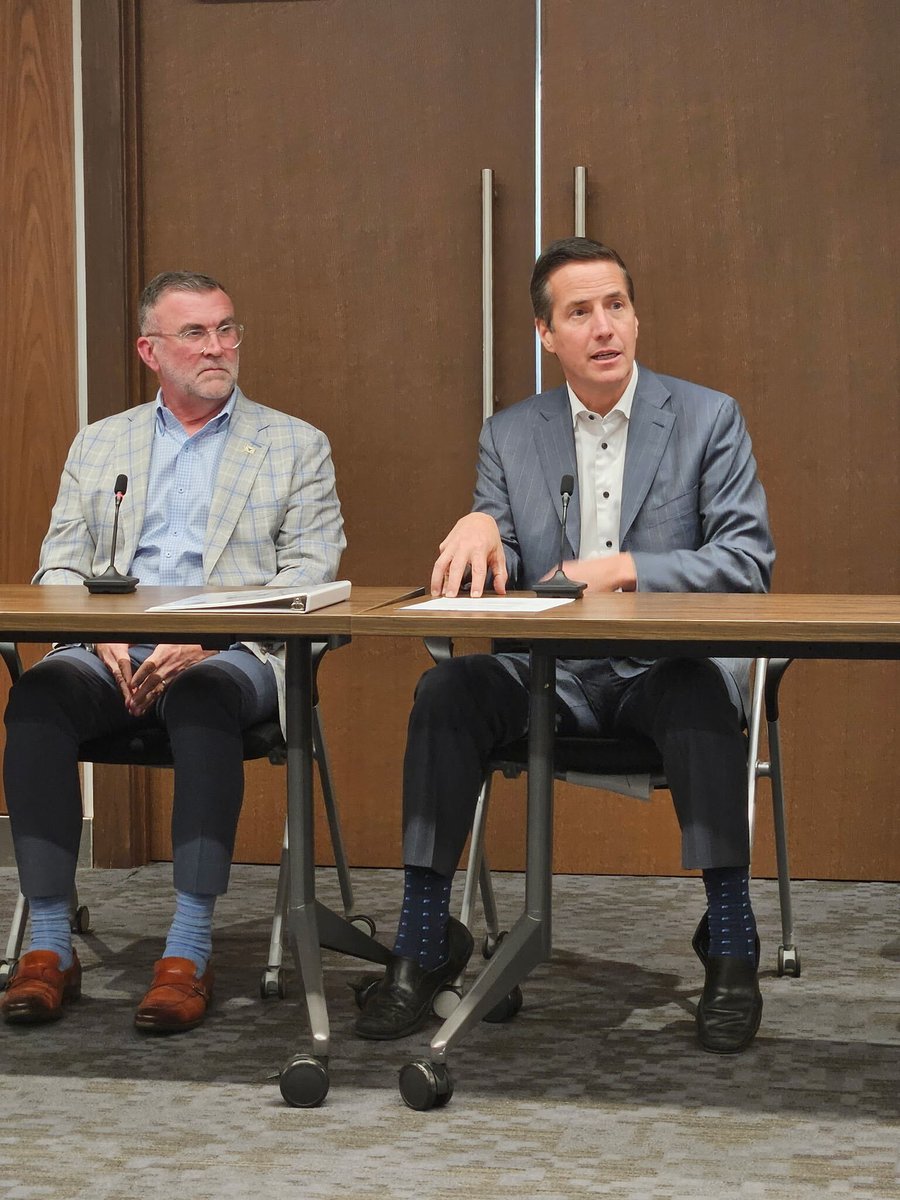
Ohio is where the next generation of defense technology gets built. Thanks to Asst. Sec. of War Mike Dodd, Sen. @berniemoreno, and @mdkmoto for a great conversation yesterday — plus the @OhioChamber for hosting. 400+ defense contractors and counting.
@JobsOhio
In the '90s, general-purpose chips wiped out the specialists. The original Thinking Machines, Cray Computer, and a wave of others shut down, and their best ideas got absorbed into other chips.
Zain Asgar of @gimletlabs argues the conditions that made generalists win have changed. Dennard scaling (shrinking transistors made chips faster at the same power) ended around 2005, transistor costs stopped falling around 2012, and memory bandwidth never kept up with compute.
Meanwhile, token demand is projected to grow 24x by 2030 while available power grows about 2x. When power is the bottleneck, performance per watt wins, and that's where specialized chips shine.
Full piece from Zain on why "the time of specialization is upon us": https://t.co/dFA8McPid5
To: any company with a support number
Please do not make me navigate a tree where at each node you constantly remind of your webiste. I know you have a website. I tried to do what I wanted the website. I do not want to call you. Pretty much no one wants to call. I'm calling you because I have no other choice. So please God, just let me either get through to an agent or put on a queue without navigating. Heck, to even *find* your phone number took me a while because you bury it on your "contact us" page.
China's own economic miracle just got declared broken, by one of the people who studies it closest.
Logan Wright of Rhodium Group titled his new book "Broken China." His argument, in his own words: "this credit-dependent, investment-driven growth model has basically come to an end." He says China built one of the largest credit expansions in a century, and now that system is running out of road.
Here's the scale. Between 2008 and 2016, Chinese banks added new lending equal to roughly a third of global GDP. Much of it went into projects that never generated enough return to pay the loans back. Property once made up 20-25% of GDP. New housing starts have fallen nearly 80% since the peak, sales are down more than 60%, and buyers no longer expect prices to rise.
Wright's conclusion matters because of what it challenges. Beijing's message to the world has been that its rise is unstoppable. He says that story doesn't hold anymore, that China now faces a genuinely more constrained future.
New strategic industries like EVs and robotics won't fix this either, he argues. They're capital-heavy, not job-heavy, and don't solve the deeper problem: Chinese households don't consume enough, and the fix (shifting taxes, writing down bad loans) is politically hard to do.
He also says the US now has more economic leverage over China than it has in years, not because of chip bans, but because China can't keep growing without selling into markets abroad.
What will China do in the next five years for the biopharmaceutical industry?
More drugs, more clinical trials, and more partnerships.
Great post from my @atlasventure colleague Julia Pian - examining the 2026 "Five Year Plan" from China affirming biopharmaceutical industry as a top priority
https://t.co/VHMQkdAfRt
this is Dario and sama's worst nightmare -
A law firm buying Nvidia servers.
Latham & Watkins is building an in-house AI stack..
this is US’s second-largest law firm with $8.3 Billion in revenue last year
And now it has -
- Nvidia hardware it controls
- open-weight models it can fine tune
- proprietary legal data it is trusted to protect
- infrastructure only Latham employees can access
A law firm has decades of contracts, negotiations, client context, legal reasoning, and institutional knowledge.
They dont want to give all of that away to OpenAI or Anthropic in exchange for expensive tokens..
And on top of that - risk their data being used to train frontier models..
This will happen more and more now..
The big AI labs have no moat.. nothing protecting their largest customers from moving on..
The biggest companies in the world will -
- own the compute
- own the data
- own the workflow
- fine tune the model around their business
- switch providers when the pricing or quality changes
Dario and sama want to make this illegal by bringing in regulation.. and become the AI overlords..
Did Trump just tell Ratcliffe to send "one ping only"?
Basically, using the timing of 9/11 anniversary to prove to Putin he does actually have control over the CIA.
The ping:
https://t.co/9TMItF5L65
Lauren Grandcolas was pregnant with her first child on 9/11 when she was m*rdered, along with 39 others on Flight 93.
She was flying home from a funeral and, as she'd arrived at the airport early, she was bumped to the earlier flight 93, already targeted by hijackers. Her Jack husband has said that was the first time she'd ever been early for a flight.
Flight 93 was delayed and the last to be hijacked, resulting in a revolt by passengers who were well aware of their fate otherwise.
Grandcolas called her husband Jack and left a message (below) that there was a "problem with the plane" before the final fight between the passengers and the 4 hijackers.
Hijacker pilot Ziad Jarrah tried various maneuvers to knock the passengers off balance, one hijacker was likely k*lled by the passengers as per audio only heard by officials and family members.
The last words on the recording are of the hijackers deciding to crash the plane with two of them yelling "Allah Akbar" as they drove the flight into the ground in Pennsylvania.
Lauren Grandcolas was 38 and 3 months pregnant when she was m*rdered by Muslim t*rrorists Ziad Jarrah, Ahmed al-Haznawi, Ahmed al-Nami and Saaed al-Ghamdi on September 11, 2001.
This was an incredible segment.
Before ending his interview with CNBC Squawk Box this morning, CMS Administrator Dr. Oz took a moment to sound the alarm on America’s $100 BILLION healthcare fraud epidemic.
And then he dropped a line that really says it all:
“They’re not just stealing your money, they’re stealing your health.”
DR. OZ: “Can I touch on one last thing before I leave you?”
BECKY QUICK: “Yeah, I was going to ask what your biggest goal is for this year?”
DR. OZ: “We have got to deal with the fraud issues, and here’s why.”
“They’re not just stealing your money, they’re stealing your health, because if they don’t care about stealing from poor people, they’ll take your health away, and they’re stealing the nation’s trust.”
“Medicare and Medicaid were created in a high trust environment.”
“We assumed people would do the right things. We now are experiencing about $100 billion of theft a year, much of it because of the Covid pandemic impact on teaching criminals to move into healthcare.”
“And we believe if we could just take the fraud out of Medicare, we would double the life expectancy of the Medicare trust fund, which means not only would you have it for your retirement, but it could be there for your kids as well.”
That last point is the bigger issue Oz was getting at.
And if the administration can actually recover a meaningful portion of that money, Oz says the payoff could extend far beyond the current generation of Medicare recipients.
This might be one of the craziest healthcare fraud stories ever told on CNBC.
Dr. Oz was explaining how deeply fraud has become embedded in the healthcare system when he recalled a bust in Philadelphia.
The suspect was being arrested for drug possession and sales, but before the police could cuff him, he had to log out of his day job...
DR. OZ: “Some of the things these charlatans do is, they’re shockingly effective at being grifters…”
“I was just doing a bust in Philadelphia and a guy was getting arrested and they’re about to cuff him, and he said, before you cuff me, I got to log out of my day job, which is being a home care attendant.”
“And the cop said, what are you talking about? I’m arresting you for narcotics possession and sales.”
“And he says, yeah, I got that as a side gig. But my real money is like all the all the drug dealers became home care providers and he logged out on his phone.”
“He was still making money. And the cop said, I’m going to arrest you because you’re lying to the, you know, because pretending you’re providing care.”
“And the criminals said something very interesting…”
“He said, if you arrest me, you have to arrest everybody in Philadelphia…”
“We have normalized criminal behavior.”
“We have normalized fraud.”
“We have normalized stealing from the poor.”
“That is an abdication of trust, we cannot tolerate as a nation.”
“That’s why we’ve been so aggressive on this. We’re making huge inroads, and I’m quite confident that over the next year, we’ll send a very clear message: if you want to steal, don’t do it from the federal taxpayer.”
9/11 victim #3 of 2977: Marie Rose Abad 49.
Queens-born. Senior vice president at Keefe, Bruyette & Woods at Two World Trade Center.
One of the highest-ranking women in the firm. She dreamed of teaching, studied sociology at Queens College, and built a life on Long Island with her husband, Rudy. Work mattered. Escape mattered more. She read on the train into the Trade Center and packed eight thick books for their three weeks in Hawaii every October a honeymoon tradition that lasted twenty years. They had a plan for later: half the year on the road, and a world of pages still unread. Marie was in Two World Trade Center on September 11. Friends still talk about the smile. Rudy kept the promise she cared about and helped children in poverty in the Philippines.
Remember Marie Rose Abad. You have not been forgotten.❤️
A Hero That Trusted His Intuition.
The problem wasn’t that Morgan Stanley didn’t believe him.
Rick Rescorla had already been right once. After the 1993 basement bombing of the World Trade Center, the firm’s security chief walked the towers, studied the site, and reached a conclusion most people preferred not to hear: the World Trade Center was still a target. Next time, he said, it would not be a truck. It would be an airplane.
An airplane. In a 1993 report.
Executives listened. Then they looked at the lease.
Morgan Stanley was the largest tenant in the complex—twenty-two floors of the South Tower, thousands of brokers, and a trading infrastructure that could not be packed into boxes and wheeled across the Hudson.
They literally made it a trading center.
The contract with the Port Authority ran until 2006. Walking away from premium Manhattan space of that scale would have meant penalties measured in the hundreds of millions, plus the operational chaos of relocating an entire downtown machine. So the company stayed.
Rescorla adjusted. If they could not leave the building, they would learn to escape it.
He built a protocol and treated it like doctrine. Unannounced drills. No exemptions. Brokers who billed by the minute were pulled off their desks and sent into the stairwells two by two, starting from the top floors, leaving a lane for firefighters coming the other way.
People complained. He did not care. Practice, he believed, was the only thing that would beat panic.
On the morning of September 11, 2001, American Airlines Flight 11 hit the North Tower. From the 44th floor of the South Tower, Rescorla could see the fire. Then the Port Authority came over the speakers: the South Tower was secure. Stay at your desks.
Rescorla grabbed a bullhorn and ignored them.
He started the drill his people already knew by heart. Floor by floor, two by two, down the stairs. He sang as he moved—Cornish songs from childhood, then “God Bless America”—keeping the line moving, refusing to let the stairwell become a stampede. Seventeen minutes later, the second plane struck the South Tower.
By then, most of Morgan Stanley was already on the way out.
Of the 2,687 employees in the building that morning, all but 13 survived.
It was stunning.
Rescorla could have been outside with them. He went back up instead. Colleagues told him to leave. He said he would, as soon as he was sure no one was left behind.
He was last seen around the 10th floor, heading higher.
The South Tower fell at 9:59 a.m. They never found him.
He was one of the 13.
He was a hero in every sense of the word.
Remember Rick Rescorla, he remembered for us.
Everyone arguing about whether the Midjourney Scanner can replace an MRI or CT is missing the point.
The reason it's reasonating so broadly, and especially with technologists, is that it could create a beautiful opportunity for The Bitter Lesson to get a foothold in healthcare.
Almost all of our medical data has been totally bastardized by the way we capture and store it. The EHR is supposed to be a medical record, but it is really a billing system. Every patient encounter gets compressed into a lossy template or heuristic just to facilitate billing logic.
The Bitter Lesson is simple. AI gets powerful when you feed it raw, unfiltered data and let learning, search, and compute to the work.
Stop worrying about whether AI can sharpen the resolution of the ultrasonic tomography. If the images get prettier for human interpretation, that will just be a nice bonus.
The actual goal should be to capture as much raw signal of a person's clinical state as possible. Connect that signal to similar measurement of future outcomes. Then let a model learn from that data with minimal imposition of human judgment or measurement.
Start with the assumption that we don't even necessarily know what we're looking for. This is the way to actually do great medical science.
I've watched this play out in endoscopy. As an example, historically we would take 15-20 minute colonoscopy videos of patients with ulcerative colitis and compress it down into a Mayo score of 0, 1, 2, or 3 based on the single worst moment of the entire video. So much data wasted just because we needed a human-digestible heuristic.
It turns out if you instead capture all of that raw data and use it to train a self-supervised model, those embeddings can actually learn far more about a patient's disease state. So much more that they can actually predict treatment outcomes.
This is why I'm personally fired up about the Midjourney Scanner. Don't think about it like an MRI or CT. Think of it as a beautiful fountain of human health data.