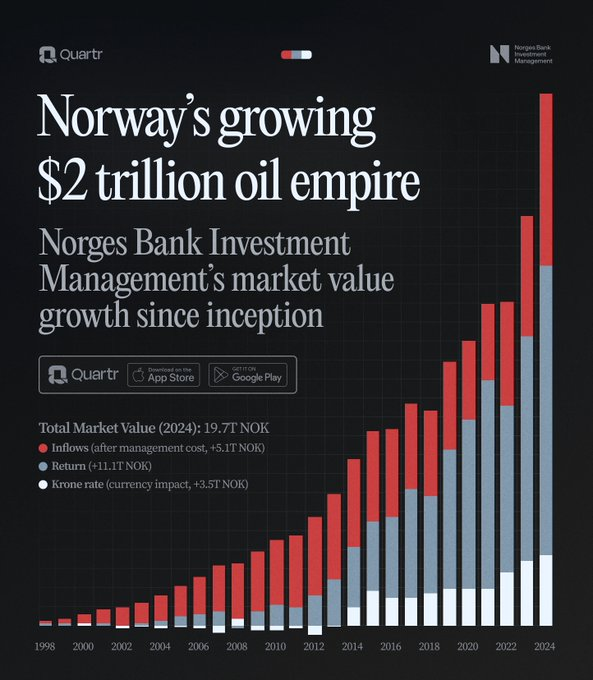
Norway, a country with just over 5 million people, manages the world’s largest sovereign wealth fund — worth nearly $2 trillion. This translates to around $340,000 for every citizen, making it one of the richest countries per capita.
The fund was built from oil revenues, but instead of spending it all, Norway invested globally in stocks, bonds, and green energy projects. It serves as a safety net for future generations, ensuring the country’s wealth continues long after oil production declines.
Norway’s model is admired worldwide as an example of smart resource management. It shows how natural resources can be transformed into long-term prosperity when governments prioritize sustainability and financial discipline.
Banks are preparing to hit back.
With CBK having already capped loan rates & mobile loan fees. Banks will likely go for higher account ledger fees, higher FX spreads, higher card fees etc
Other measures that banks will likely implement include:-
1. Cutting more branches/agents
2. Pushing fees into "service charges"
3. Growing non-funded income faster to dilute the %
With the new policy, we see a permanent structural drag on margins when banks need capital to lend & digitize.
This a smart policy design which aligns regulator funding with the digital economy.
But for legacy banks it’s a structural tax on the very revenue they need to fund their transformation.
What does it mean?
1. Rewards - asset-light, low-cost, high-volume digital players.
2. It punishes: asset-heavy, branch-heavy, high-cost incumbents.
Banks are lobbying hard.
Fintechs are quiet.
Thank you Julians.
You are spot on. The taxpayer should not bear the full burden of proof when the dispute originates from KRA’s pre-populated data. And if Sec56(1) isn’t amended, the Finance Bill 2026 will automatically be unconstitutional, punitive, and counterproductive.
There is already a legal conflict that Finance Bill 2026 creates.
What Bill 2026 addsWhat Sec56(1) still saysThe mismatch
KRA is attempting to flip natural justice: that requires "he who alleges must prove"
Again this shifts Kenya toward "dual assessment":- self-assessment plus KRA-assessment
This is crazy:- You’re asking taxpayers to disprove system errors, API failures, mismatched TIMS/eTIMS feeds, bank reporting errors, or wrong 3rd party PAYE data — often without access to KRA’s source logs.
Kenyan tax laws are now more retrogressive & punitive in my opinion in 2 ways:
1. Retrogressive by design. Every tax rule change hits smallest firms hardest. A Safaricom can afford a tax-tech team to contest pre-populated errors. A 5-person manufacturer can’t. So effective tax rate plus compliance burden is higher for SMEs than large firms. That’s text-book regressive.
2. The tax laws are Punitive by effect:- Combined with the 60% deemed dividend rule, the 2026 Bill taxes income you didn’t receive, taxes you based on data you didn’t create and makes you prove the taxman’s data wrong.
Honestly, that’s not taxation - it's extraction.
This will not grow tax revenues sustainably - it’s a short-term revenue bump, and long-term tax base erosion.
Countries with pre-population like Norway, Estonia, Singapore all put burden on Revenue Authority, to prove pre-filled data if taxpayer disputes within a window. Why? Because system trust drives voluntary compliance. Kill trust, kill compliance.
@Stay_Hidden0@rodgers_adai Kenya has been on an aggregate steady decline since 2013. Any honest economic & business analyst will tell you. The rest is false hope.
@japan_nobunaga 3 million people daily! That translates to 90million in 30 days over a BILLION people using the station annually!
Is this the correct position @japan_nobunaga?
This isn’t fair taxation — it’s forced extraction.
It penalizes reinvestment, treats business cash flow as government cash flow, and lets KRA override management decisions. It punishes growth to collect tax on unrealized income.
This tax policy direction will definitely contract Kenya's economy.
@japan_nobunaga This one of the Performance Improvement Principles taught in Business Schools all over the world. Small daily habits become business principles.
From Japan to the World.
@japan_nobunaga The great display of humanity, through the following:-
1. Honesty
2. Humility
3. Respect
4. Responsibility - (Leaving spaces better than they found them)
5. And many small soft human actions