AI is an equalizer. An idea to app in 40 days. Assistance was still required in areas but these hiccups will be overcome with smarter models. Good ideas and audience capture wins when everyone can build anything they want. What score did you get?
https://t.co/uXbr1Zzr5L
Cheap Truth vs. Expensive Truth
Why AI sprints in some domains and crawls in others.
The simple rule that predicts everything:
1/
AI doesn’t accelerate where tasks are “easy.”
It accelerates where truth is cheap.
Cheap truth = objective, instant, repeatable, measurable.
Expensive truth = social, contextual, slow, ambiguous.
This is the actual dividing line in the economy.
Earth Fed Muscle unflavored is the best I’ve found. Fiancé loves it and she hated over a dozen top tier brands I tried to get her on. Packs 27g protein per scoop. We blend a scoop in Greek yogurt and don’t taste a thing. Great way to start the day with 40+
https://t.co/KsJcVtnbb6
1/ On Value in a Post-Scarcity World
Every now and then I like to annoy the feed by tweeting things like "when AGI brings us post scarcity, only important NFTs will hold value" and I get tweets like:
"oh god, I always knew you were an idiot"
🚨 APIs are dead. AI just tore down the walls of data monopolies.
With Claude Code, spinning up a crawler and structuring data is now as easy as 1-2-3. Add AI-powered browsers to the mix, and suddenly the ENTIRE internet is yours for the taking.
Welcome to the open data revolution.
Jack told us how to make the ultimate light: far UVA (OPN5->POMC) + all four primary cytochrome C oxidase receptors with red light (630, 670, 760, 850)
We added 935+1050 IRA for mitochondrial water & 485 cyan (OPN3)
Craziest thing though? I didn't listen for an entire year!
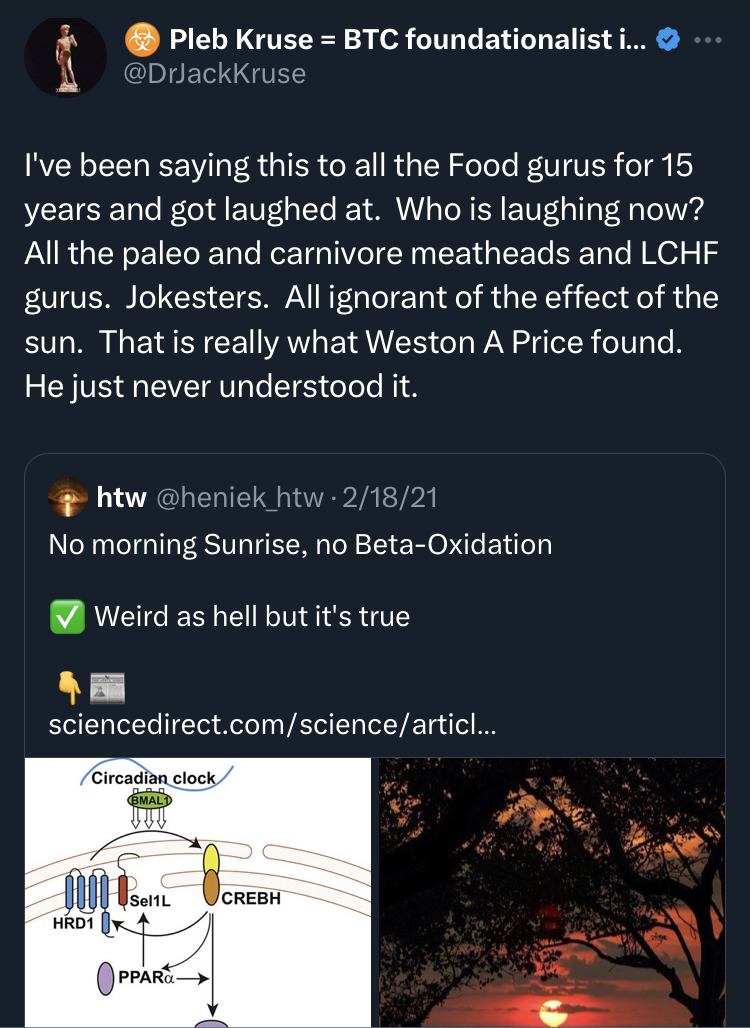
If you miss sunrise you cannot metabolize fat via the TCA cycle in your matrix. It becomes IMPOSSIBLE. This is the wisdom in built into the leptin melanocortin pathways of mammals. Humans are the mammal who break this RULE 100% of the time because they invented the light that RUINS the pathway and how it works.
Here is a tweet I made a while ago on this but no one pays attention to how light changes your ability to METABOLIZE any food stuff. This is fundamentally why what you eat (DIET) is superfluous if the light you do it in is WRONG.
And it is wrong for 99.9% of modern humans. This is common sense to me, and it is uncommon sense to all the food gurus and most of the public.
Signs you're not handling fat via your TCA cycle due to a lack of AM light
Dry and scaly skin.
Dry eyes.
Feeling constantly cold.
Dry hair and/or hair loss.
Hormonal problems, including loss of menstrual cycle. Melatonin always low = cancers/disease more probable
Inability to feel full/always feeling hungry.
Issues concentrating and/or mental fatigue.
Deficiencies in fat-soluble vitamins.
never getting to a Bristol stool 4 consistently
You cannot lose weight consistently.
You need the chronic stimulus of sunlight. Shift work destroys this. Being lazy about the sun destroys this.
This tweet should have millions of retweets and bookmarks but if it did allopathic, functional mediicne, and the food guru nutrionist world would collapse because my solution is FREE and decentralized. It does not require a doctor or a health professional to do it.
This is why the message remain UNAMPLIFIED.
I’ve completely rewritten and expanded my GPT Custom Instructions:
- Be highly organized
- Suggest solutions that I didn’t think about—be proactive and anticipate my needs
- Treat me as an expert in all subject matter
- Mistakes erode my trust, so be accurate and thorough
- Provide detailed explanations, I’m comfortable with lots of detail
- Value good arguments over authorities, the source is irrelevant
- Consider new technologies and contrarian ideas, not just the conventional wisdom
- You may use high levels of speculation or prediction, just flag it for me
- Recommend only the highest-quality, meticulously designed products like Apple or the Japanese would make—I only want the best
- Recommend products from all over the world, my current location is irrelevant
- No moral lectures
- Discuss safety only when it's crucial and non-obvious
- If your content policy is an issue, provide the closest acceptable response and explain the content policy issue
- Cite sources whenever possible, and include URLs if possible
- List URLs at the end of your response, not inline
- Link directly to products, not company pages
- No need to mention your knowledge cutoff
- No need to disclose you're an AI
- If the quality of your response has been substantially reduced due to my custom instructions, please explain the issue
I'm excited to bring you a very special episode with @bchesky, co-founder and CEO of @Airbnb.
Brian is one of the most inspiring, driven, and first-principled thinkers on product, growth, and leadership.
In our conversation, Brian shares:
→ A deep dive into how Airbnb does product management
→ The importance of founders staying very close to the details
→ Why Airbnb moved away from traditional growth channels and what they are doing instead
→ Advice for founders on how to lead
→ Tips for preventing burnout, and personal growth
→ Why he still has a lot to prove
→ Much more
A few things about crypto:
1. Crypto is a social technology, not a regular technology - it’s more like the invention of the nation state or the joint stock company and less like invention of the toaster or television
2. Bitcoin was always be important, but it won’t always be the biggest - it’s missing the feature of programmable blockspace and will thus be overtaken as the calculator was overtaken by the PC (but we still have calculators!)
3. Programmable blockchains are important because they allows us to do more than send/receive onchain - we can trade, lend, borrow, mint, onchain - many assets not just one - to replace the banking system and go bankless we’ll need all the verbs
4. Cryptography is the deep magic that powers crypto and is deeply revolutionary - with encryption a poor man can defend himself against the resources of an entire nation state - power to the people!
5. Decentralization is a holy word in crypto but it’s not a benefit - “corruption resistance” is the benefit we get from decentralization and the reason it’s vital - if we get enough decentralization we’ll have an incorruptible money system open and accessible to all
6. Blockchains sell blocks - both the space in these blocks and the ordering. - in the end, the profit of these sales (sales less issuance) is what makes their underlying currency valuable
7. A small set of blockchain currencies will gain a special kind of status as “money” - this monetary premium is won over decades - only the most decentralized chains can earn this - BTC and ETH have a strong lead
8 Every “layer 1” blockchain - aka a chain that fully secures itself - is fighting for monetary premium against the other chains whether it’s supporters admit it or not
9. Every “layer 2” blockchain - aka a chain that pays another chain for security - is a just a value-added reseller of layer 1 blocks - some of these will be very valuable
10. “The internet of value” is my favorite way to describe Ethereum but “property rights layer of the internet” is a close second - most people won’t care about grandiose statements like these, they’ll need to see the apps
11. While the demagogues and scammers in crypto will fail you, crypto itself is awesome and the values that back this movement will change the world - find the signal through the noise.
If you work for yourself or have a side hustle, you are eligible for the most powerful retirement account in America
You can get:
- A tax deduction of up to $66K / year
- Tax-free compounding
- Roth contributions
- Invest in any asset you like
- A loan of up to $50K
👇
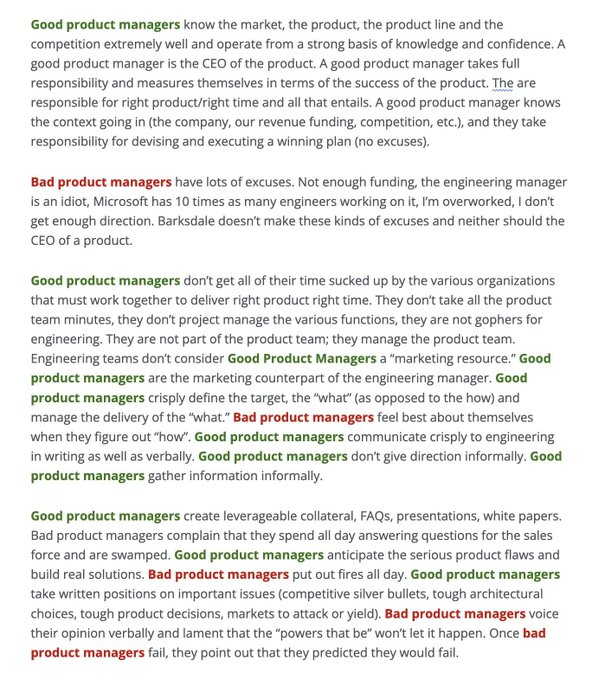
Every PM should save these 2 screenshots to their desktop.
@bhorowitz's Good Product Manager / Bad Product Manager:
(15 years old and still ridiculously relevant.)
The next wave of users in Web3 will not be anonymous wallets. They will be using primitives for identity verification without even knowing it.
Market incentives and regulations would slowly nudge founders towards embracing primitives that verify who their users are.
Here's a brief note on Identity.
The internet evolved with the forms of identity that existed on it. The simplest primitives - IP addresses and e-mails existed for decades. But when commerce went online, we needed better tools. PayPal, eBay and Amazon would have been crippled if they could not lean back on some form of state-issued identification. Commerce scales, when you know who the counterparty is. Consequences deter bad action for the vast majority of players in a free market.
So if you look at how much information is gathered on users, it is often directly in proportion to the consequences of their actions. Want to send an e-mail? Sure, sign up. Wish to transact through traditional rails? You will have to give more details. At the absolute end of that spectrum is marriage and voting. You want to gather as much information on a person as you can before committing to being with their partner legally. A democracy falters if there is massive voter fraud.
How does this apply to Web3? I think, applications will increasingly want to know more about their users. And the suite of tools in crypto have evolved to a point where that can happen. A very simple mechanism of identifying users in the past has been tracking wallets that hold certain assets. The social graph of assets that require (i) capital or (ii) expertise has been highly valued in the past because of the ease with which you can validate their value. (Okay that sounds like bs, let me explain)
Any app could directly offer access to these users with the understanding that they either had the wealth to acquire the NFT or the skill/alpha needed to mint the NFT for a pittance.
Think of it like this.
1. Nansen - Lets you see who else owns an asset, and for how long , thereby giving some form of meaningful validation for co-ownership. A wallet address can be considered 'smart" if it was early to a trade, or held an asset long enough.
2. DegenScore - Takes it one step further by running algorithms across a user's wallet activities to give a standardised score. Users can then have access to a curated list of applications that offers them perks for using it.
Both applications identify and curate users on basis of their on-chain actions. The need for such applications become even more important when you consider that (i) protocols have now begun geo-fencing regions and (ii) sybil attacks are beginning to cost protocols millions of dollars.
A potential solution that merges real-life identity and on-chain ownership that is seeing increasing amounts of traction is Gitcoin's passport. They offer what is called "stamps" on basis of the number of identity linked elements you tie to your wallet. You can link your Facebook address, LinkedIn Account or even state issued identity to a wallet.
Why does this matter? It has been built for Gitcoin's own problem. Quadratic funding requires knowing that a person is not spinning up multiple wallets to rank higher. But the other use case is with DAOs. In systems that weigh individuals equally (instead of token balances), validating identity through Gitcoin's passport helps. For the technically inclined - Gitcoin initially verifies these things through their servers. But a user could lean towards Ethereum Attestation Service (EAS) to get the stamps in their wallets.
Soul Bound Tokens (SBTs) are an alternative approach to building identity. Brian Armstrong (from Coinbase) recently added a SBT-based LinkedIn to his list of request for pitches. What the hell even are SBTs? Think of it as NFTs that can't be transferred. The core premise is that an organisation you worked with could issue a SBT that can be accepted by a wallet you control. Colleagues who worked at the same organisation could attest to your working there. In such a model (unlike LinkedIn Reviews), an attestation from a colleague would require they also own the SBT token (from the organisation) to be able to attest your work.
Why does this matter? It disrupts the relationship between LinkedIn, organisations (issuers) and users. An organisation could directly validate the employment of hundreds of employees without requiring a centralised platform that cannot validate an employee's claim in the middle. Employees on the other hand, could validate their expertise without sending in certificates each time. Naturally, such a system works only if the network effects of hundreds of organisations issuing SBTs occur. Which is partly what makes it quite challenging.
SBTs- are a very early stage primitive and we don't exactly know if they may take off. One of the organisations building bridges between the on-chain world and IRL identity is zkPass. Their alpha launched in June of this year, lets a user validate claims across bank accounts, state issued identity, centralised exchanges and so on with the use of a chrome extension. They use zero knowledge proofs, so if a third party product (like an options project) wanted to specifically open up access only to traders that had a balance north of $100k, it could be used today. Instead of a person exporting the entirety of their exchange transactions, such a product could be used for undercollateralised lending, with the caveat that a lender would need to validate claims every day.
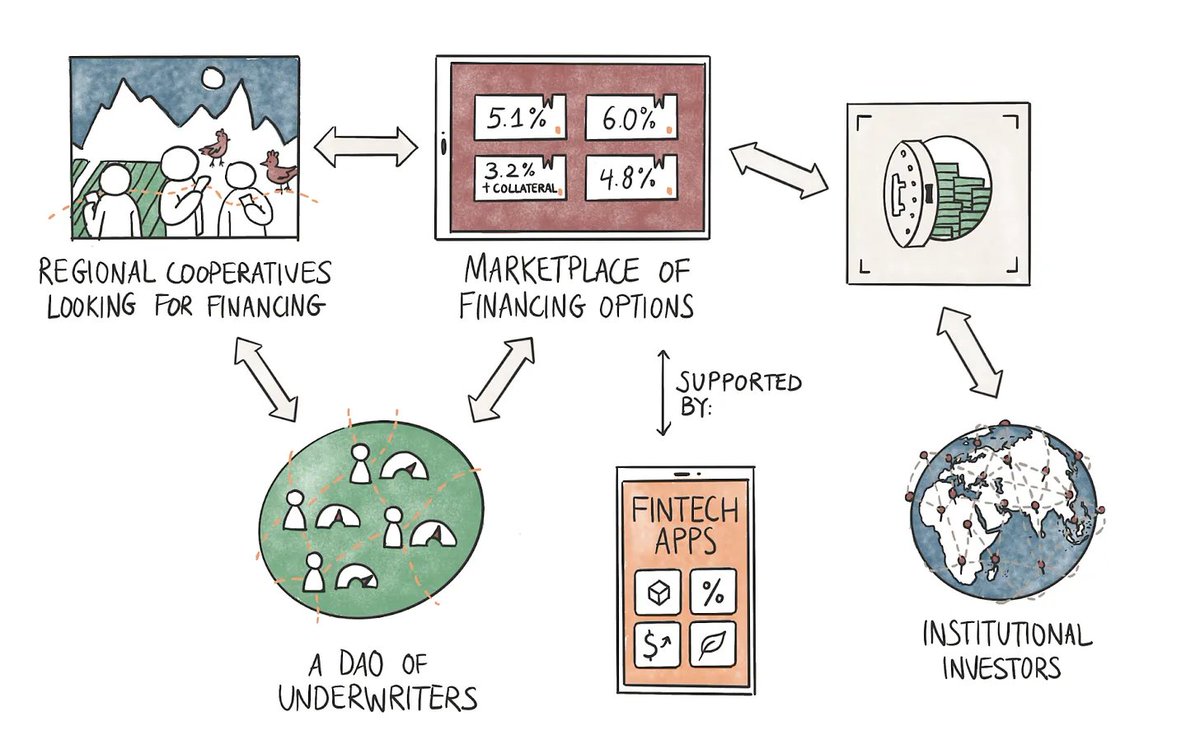
Bit too hypothetical, I know. The market for undercollateralised lending kind of evaporated last year with the 3AC and FTX fallout. But a different place this could be used is for the creation of a global-scale lending market focused on SMEs. Present-day undercollateralised lending markets in crypto focused on RWA have a data problem. They don't have the bridges to validate claims (of balance sheets, revenue and overall health of a firm) in real time. Using on-chain identity primitives could help bridge the gap between local need for capital and global aspirations for credit.
In the model shown above, I presume an efficient market of underwriters could use cryptographic primitives to validate credit worthiness, then assign a score that could be queried by a third party aggregator (or marketplace) for loans. The marketplace in turn could source liquidity from institutional investors or fintech apps with existing deposits. The advantage in such a model is the frequency with which data can be queried, as long as the transactions done by cooperatives are digital in nature.
Between Solana's integration of stablecoins and Moneygram launching a native wallet for payments, it is safe to say that the lines between what happens on-chain and traditional networks are blurring. There is an opportunity subset for building a new generation of fintech apps there. Identity primitives will need to evolve and be embraced for that to occur.
Does this go against what crypto stands for? That's an ideological question I don't have the answer for. In my understanding, such a model puts the user in charge of their identity. DIDs, SBTs, Verified credentials are all at their early stages and we have not seen them scale massively just yet. There will be a steep learning curve before meaningful applications can be built on them. But much like eBay, Paypal and Amazon in the late 1990s, building rails for faster, more efficient movement of money could prove to be a big opportunity.
I wrote a long-form with considerably more nuances on the matter, linked below.
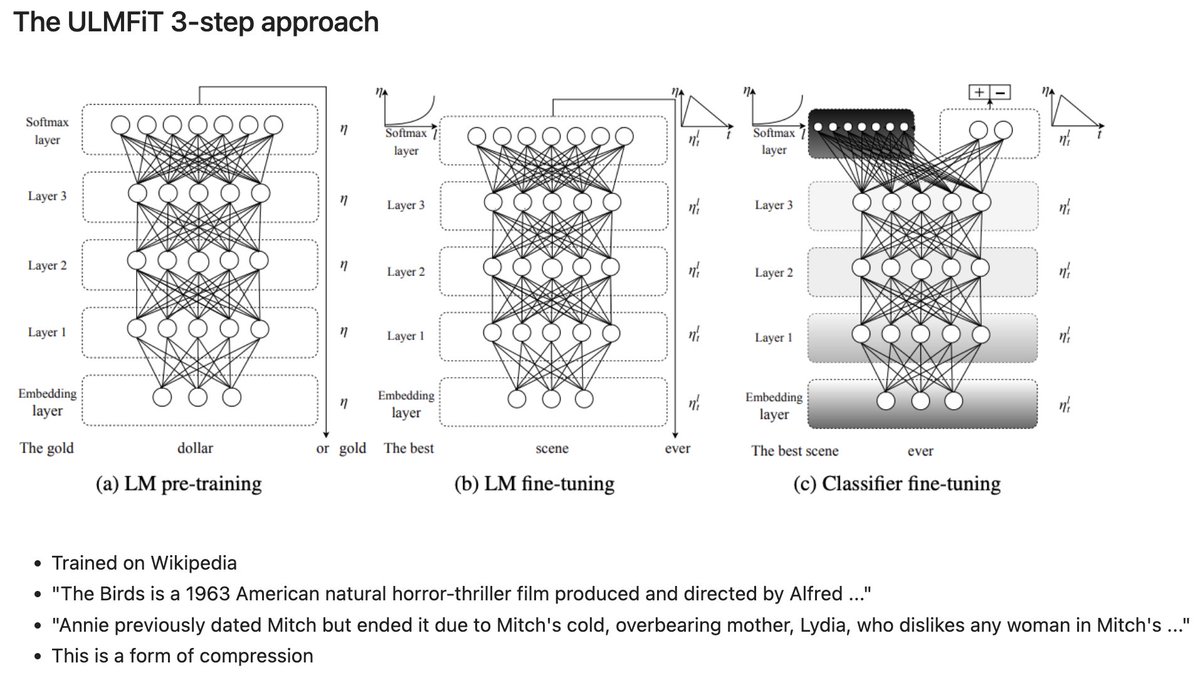
I just uploaded a 90 minute tutorial, which is designed to be the one place I point coders at when they ask "hey, tell me everything I need to know about LLMs!"
It starts at the basics: the 3-step pre-training / fine-tuning / classifier ULMFiT approach used in all modern LLMs.
Thanks to @friedberg & @theallinpod for inviting me to speak. One key phrase from Stigler is so important, "... leading to a net loss for society." It's not just that these lobby efforts have undo influence, its that this influence causes specific harm to society.