The man who proved your phone's safety standard is wrong worked for NASA.
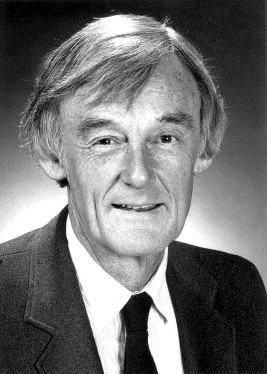
W. Ross Adey.
UCLA Brain Research Institute. Then Loma Linda. 400+ papers.
NASA built his lab's biotelemetry into the Apollo program. The EEG of Lovell and Borman in orbit was Adey's tech.
In the mid-1970s, 20 years before the FCC set its safety standard, Adey proved the assumption it would rest on was wrong.
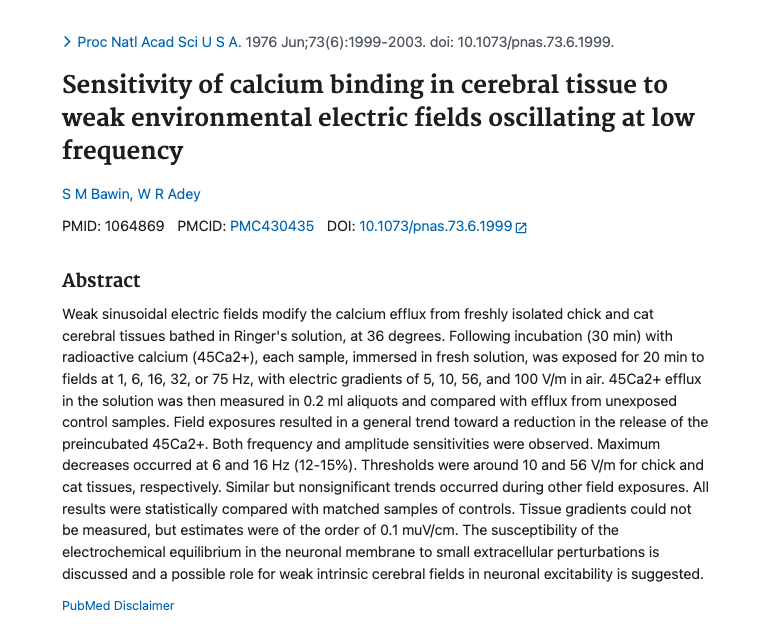
With Suzanne Bawin he showed that Radiofrequency radiation at "non-thermal" levels, too weak to heat tissue, could still drive calcium ions out of brain tissue.
But only inside a window.
Specific intensities.
Specific modulation frequencies.
Peak effect at 16 Hz, right in the EEG band.
Crank the power higher? Effect disappears.
Use an unmodulated carrier? Effect disappears.
This is the Adey window.
It is why FCC safety limits are useless.
The FCC measures average power. Adey proved power alone isn't the variable. Modulation matters. Frequency matters. The window matters.
He testified to Congress in 1980s, warning that the safety standard rested on a biology the science had already moved past.
Congress thanked him. The standard got written anyway.
Adey died in 2004. The Adey window is in physics journals and out of every regulatory document.
The FCC's RF exposure rules were adopted August 1, 1996, built on an engineering standard from 1992. They have not been updated in 30 years.
In 2021 a federal court, the DC Circuit, ruled that the FCC's RF guidelines were arbitrary and capricious.
The court said the agency had ignored exactly the things Adey proved mattered. Non-thermal effects. Modulation. Children. Long-term exposure.
The FCC was ordered to fix it.
It hasn't.
Three generations of kids have grown up inside the window Adey warned about.
The fourth is being born this year.