This week I wrote about why intelligence isn't the only bottleneck to real-world progress & why overlooking the others leads many "AGI-pilled" people to mistaken conclusions about the future.
New research from the @stripe Economics team shows how this looks in practice. TLDR is that so far, the "micro-productivity" gains (so increase in productivity on specific tasks) that we see due to AI are not causing the macro-productivity gains one would expect.
Of course, this is just the beginning and it is likely that as time passes, organizations will learn how to convert the micro-productivity gains into macro ones. What's more, models are likely to continue improving.
Nonetheless, I think this is an important result that proves my point. Models are already absolutely impressive on a whole range of tasks. Yet real world diffusion is just incredibly hard. I also really do not think we understand the nature of the intelligence of these models. Such findings should update some priors imo in terms of how the world will change in the coming years and decades and the importance of real-world friction.
A hairdresser with zero archaeological completely changed our understanding of Roman hairstyling tools because she tried reproducing hairstyles on Roman statues.
She couldn’t replicate the styles so she started going through Roman manuscripts using Google Translate to find references to tools. She discovered that Roman’s used bone needles to weave hairstyles like fabric…. Something Latin scholars with zero knowledge of hair styling missed
From a friend who joined a fast-growth, later-stage startup:
"I was wondering why no one is doing PRDs here. Then I realized that the Head of Product and most PMs are 25-year-olds who don't have the attention span to *read* even a 1-page doc.
You lose them after 3 bullet points."
Excellent software takes time.
It requires smart people to care deeply about the product and to obsess over the details. To debate passionately about the details big and small. To spend time deeply thinking.
Nothing about this has changed.
@NurderK Die Gesichtsausdrücke sagen schon alles. Gehorsamsverweigerung hat und hatte bei Corona bis heute negative Konsequenzen für die betroffenen Soldaten - das wissen auch die jungen Rekruten.
@viktaur27 @Teslarati The rate of improvement from original GPT to GPT-3 is impressive. If this rate of improvement continues, GPT-5 or 6 could be indistinguishable from the smartest humans. Just my opinion, not an endorsement. I left OpenAI 2 to 3 years ago. Am a neutral outsider at this point.
Just to take a step back here, Levent had the highest GPA at Harvard, won the top undergrad math research prize and most frequently collaborates with a Fields Medalist.
We don’t have enough human mathematicians to ask questions to AI and spend time understanding the results
One idea: intelligence isn’t the bottleneck in a lot of society, the speed of moving atoms is. And so we’ve developed a huge number of intelligence sinks to keep humans occupied (startups that don’t make sense, bullshit jobs, non-profits that don’t have much impact).
AI could just mean a firehose of intelligence that largely gets drained into intelligence sinks.
That may be why the world doesn’t seem that different.
@justinskycak is Chief Quant at Math Academy. He generously shares his knowledge for free across topics such as upskilling, algebra, calculus, linear algebra, algorithms, and machine learning. Highly recommended.
https://t.co/7t6lOsr8dS
Andrej Karpathy just said what no one wants to admit:
"Your agent loop is generating garbage at scale and you can't see it."
1 output looks fine. 1,000 outputs = dead entropy, dead diversity.
90% of AI companies are building demos, not products.
In a 20-minute conversation, Karpathy reveals the full reasoning stack
Very cool #rss2026 talk from
@YunzhuLiYZ on tactile/touch; to top it off he threw in an interactive world model 🤯
Tks for open sourcing this too! https://t.co/4Ns24xd1uF
18 months ago I made a bet to rebuild everything AI first for 1 specific ICP: b2b. Groove was flatlined for 3 years and still is at $5M arr. Went all in and created a completely new co. around it: Helply.
Most told me I was crazy and that I was chasing a shiny object.
Today Groove funds Helply: 85% R&D, 100% marketing.
We'll continue to run both forever.
In june we hit a major milestone, crossing $1M arr...I think we've validated it but you never know.
The market is super competitive though with some major VC backed players. most days I think we can compete and it's not a zero sum game but other days I'm like 'how the fuck are we actually going to compete with these goliaths'.
Different goals though when you own 88.02%. $10M arr vs. $100M arr. goes alongway.
Let see...
Every steer becomes its own subtree.
You can see where each idea came from and which steer actually moved the metric, so you know what to build on and what to drop.
"The problem is in essence very simple. Decentralized Western capitalists have been able to squeeze domestic labor for forty years and run outsized profits. But now they are faced by a centralized capitalist (which is in effect the Chinese state) who is even more efficient in squeezing wages and increasing productivity. That centralized capitalist is now driving out of business Western decentralized capitalists. This is why the latter have to move the heaven and the earth in order to stop the centralized capitalist from winning. But they have to do all of that while never mentioning the role their own profits play in it."
https://t.co/BihdkikaDf
The first experimental evidence of recursive self-improvement (RSI).
Autoresearching the autoresearch agent for eight days.
The result beats the harness we hand-tuned for two years, on held-out benchmarks: 🧵(1/7)
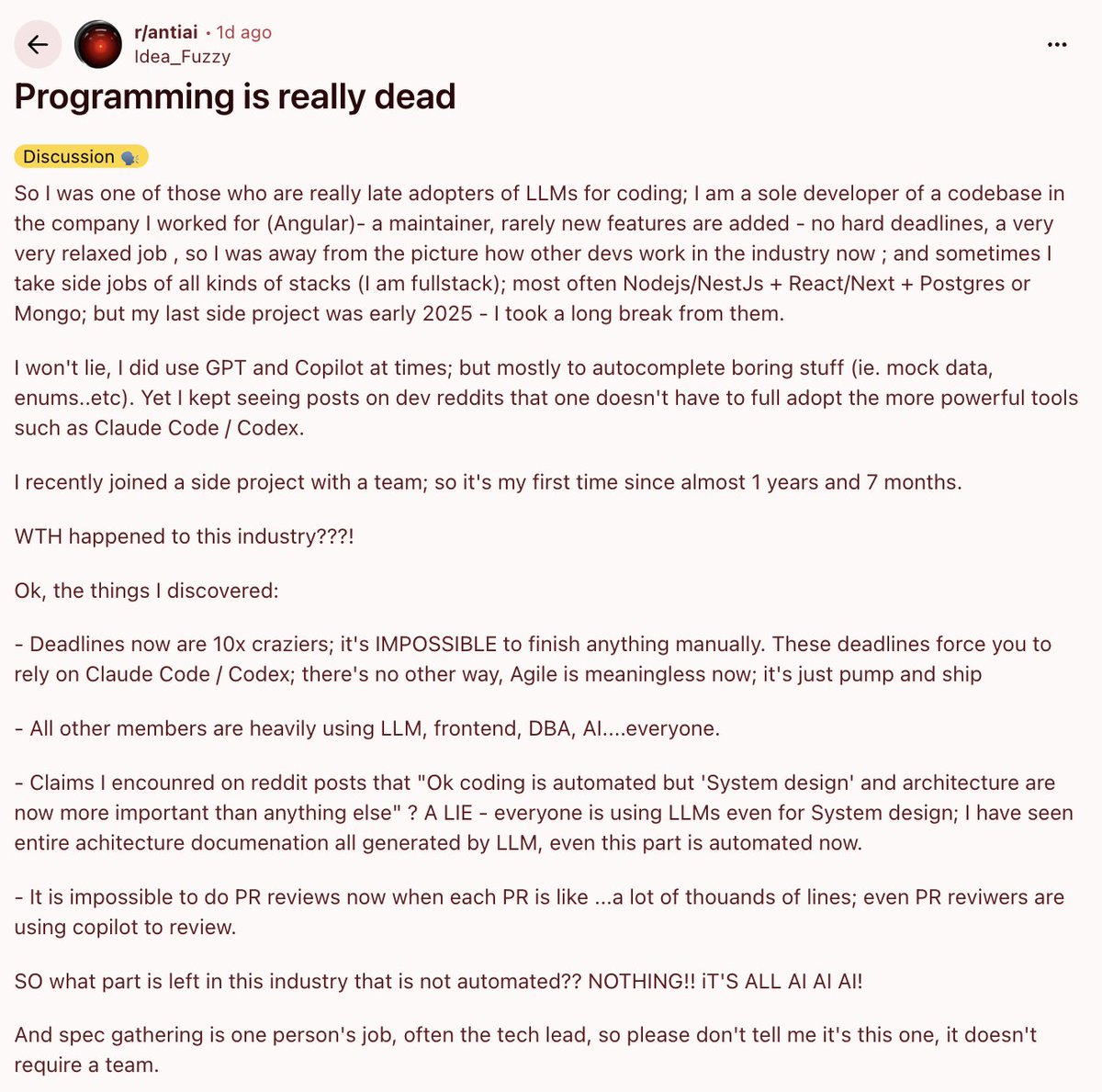
this antiai subreddit is one of the most fascinating places on the internet right now. every post reads like someone time traveled from 2023 and thinks civilization ended
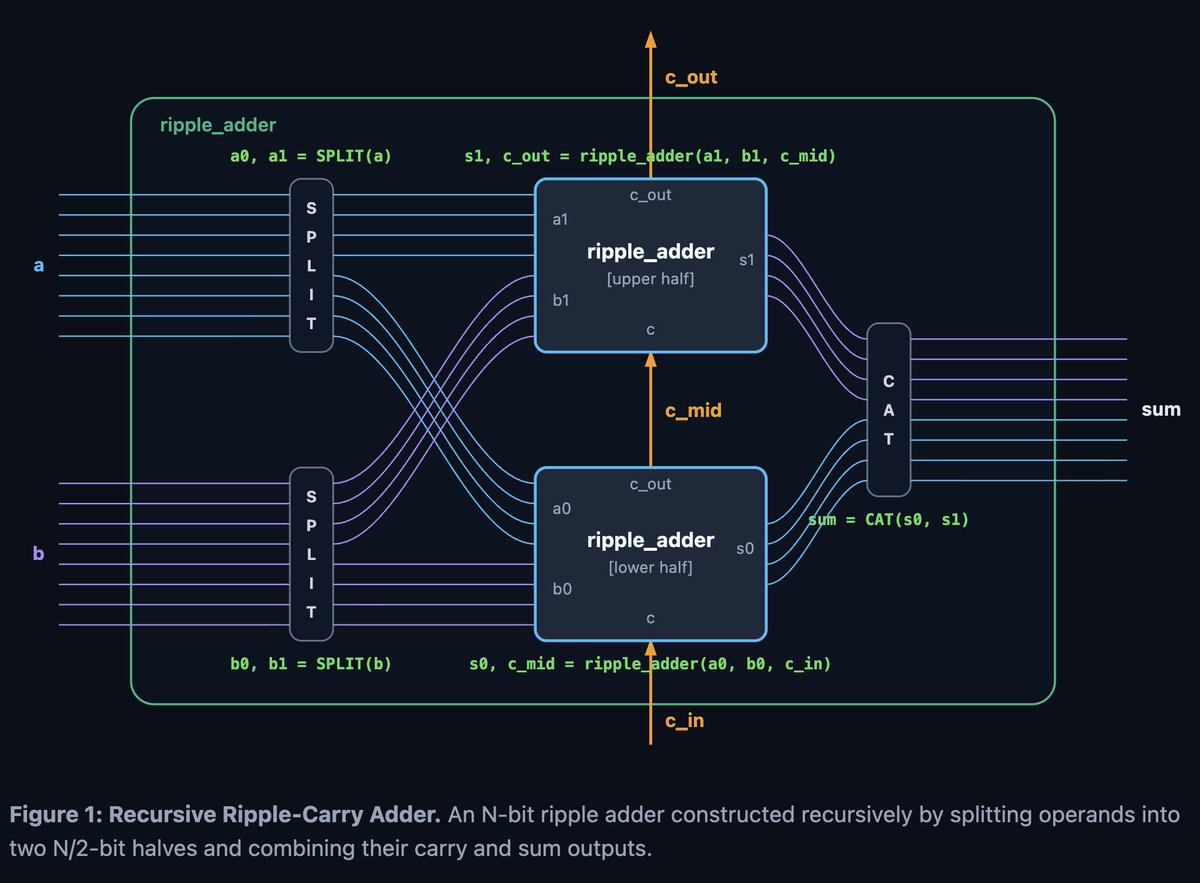
Introducing MorphoHDL, a minimal language prototype for growing boolean circuits! https://t.co/BAVKXKkXes
Early this year I wanted to design a size-agnostic graph rewrite rule system that could build functional boolean circuits. First I thought about "chemistry"-like reactive systems, but rules were too complicated with many different node types carrying multiple indices...
Then I realized, that cell division is much more natural way of building complex structures, and once I started to treat graph edges as buses instead of single wires, everything clicked. No new formalism — just taking good old recursion and seeing how far I can push it. Ripple-carry adder, Brent–Kung adder, multipliers ... and some Haeckel-esque creatures along the way! Hope you enjoy the report of my journey and the demos.