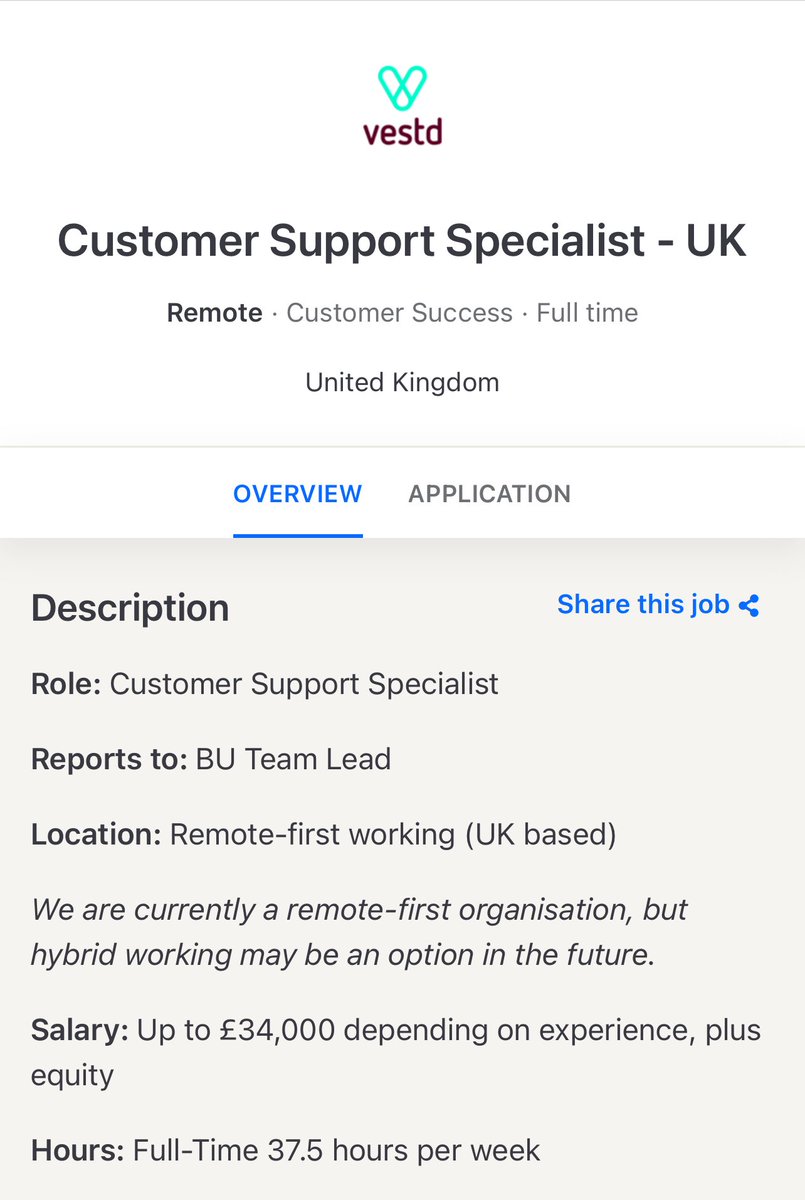
JUST IN: Customer Support Specialist – Remote, UK
(UK-Based Applicants Only)
If you're based in the UK and can work Remotely (Home-based) as a Customer Support Specialist, apply now for this vacancy with Vestd.
✅ Support with home-working equipment.
✅ A personal training and development budget to support your career and professional growth.
▫️ Eligibility: UK-based applicants only
▫️ Position: Customer Support Specialist
▫️ Job Type: Full-time
▫️ Salary: Up to £34,000 per year
▫️ Location: Remote (UK-based)
▫️ Employer: Vestd
If you are interested in this Job, check the details and submit your CV⤵️
https://t.co/rDFrs8hQux
Note: UK-based applicants only.
Apply now, Share or Repost for others in the UK who may be interested in this Job.
Take Courses for $0.00
Open University 🇬🇧 https://t.co/9VNr4Yt6tr
FutureLearn 🇬🇧 https://t.co/Ql6nYnbK8U
FUN MOOC 🇫🇷 https://t.co/x2DYlzx3Ec
openHPI (tech) 🇩🇪 https://t.co/DzUjhetY3T
WHO (health) 🌍 https://t.co/iYkvd2S32t
FAO (agriculture) 🌍 https://t.co/G64YlvZC8N
iMooX 🇦🇹 https://t.co/X1hEQj0RGN
If you are looking for a single Math book as your starting point which starts with very "basic" things, try this book. And if you don't want to buy the book, just watch the lectures on this book on Real Physics YouTube channel. Learn every day 💪😎👊
Universities fail to teach FPGA design to a good level. I am thinking of creating a series of FPGA classes designed to fit into semesters that universities can use so their graduates are actually useful in industry (Sorry profs you are mostly out of date). It will all be free and coming as part of a new initiative I am launching.
I have my own ideas as to what needs to be included but a question to professional FPGA engineers.
What basics do you think students today need to learn ?
Bayes' Theorem is a fundamental concept in data science.
But it took me 2 years to understand its importance.
In 2 minutes, I'll share my best findings over the last 2 years exploring Bayesian Statistics. Let's go.
Why does P(A|B) differ from P(B|A)?
Both are the same overlap, divided by different circles: P(A|B) = P(A∩B)/P(B) and P(B|A) = P(A∩B)/P(A). Bayes' rule P(B|A) = P(B)P(A|B)/P(A) just swaps the denominator.
Thomas Bayes never published it; Richard Price presented his essay to the Royal Society in 1763, after Bayes died.
Deloitte - 70% rounds are (SQL + Python + Pyspark)
KPMG - 60% (SQL + Python + Pyspark)
PwC - 80% (SQL + Python + Pyspark)
EY - 75% (SQL + Python + Pyspark)
If you want to crack any Data Engineering Interview, the key is simple SQL, Python, Pyspark.
Here are 18 most asked question on these 3 topics.
𝗦𝗤𝗟:
1. You need to retrieve the names and salaries of employees from the employees
table, but only for those working in the Finance department.
2. You need to increase the salary of all employees in the IT department by 10%.
3. Write a SQL query to find all duplicate emails in a table named Person.
4. Write a SQL query to get the second highest salary from the Employee table.
5. Write an SQL query to find all numbers that appear at least three times consecutively.
6. Given the Employee table, write a SQL query that finds out employees who earn more than their managers.
𝗣𝘆𝘁𝗵𝗼𝗻:
7. Generate an Infinite Fibonacci Series Using a Generator.
8. Sort a List Without Using the sort Keyword
9. Check Whether a String is a Palindrome or Not
10. Python Program to Find the Factorial of a Number.
11. Frequency of Words in a Sentence
12. Find the Smallest and Largest Number in an Array
𝗣𝘆𝘀𝗽𝗮𝗿𝗸:
13. What are the differences between RDDs, DataFrames, and Datasets in PySpark?
14. How do Spark’s lazy evaluation and the DAG (Directed Acyclic Graph) execution model work?
15. How can you optimize performance in PySpark jobs?
16. How do you handle data skew or imbalanced joins in PySpark?
17. Explain broadcast variables - what are they and when would you use them?
18. Can you walk me through how to implement a PySpark transformation using a custom UDF?
This is f*cking insane. Joe Rogan asked Nvidia founder and ex-CEO Jensen Huang if AI will replace a lot of jobs. His answer:
"If your job is just to chop vegetables, Cuisinart is going to replace you"
In 66 seconds, he draws the line: a lawyer's job is to help people. Reading and writing documents is just a task. If your job is the task, AI takes it
Rogan pushes back: that's a lot of people. Jensen doesn't argue. It could be a lot of people
Doing the Task → AI Does the Task → Harness → You Own the Purpose
A harness is how you hand the task off: agents do the work, you keep the part that's actually your job
Everyone's hoping their job is more than the task, almost nobody is building the harness that takes the task off their plate
Bookmark and watch it today
Then read how to build that harness in the guide below ↓
Linux is beautiful. Read this, and you will say the same.
You start by logging in to a Linux VM for the first time and have no idea where anything is. Config, logs, apps, all scattered somewhere.
So Linux gives you one tree. Everything starts from /. Configs live in /etc, logs in /var/log, user files in /home, programs in /usr/bin. Once you know the map, you can find anything.
But the server has 5 people on it. Anyone can read your files, edit your scripts, or delete your folder by mistake.
So you use users, groups, and permissions. Every file has an owner, a group, and read, write, execute bits. chmod and chown decide who can touch what. Permission denied is not an error; it is the system doing its job.
You run a script and your terminal freezes. It takes 10 minutes and you cannot do anything else.
So you learn processes. Every running program has a PID. Add & to run it in the background, ps to see it, kill to stop it. Linux is just processes started by other processes.
But kill does not always work, because kill only sends a signal. SIGTERM asks the process to stop politely. SIGKILL ends it with no cleanup. Now you know why a database should never get kill -9 first.
Your log file has 2 million lines and you only need the errors from the last hour. Opening it in an editor would hang your session.
So you use pipes. Every command reads from stdin and writes to stdout. Chain them together: grep ERROR app.log | sort | uniq -c. Small tools, each doing one job, combined into something powerful.
Now you need nginx. You download a tarball, compile it, and hunt for missing libraries for two hours. Then the next server needs the same thing.
So you use a package manager. apt or yum installs the software with its dependencies, updates it, and removes it cleanly. One command, same result on every server.
Your script has the database host hardcoded. It works on your machine and breaks on staging. You edit the file every time you switch environments.
So you use environment variables. export DB_HOST=prod-db and the same script runs anywhere. Config lives outside the code.
Every night at 2am you run a backup by hand. One night you forget, and that is the night the disk fails.
So you use cron. A single line like 0 2 * * * /opt/backup.sh runs it every night, whether you remember or not.
Finally, all of this lives on a server you reach with a password. Anyone who guesses it owns your machine.
So you use SSH keys. A private key stays with you, the public key sits on the server. No password to guess, no password to leak.
Files, permissions, processes, pipes, packages, variables, cron, keys. Learn these 8 and you can walk into any Linux box and feel at home.
Which one took you the longest to understand?