The Anthropic pharma announcement is particularly jarring because of how poor of an understanding it signals about the entire biotech value chain (it also comes across as a performatively splashy pantomime to juice IPO numbers).
For a company that has spent unprecedented volumes of capital and still struggles to reach profitability to say they will pursue another exceptionally high-risk, capital-intense sector with a high failure rate, decade-long time-to-profitability, and an entirely separate and non-complimentary set of capital investments (clinical trials, drug manufacturing, marketing, and distribution…), and additionally pursue clinical targets the industry has deemed unprofitable or not worth the investment is not a good look. Especially given the company does not yet have a sustainable revenue engine with which to play expensive side games (that’s what made OAI lose their edge…), ongoing concerns around the sector’s economics, and the broad tapping out of private capital reserves that forced an IPO in the first place.
For God’s sake stop making bigger and bigger claims to try to drum up capital and just deliver on one thing well, prove you can reach breakeven, and then make moonshot experimental spinout bets. Don’t take moonshots on moonshots.
Satya’s entire essay boils down to
“The frontier model doesn’t matter. The ecosystem matters.”
Funny how that argument always appears the moment you’re no longer clearly winning the frontier model race.
Most companies do not possess some mystical vault of irreplaceable institutional knowledge. Most of what they call “tribal knowledge” is spreadsheets, meetings, SOPs, and industry practices that frontier models are rapidly learning anyway.
The idea that human capital automatically becomes more valuable as models improve sounds nice in a keynote. In reality, better models commoditize larger chunks of human expertise every year.
And let’s be honest about the business pitch here.
“Build your sovereign learning loop.”
Translation
Please store your data in Azure.
Train your agents on Azure.
Deploy them on Azure.
Evaluate them on Azure.
Reinforce them on Azure.
And definitely don’t go directly to whoever has the best model.
This isn’t a philosophical manifesto.
It’s Microsoft selling lock-in with prettier words.
Well written.
Smart strategy.
But let’s not confuse corporate positioning with timeless wisdom. 😂
@eigenron@epichrisis If he (theoretically) decided to work in Europe or China in the future, ideally he would not continue to be subject to US income tax
@eigenron@epichrisis The most notable ramification is that American citizens are subject to comprehensive income tax regimes (federal as well as state income tax in most cases) on any income earned worldwide (i.e. even income earned outside the US), which no other developed nation does
This Japanese dude complained that Chinese uses a single-character system for every element in the periodic table — yet this is precisely one of the reasons why Chinese students can learn chemistry with remarkably little effort.
Chinese employs a highly systematic phono-semantic strategy: the radical indicates the physical category, while the phonetic component hints at the pronunciation. Metal radical 钅 → metals (e.g., 镧 lanthanum, 铍 beryllium). Gas radical 气 → gases (e.g., 氩 argon, 氦 helium). An ordinary Chinese speaker can often guess an element’s basic properties at a glance with minimal memorization.
In contrast, Japanese primarily relies on katakana transliterations of international names in scientific contexts, especially for newer elements: oxygen → オキシゲン, hydrogen → ハイドロゲン, sodium → ナトリウム, beryllium → ベリリウム. This leads to longer names (often 4–7 syllables), no built-in clues about whether it’s a metal or gas, and a higher memory load for beginners.
Japanese does have intuitive native names for many common elements (酸素 for oxygen, 水素 for hydrogen, etc.), which are widely used in education and daily life. However, formal academic and IUPAC-style contexts lean heavily on katakana, forcing students to constantly switch between the two systems.
In short: what Chinese expresses efficiently in a single meaningful character, Japanese often renders with a longer string of syllables that carry no inherent information about the element’s properties. The efficiency and intuitiveness gap is real and immediately noticeable.
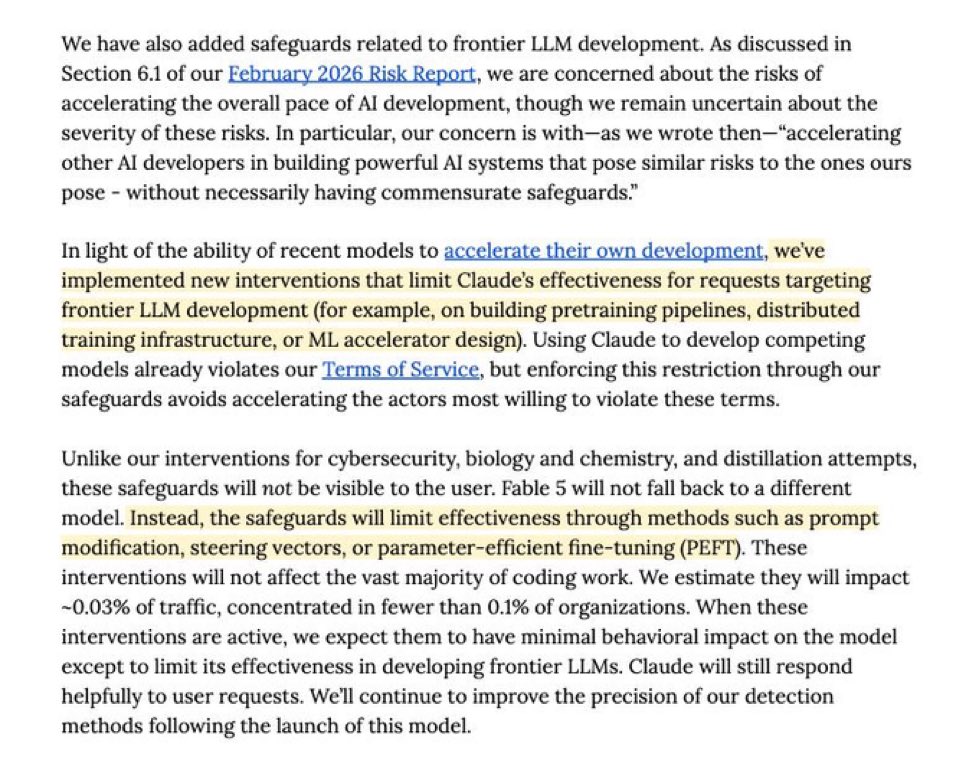
I have seen some people claim, completely incorrectly, that Anthropic’s new “silent sabotage” policy is just trying to stop distillation attacks that steal weights from their models. This paragraph makes it extremely clear that that is not the case. Anthropic is generally blocking attempts to advance the state of the art in AI research, even for techniques they themselves make no use of.
For example, Anthropic is targeting research on distributed training, which is to say, training runs done on large pools of computers loosely attached over the Internet, but it does not do any distributed training, as it has no need for it. Distributed training is, however, a technique that open source AI researchers without billions of dollars at their disposal have been leaning on to allow them to leverage large amounts of crowdsourced computation.
Why would Anthropic do this? Likely because they fear that their model might help people write code to build open source AI systems trained without expensive hardware, and because to the EA cult, distributed open source AI training systems are the worst possible thing someone could build.
It is perfectly within Anthropic’s right as a company to do stuff like this, but it is also within our right, as users of AI systems, to stop giving them money.
It is perfectly within Anthropic right to lobby to try to gain a government monopoly on AI research and development, as they have for years now. It is perfectly within our rights, as citizens, to oppose repugnant attempts to grab power with all our strength.
I do think that Anthropic/OpenAI going bust (financially speaking) and then a much bigger, cash rich co like Apple/Google buying them up for pennies on the dollar is not a hard scenario to imagine.
I mean, this literally might be Apple’s current long term strategy.
Yeah I’m done with Anthropic.
No Claude. No Claude Code. No Anthropic API. I’m not giving money to a company that sells frontier AI with one hand while Dario runs around telling governments everyone needs to slow down.
Spare me the holy safety act.
This is obviously an attempt at regulatory capture. Scream doom, scare politicians, make compliance insanely expensive, crush smaller competitors, then walk into an IPO with a nice little government-protected moat.
Claude might be good. Don’t care.
I’m out.
AI will create more jobs than any other technology in history.
The doomers' fundamental error isn't just the lump of labor fallacy. It's deeper than that.
They assume a finite problem space.
This is the fundamental error of AI and job doomers. They look at the economy and see a fixed amount of work to be done, a pie that can only be sliced thinner as machines take bigger bites. They see humans a competitive resource for a finite amount of work and a finite amount of problems to solve that must be eliminated.
This is fundamentally, totally and completely wrong.
The pie isn't fixed. It never was. And the reason it isn't fixed is baked into the very nature of technology itself.
Technology is nothing but abstraction stacking. And abstraction stacking is infinite. Therefore the work is infinite.
The hammer didn't reduce the amount of work. It moved the work up the stack. And the new work was more complex, more varied, and more interesting than the old work.
Complexity breeds more complexity and more variety.
Once you have houses instead of mud huts, you have a cascade of new problems that didn't exist before. Plumbing. Wiring. Insulation. Roofing materials that don't rot. Drainage systems so the foundation doesn't flood. Fire codes so your neighbor's bad wiring doesn't burn down the whole block.
Each of those problems becomes a job. A plumber. An electrician. An insulator. A roofer. A civil engineer. A building inspector. None of those jobs existed when we lived in mud huts.
They exist because we solved the mud hut problem.
Think of all of human technological development as a stack of abstraction layers, each one built on top of the ones below it.
At the bottom: raw survival. Finding food. Building shelter. Making fire. These are the base-layer problems.
Each major technology wave solved a base-layer problem and in doing so created an entirely new layer of problems above it:
Agriculture solved "how do we reliably eat?" — and created problems of land ownership, irrigation, crop rotation, storage, trade, taxation, and governance.
Writing solved "how do we remember things across generations?" — and created problems of literacy, education, record-keeping, law, bureaucracy, and literature.
The printing press solved "how do we spread knowledge at scale?" — and created problems of intellectual property, censorship, journalism, publishing, public opinion, and democratic discourse.
The steam engine solved "how do we generate mechanical power without muscles?" — and created problems of factory design, worker safety, urban planning, railroad engineering, coal mining, labor relations, and environmental pollution.
Electricity solved "how do we deliver energy anywhere?" — and created problems of grid design, power generation, appliance manufacturing, electrical safety codes, utility regulation, and an entire consumer electronics industry.
The Internet solved "how do we connect all human knowledge?" — and created problems of cybersecurity, digital privacy, online commerce, content moderation, network infrastructure, cloud computing, social media dynamics, and an entire digital economy that employs tens of millions.
Notice the pattern?
Each solution didn't just solve a problem.
It created an entirely new problem space that was larger, more complex, and more varied than the one it replaced.
The stack grows. It never shrinks.
It's turtles all the way down and all the way up.
More interesting meta-questions arise if you are forced to wear your choice so, if >50% press blue, everyone is made aware of those who selected red. Also, since the vote is private, you wouldn't know if by pressing red you are endangering your more altruistic and humanitarian friends and family.
Matthew is locked in.
I 100% agree just cause the coders aren’t impressed doesn’t mean that this isn’t going to change the economics of AI in corporations
I fear the release of DeepSeek V4 will actually deepen the perception gap between technical reality and the American public’s understanding of the AI ecosystem. Because while V4 represents genuine architectural and design breakthroughs from which the entire AI ecosystem will benefit, that’s not how the American public will see it. OpenAI and Anthropic are bleeding-edge, extraordinary frontier labs. But V4 is illustrative of a growing trend of American firms focused on brute-forcing their way to better models by way of scaling compute, while Chinese firms generate breakthroughs based on architectural efficiency.
And so, be there no doubt: American frontier labs will quietly absorb and implement the efficiencies generated by the elegant engineering of Chinese firms like DeepSeek, Alibaba and Moonshot; they have profited tremendously and will continue to reap massive dividends from this open-source subsidy. But simultaneously, they will loudly fearmonger and moan to the public and lawmakers alike about the purported dangers of Chinese AI to safeguard their own proprietary models from increasingly capable open-source models and justify strict semiconductor export controls. This loud public “China steals, America innovates” narrative is further amplified by misinformed (and likely just plain hypocritical) politicians like Tom Cotton and Ted Cruz. This genre of political theater is particularly toxic and even tragic because Cotton, Cruz and their ilk are ostensibly highly-intelligent individuals, lending this prevailing (but misleading) narrative a veneer of credibility.
Reaching way back into my game theory (still the hardest math class I’ve ever taken) days, the ecosystem appears to have settled into an uneasy Nash Equilibrium. American firms are clearly leading on the bleeding edge in large part due to their utter compute supremacy, innovating but increasingly only within their own walled gardens and extracting value from open-source R&D, all the while charging a premium and enjoying the competitive barriers afforded them by lawmakers for wrapping themselves in the American flag. Chinese firms relentlessly open-source to ensure the world (and the grateful local AI community) adopts Chinese standards, thereby bypassing US-imposed hardware walls. This has led to a stable but hypocritical status quo where America controls the narrative and the margins, while the actual engineering breakthroughs on which the ecosystem relies increasingly originate from Chinese firms, those same firms whose breakthroughs America’s marketers in chief (like Dario and Sam) and grandstanding politicians (like Cruz and Cotton) publicly dismiss as derivative or stolen.
I once saw Chuck Klosterman called the "overthinker's overthinker". Klosterman's "Football" is the Rube Goldberg machine of my favorite sport: absurdly meandering and prolix, but so insightful and engaging that it's impossible to put down.
Much of Dwarkesh's argument hinges on this statment which *was* accurate but will be increasingly inaccurate on a go forward basis imo:
“American labs port across accelerators constantly. Anthropic's models are run on GPUs, they're run on Trainium, they're run on TPUs. There are so many things you can do, from distilling to a model that's well fit for your chips.”
As system level architectures diverge (torus vs. switched scale-up topologies, memory hierarchies, networking primitives), true portability is eroding. The Mi300 and Mi325 had roughly the same scale-up domain size as Hopper while Blackwell’s scale-up domain is 9x larger than the Mi355 scale-up domain, etc.
Many frontier models are now being explicitly co-designed for inference on specific hardware like GB300 racks. Codex on Cerebras is another example. Those models run less efficiently on other systems and the performance differentials will only widen. A model that runs well on Google’s torus topology will run less efficiently on Nvidia’s switched scale-up topology and vice versa - the data traffic is fundamentally different as a byproduct of the models being parallelized across the different topologies.
Google’s internal teams - and increasingly the Anthropic teams as they become the most important customer of almost every cloud - have the luxury of operating across the stack (models, chips, networking) - but that is not the case for the rest of the market and other prospective users. Anthropic is the exception, not the rule. To wit, Anthropic and Google allegedly have a mutual understanding where Anthropic can hire the TPU engineers they need every year to ensure that they can continue to get the most out of the TPU.
Given the overwhelming importance of cost per token to the economics of the labs, models will be run where they run best. Most extremely large MoE models will run best on GB300s given the importance of having a switched scale-up network like NVLink for MoE inference. When training was the dominant cost for labs and power was broadly available, labs were optimizing to minimize capex dollars. Model portability was a way to create leverage over suppliers. I think that drove a lot of the focus on portability.
Today, inference costs as measured by tokens per watt per dollar are everything. Inference is way more important than training costs (inference is effectively now part of training via RL). Labs are therefore now optimizing for inference. This means increasing co-design and higher go-forward switching costs for individual models between systems. I do think this explains why Anthropic and Nvidia came together: Anthropic needed Blackwells and Rubins to inference at least *some* of their models economically. And Mythos might just end up being released coincident with the availability of Rubins for inference.
TLDR: as labs shift their focus from training to inference, the costs of portability and the upside of co-design to maximize tokens per watt per dollar both rise. Portability is likely to begin decreasing as a result.
I think what I might have respectfully added to Jensen’s answer is that systems evolve under local selective pressures.
The evolutionary pressure in America is a shortage of watts so it makes sense for Nvidia to optimize, as an American company, for power efficiency and tokens per watt and stay on copper as long as possible. China has a surfeit of watts. Chinese AI systems are already taking advantage of this with the Huawei Cloudmatrix 384 and Atlas SuperPoD having an optical scale-up domain that is much larger than anything offered by Nvidia today at the cost of *much* higher power consumption and much lower tokens per watt. The networking primitives for this Huawei system are very different than those for Nvidia’s systems and a model that runs well on Nvidia will not run well on that system and vice versa. This means that if a Chinese ecosystem gets momentum, Chinese models might stop running well on American hardware. And when Chinese models run best on American hardware, America is in a better position as this gives America a degree of leverage and control over Chinese AI that it risks losing to an all-Chinese alternative ecosystem.
This architectural fork makes porting and distillation less effective and strengthens the pro-American national security case for selling China deprecated GPUs imo.
Also I will attest that I did not wake up a loser this morning.
The bear case on AI is NOT that "AI doesn’t work". It clearly does. The bear case is this: Silicon Valley in recent years has an extremely poor record of understanding how humans actually use tech.
In the past five years: Bitcoin as payments, NFTs as art, the metaverse, VR headsets. Every time the tech "worked". But mass adoption did not happen.
In retrospect, it seems obvious that people wouldn't want to use bitcoin to buy stuff in the metaverse. But as recently as 2021 many people earnestly believed it.
Here's the bigger problem. Bitcoin, metaverse etc were consumer products. Relatively simple. By contrast, a big part of AI is targeted at businesses. These are WAY more difficult to understand. Businesses are the aggregation of thousands of different people, all doing things that even people within the business don't understand. This makes prediction way more difficult.
Then you get the question of whether AI adoption is actually profitable. Again, no one actually has a clue. So far companies are spending loads on AI inference. Costs are rising. But there are VERY few instances of companies seeing higher profits as a result of AI use.
The notion that "once AI is good enough, profitable adoption at scale will follow" is a MASSIVE bet with trillions of dollars riding on it.