Hi! I'm looking for Biblical Hebrew resources that will ideally take me from beginner to high advanced level. Textbooks are very welcome. I have intermediate knowledge of Modern Hebrew, so familiar with the Alef Bet but want expert knowledge of Biblical. Any suggestions? #langtwt
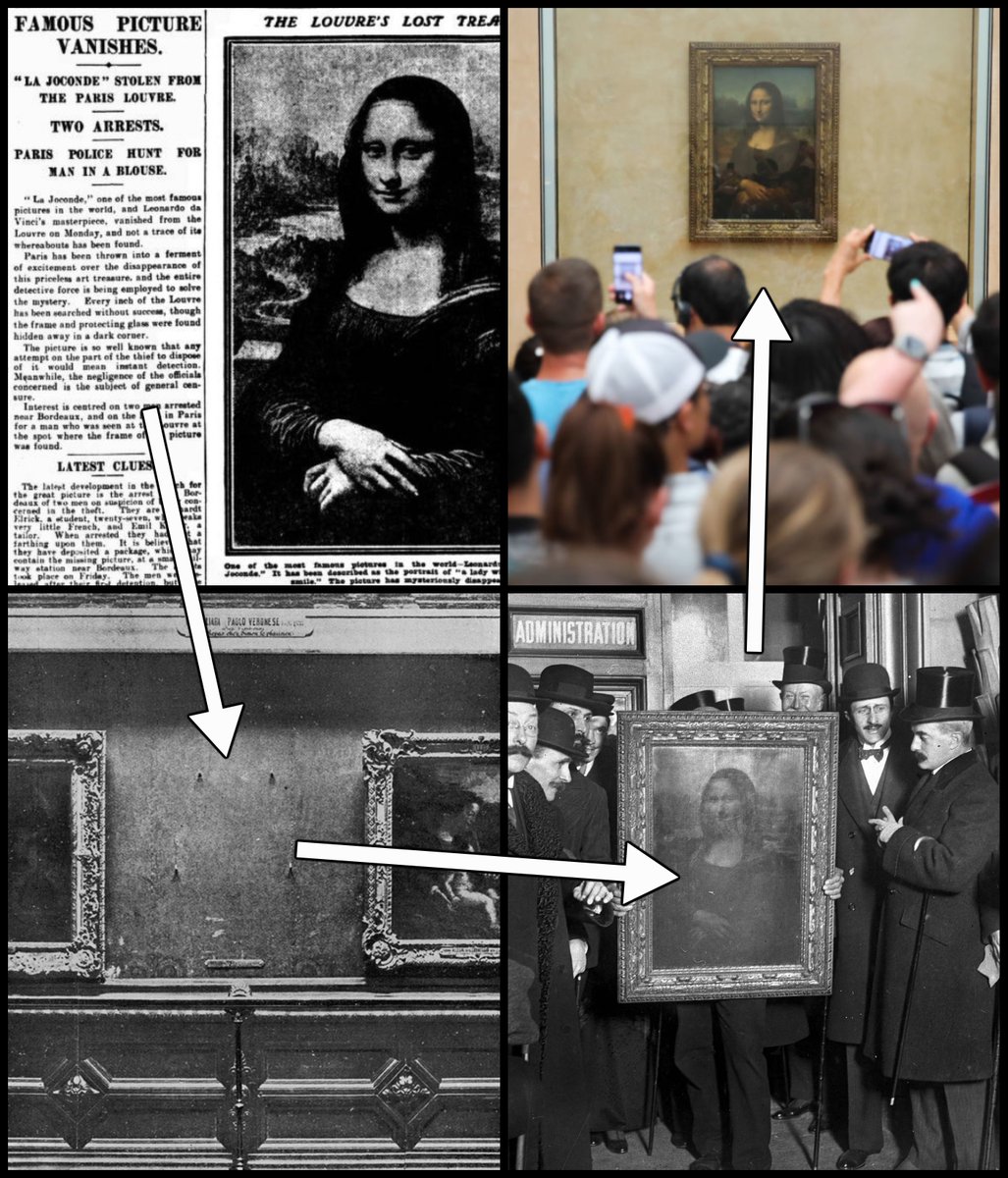
Exactly 112 years ago today a man called Vincenzo Peruggia walked into the Louvre and stole the Mona Lisa.
It is the most famous art theft in history, and it's what made the Mona Lisa the most famous painting in the world.
And the man who stole it only spent 6 months in prison.
The Mona Lisa was commissioned in 1503 by a cloth merchant from Florence called Francesco del Giocondo. He asked none other than Leonardo da Vinci to paint a portrait of his wife, Lisa.
But Leonardo — a famously slow worker — didn't finish the painting. When he went to work for the King of France he took it with him, finished it, and gave it to his new employer as a gift.
So the subject of the world's most famous painting, Lisa del Giocondo, never actually saw it herself! The Mona Lisa remained in the possession of French royalty, at the Palace of Fontainebleau and then at Versailles, for nearly 300 years.
But in 1797, after the French Revolution, it was moved the Louvre. Still, it wasn't a particularly famous painting at the time. In the later half of the 19th century certain critics started to acclaim the Mona Lisa as a masterpiece, but it wasn't popular with the public.
Until the 21st August 1911.
Vincenzo Peruggia was an Italian tradesman who had moved to Paris in 1907 in search of work. He got a job at the Louvre, cleaning and reframing paintings.
There he learned how many Italian works of art Napoleon had taken from Italy and brought to France. Inspired to reclaim his country's heritage, Peruggia decided to steal the Mona Lisa.
Of course, although so many works of art all around the world were stolen or at least have murky history, the Mona Lisa was in France legitimately — Leonardo had given it to King Francis as a gift. Whether Peruggia knew this or not is still unclear.
How did he steal it? For what is probably the most famous art theft in history, it was remarkably easy. He entered the Louvre on the morning of 21st August, 1911, on a day when it was closed to the public, dressed like his fellow workers in a white smock.
He went to the Salon Carré, the room in which the Mona Lisa was kept, and simply took it off the wall when nobody was looking. Then he wrapped it in his smock and left the Louvre. Simple as that.
It wasn't until the next day that anybody realised the Mona Lisa was missing, at which point the authorities were alerted, the press heard about it, and the theft became an international phenomenon reported in newspapers all over the world.
The police were clueless. They arrested the poet Guillaume Apollinaire, who implicated Pablo Picasso — he was then brought in for questioning. But they were both released and the case remained unsolved for two years.
The American businessman and art collector J.P. Morgan was even suspected of having commissioned the theft. There was a fear in France at the time that French art and heritage was being bought up by Americans, and the loss of the Mona Lisa was seen as a national disgrace.
Tourists came flocking to the Louvre to see the empty spot where the Mona Lisa had been — a relatively unknown portrait had suddenly become the world's most talked-about painting.
All the while Peruggia had the Mona Lisa in a suitcase in his Parisian apartment. In December 1913 he took it to Florence with him, hoping to sell it. At which point an art dealer called Alfredo Geri received a mysterious letter offering to sell him the Mona Lisa...
Immediately suspicious, Geri contacted the director of Florence's Uffizi Gallery, Giovanni Poggi. They pretended to go along with the sale, met up with Peruggia, verified the painting — and then contacted the police.
Peruggia was arrested, newspapers all around the world reported that the Mona Lisa had been recovered, and after being displayed for two weeks in Italy it was returned with great pomp and ceremony to the Louvre.
Thereafter the Mona Lisa became, and has remained, the world's most famous painting. It is undoubtedly a masterpiece, not least because of Leonardo's revolutionary use of a technique he called "sfumato", in which he blurred the colours and lines of the Mona Lisa's face to make it more realistic. But many people rightly wonder why it is *so* famous when there are many other paintings that are more important, interesting, and beautiful.
Well, it's all thanks to Vincenzo Peruggia, whose theft gave the Mona Lisa a unique place in the public consciousness. The Mona Lisa isn't famous because it's the best work of art ever made; it is the world's most famous painting... simply because it's so famous. A self-perpetuating cycle.
What happened to Peruggia? His trial took place in June of 1914, six months after having being first arrested — but by July he had been released.
See, Peruggia was hailed as a patriot and a hero in Italy, and there was immense public pressure for a lenient sentence. There had even been a campaign to raise money for him. He later served in the First World War, during which he was captured and imprisoned by the Austrians. After the war he returned to France, under a different name, and died there in 1925.
So, although he didn't precisely achieve his aim, Peruggia did succeed in making an Italian painting the most famous work of art in the world.
@frankiestudiies i'm interested in taking french since i was considering enrolling for erasmus programme in france but arabic and mandarin also sound tempting 🫠
#langtwt is "halo" in croatian/serbian equivalent to "hello" in english or do they just pronounce it with an accent? we also use "halo" in polish but only while speaking on the phone and i haven't found any info on the internet so i'm curious


![Myuniblr's tweet photo. My fave podcasts I use to help me learn languages
[🇰🇷🇲🇽🇫🇷🇯🇵(🇺🇸)— thread] https://t.co/cmdtFwgm6y](https://pbs.twimg.com/media/F4tFVA3bsAA9BDj.jpg)







![Myuniblr's tweet photo. My fave podcasts I use to help me learn languages
[🇰🇷🇲🇽🇫🇷🇯🇵(🇺🇸)— thread] https://t.co/cmdtFwgm6y](https://pbs.twimg.com/media/F4tFVA8aYAARGnC.jpg)