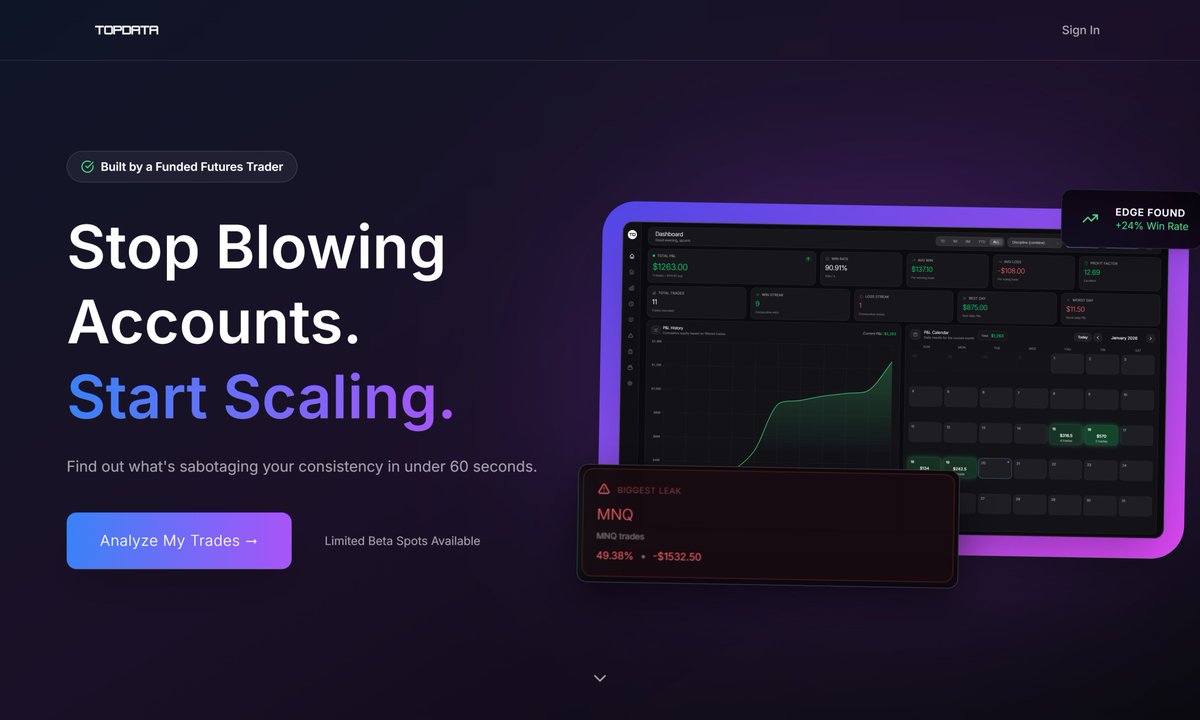
TopData started as a personal project to stop blowing funded accounts before getting a payout.
I wanted to track my trades properly, but I could not justify spending the cost of another combine each month just to understand why I was failing. My goal is to help you identify your own expensive habits so you can succeed too.
Never treat trading like a job, where you feel the need to trade all the time. It isn’t equivalent to a 9-5. Unlike mundane jobs, the output (market’s reward) is not correlated to your efforts.
The market is indifferent to your efforts.
I.e. most of the time, no trade is the best trade.
If anything, the job isn’t to open and close trades, but to stay in-tune every single day.
@_not_a_fish@MichaelPatak Once you have a $50k balance ($10k each account) I would certainly think they would take you live. Seems like "max payout" is a thing of the past.
@pip_raider I figured you had already been down that road but just wanted to make sure! At this point just go to Mexico and do Ibogaine therapy - it seems to help many things 😂
If we think about this purely from a regulation standpoint, one working hypothesis could be:
What if your system isn’t broken in the sense of “not producing energy,” but is stuck in a chronic fight/flight loop and can’t fully return to deep recovery mode?
That pattern often shows up when the autonomic nervous system is unstable especially when sympathetic activity (threat mode) dominates and parasympathetic tone (rest/repair mode) can’t fully re-engage.
The vagus nerve is the main pathway that helps shift the body back into that parasympathetic state. It influences heart rate variability, inflammatory signaling, gut-brain communication, and brainstem sensory processing. If that system isn’t modulating properly, everything can feel amplified and recovery never feels complete.
If that hypothesis is even partially true, then approaches that increase vagal tone are at least logically aligned with the problem.
More targeted options would include:
Auricular vagus stimulation (ear-based)
The auricular branch of the vagus nerve runs through parts of the outer ear. Some non-invasive devices are designed specifically to stimulate that branch. Anatomically, that makes more sense than wrist-based devices, since the vagus nerve doesn’t run through the wrist.
Cervical vagus stimulation (neck devices)
Some external devices stimulate the vagus in the neck area where it’s more accessible. Again, this is directly targeting the nerve rather than indirectly influencing it.
Breathwork that increases vagal tone
Slow, controlled breathing — especially extended exhales — activates parasympathetic pathways. It’s simple but directly engages vagal circuits through respiratory coupling.
Cold exposure (carefully)
Brief, controlled cold exposure can stimulate vagal reflexes and shift autonomic balance. This would need to be very cautious given how sensitive your system is, but it’s one of the more direct physiologic triggers of vagal activation.
HRV biofeedback
Heart rate variability reflects vagal tone. Training with HRV feedback aims to strengthen parasympathetic control over time. It’s a way of training the system rather than forcing it.
None of this assumes vagal dysfunction is the root cause. But if part of what’s happening is that your system cannot reliably shift into deep recovery mode after stress or exertion, then targeting vagal pathways isn’t random, it’s coherent with that model.
Not advice. Just a different lens to explore if it feels worth looking into.
Some basic knowledge helps the process go faster but you can definitely do it without any.
I started in early 2023 before vibe coding was a thing and had zero experience.
1. Ask your LLM of choice to create a beginner friendly (no-coding experience) phased implementation plan for (your idea) and then feed that output to another LLM and ask it to critique it and offer improvements.
2. Once you have a refined plan copy/paste each step into coding agent of choice. (Codex or Claude Code)
3. Profit 😎
@xydotdot This all reminds me of crypto in 2016/2017. Whitepapers promising crazy use cases and paradigm changing outcomes.
But then when you actually tried to use it...